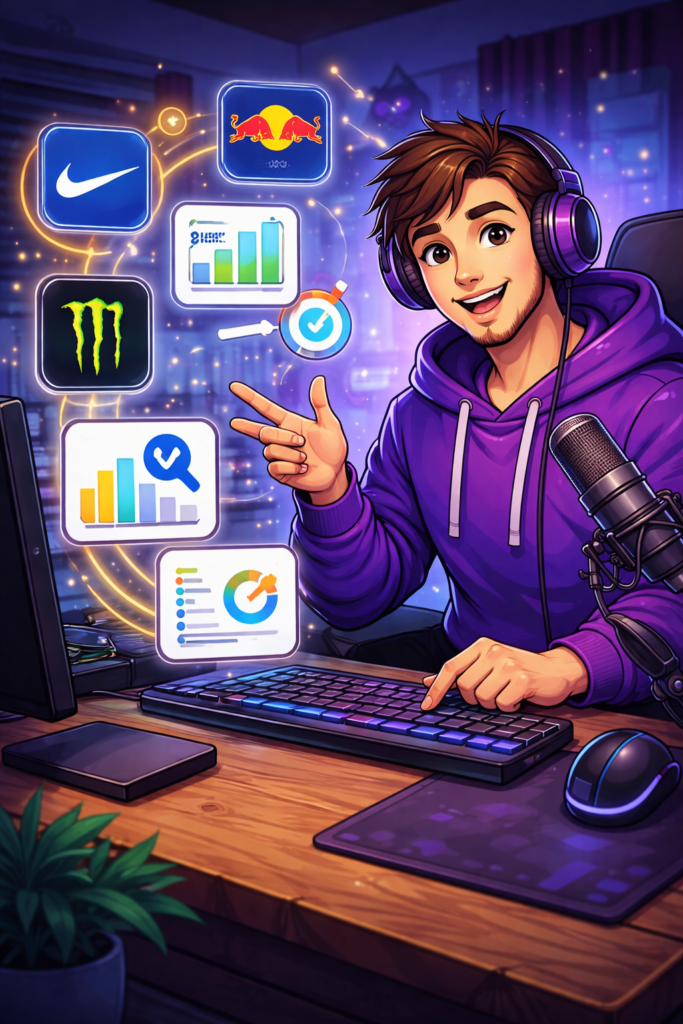
Advertising with streamers has long moved beyond experimentation. Today, it is a fully developed marketing channel where brands enter with clear KPIs, budgets, and expectations. At the same time, many streamers still do not understand why some creators receive regular brand deals while others do not, even when their viewer numbers are higher.
In reality, brands do not choose streamers based on intuition or personal preferences. Decisions are almost always driven by concrete metrics, audience behavior, and the creator’s previous experience. Let’s take a closer look at how brands actually select streamers for advertising and examine real-world examples.
Why Brands Choose Streamers Over Traditional Advertising
The main advantage of streaming is trust.
Viewers do not come just to watch content, but to spend time with a specific person. Unlike YouTube ads or banner advertising, a sponsored message delivered by a streamer is perceived as a recommendation rather than an intrusive sales pitch.
For example, the brand Logitech regularly collaborates with streamers, not only with professional esports players. The reason is simple: when a streamer says they genuinely enjoy using a specific mouse or keyboard, the audience восприives it as personal experience rather than scripted advertising.
How Brands Select Streamers for Advertising: Key Logic
Audience Size Is Not the Decisive Factor
One of the most persistent myths is that brands only work with top-tier streamers.
In practice, creators with a mid-sized average viewership receive advertising offers more often than many expect.
A good example is collaborations between gaming services and Russian-speaking streamers such as Evelone. His audience is not always the largest by raw numbers, but it is highly engaged and financially active. For brands, this means higher conversion potential rather than simple reach.
Engagement Matters More Than Numbers
Brands almost always evaluate:
- chat activity;
- the number of questions related to the stream topic;
- audience reactions to the streamer’s statements.
A practical example:
a betting company tested advertising with two streamers.
The first had an average of around 4,000 viewers, but the chat was mostly silent.
The second had about 900 viewers, but the chat actively discussed everything happening on stream.
As a result, the second streamer generated nearly twice as many registrations. The brand continued working with that creator despite the smaller audience.
Streamer Reputation and Brand Safety
Brands carefully review how a streamer behaves during live broadcasts.
Profanity, frequent conflicts, toxic behavior, or repeated bans significantly reduce the chances of collaboration.
For example, many international brands deliberately avoid streamers with aggressive communication styles, even if their viewer numbers are high. Instead, they choose calmer creators such as Pokimane, whose reputation as a “brand-safe” influencer enables long-term partnerships with major companies.
Why Brands Prefer Streamers with Mid-Sized Audiences
Mid-sized channels with 500–3,000 concurrent viewers often deliver better results than top-tier creators.
The reason is the sense of personal connection.
Example:
a financial service ran a campaign with Ninja while simultaneously working with several mid-level streamers.
Ninja provided massive reach but low conversion.
Less famous creators generated more questions and link clicks from their viewers.
As a result, part of the budget was shifted toward mid-sized channels.
How Brands Evaluate Advertising Delivery
For brands, it is not only about logo visibility, but also about how naturally the advertisement is integrated.
A strong example is HardPlay’s collaborations with gaming services.
Instead of reading scripted ad copy, he demonstrates the product live on stream, explaining how and why he uses it. In this format, the advertisement does not feel intrusive.
Brands often review stream archives before reaching out. If past integrations look natural and engaging, the chances of collaboration increase significantly.
Real Cases: Who Gets Brand Deals and Why
Ninja and Major Brands
Ninja has worked with Adidas, Red Bull, and other major brands not only because of his scale, but due to a clearly structured and predictable public image. He is stable, consistent, and easy for advertisers to understand.
Pokimane and Mass-Market Brands
Pokimane regularly collaborates with brands outside the gaming niche. She is chosen for her soft delivery, loyal audience, and high level of trust.
Mid-Sized Streamers in Eastern Europe
Many brands actively work with streamers averaging 1,000–2,000 viewers. The reason is a better balance between cost and performance. These creators are often more flexible and open to testing new formats.
Why Brands Return to the Same Streamers
If an advertising campaign delivers results, brands almost always return.
Repeated integrations are more effective because the audience has already seen the product and no longer perceives it as unfamiliar.
That is why streamers who handle advertising carefully often secure long-term partnerships rather than one-off deals.
What Brands Look for When Choosing a Streamer
Brands do not choose streamers based on hype or follower counts. They focus on:
- an engaged audience;
- viewer trust;
- a solid reputation;
- the ability to integrate advertising naturally into content.
For streamers aiming to work with brands, it is more important to build consistent relationships with their audience than to chase numbers. These are the channels that attract advertisers and receive repeat offers.