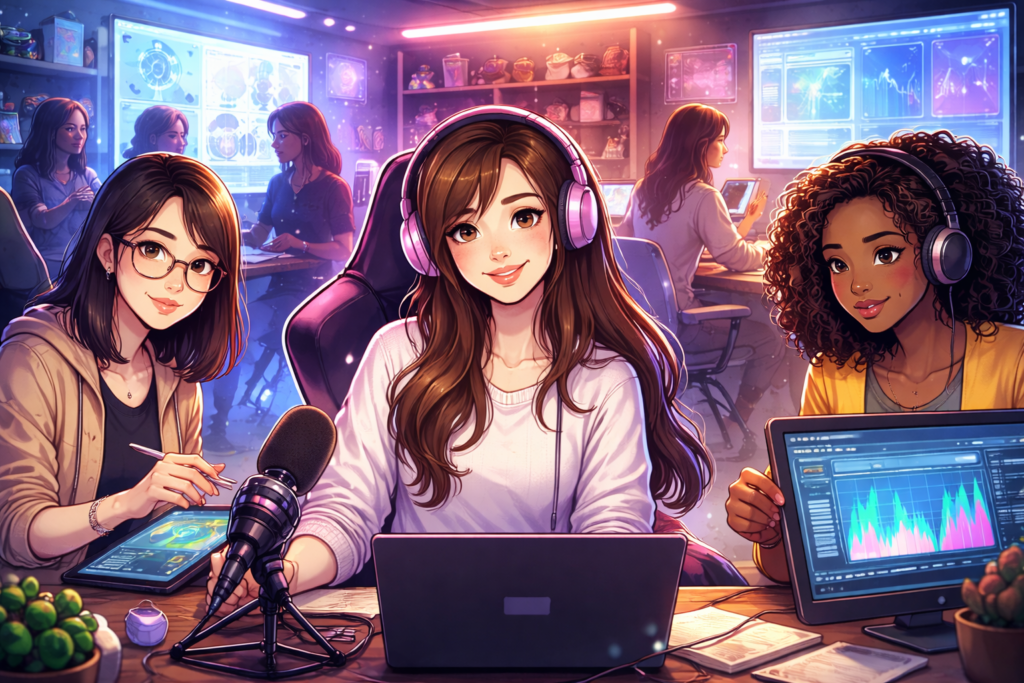
If streaming is viewed purely through statistics, women’s presence in the industry was long perceived as additional or secondary. Growth in the number of female streamers was recorded, but rarely linked to changes in format. In 2026, this logic stopped working.
Women in streaming have moved beyond being a balancing element and have become a source of qualitative shifts. This is not about numbers, but about transforming stream scenarios, communication structures, and audience expectations.
The Blurring of the “Female Stream” Category
One of the key changes has been the disappearance of the “female stream” label as a standalone format. A streamer’s gender has ceased to be the main factor of attention. Audiences increasingly respond not to identity, but to conversational logic, topic depth, and structural consistency.
Topics once associated with lifestyle or appearance have shifted toward applied and professional fields: game development, digital art, marketing, analytics, and real-time project creation. In these formats, women are not objects of attention, but organizers of thematic spaces.
Reduced Policing From Chat
Previously, a significant portion of chat messages focused on evaluating a streamer’s appearance, manner of speech, or behavior. In 2026, such reactions are observed less frequently.
This is not due to the disappearance of hate, but to changes in communication structure. When a streamer sets a clear topic and maintains a conversational frame, the audience shifts more quickly toward content. Chat moves from personal evaluation to idea-based discussion.
This shift is reflected in a higher share of substantive messages: questions, clarifications, and reasoned responses. Engagement becomes less emotional and more cognitive.
From Entertainment to Process
In 2026, many women-led streams are built around concrete tasks. Broadcasts increasingly move away from free-form conversation and become live working processes.
The most common formats include:
- collaborative case analysis;
- live project creation;
- discussion of professional trends;
- answers to practical audience questions.
Entertainment remains present, but it becomes a result of the process rather than its primary goal.
Changing Audience Expectations
Modern viewers come to streaming not only for emotional release. As the digital environment becomes more complex, there is a growing demand for meaningful interaction. Casual “talk about everything” formats increasingly fall short.
This is especially evident in audiences around women-led streams. When broadcasts have clear structure, engagement deepens and retention becomes more stable.
Chat as a Tool for Collective Thinking
With stable moderation and a defined topic, chat stops functioning as background noise. It becomes a space for collective discussion.
Viewers participate actively by proposing hypotheses, sharing experience, and уточняя details. This shifts the audience’s role from passive observation to co-participation.
Conscious Separation of Public and Private
In 2026, a strong trend toward clear role separation has emerged. Women streamers increasingly distinguish professional space from personal life.
Broadcasts are structured by function:
- part of the time devoted to a specific task;
- part to interaction with the core audience;
- part kept entirely outside the public sphere.
This predictability reduces expectation pressure and helps form a sustainable format.
From Competition to Dialogue
Competition for attention within chats is decreasing. Provocations and aggressive remarks are giving way to questions and attempts at understanding.
Women in streaming increasingly act as facilitators of dialogue rather than participants in dominance struggles.
The Influence of Professional Communities
Women-led streams are increasingly integrating external communities: art groups, technical teams, and entrepreneurial networks. Broadcasts move away from the “one-to-many” model and toward networked formats.
In these conditions, the streamer acts as a coordinator rather than a central figure. This increases content depth and engagement stability.
Conclusion
Trends in 2026 show that women in streaming are no longer reproducing outdated models. They are shaping a new broadcast logic based on structure, meaning, and dialogue.
Audiences perceive these changes not as a passing trend, but as a response to evolving expectations. Streaming is increasingly viewed not only as entertainment, but as an intellectual and social space.
In this context, 2026 became not a year of numerical growth, but a year of paradigm shift, where women’s presence became the norm of a new quality.