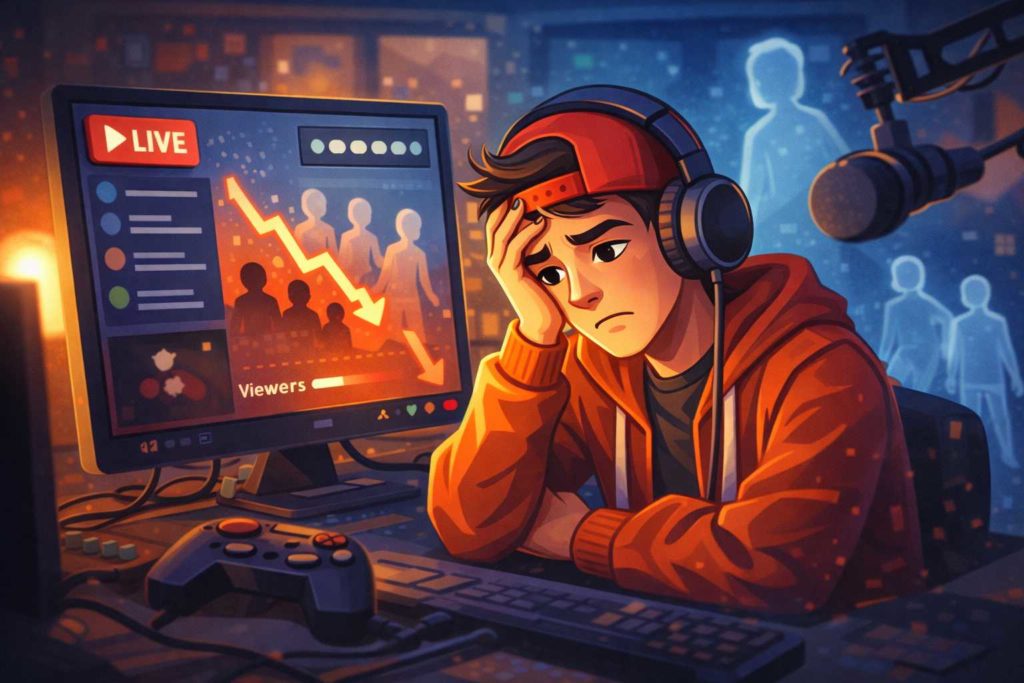
Sometimes a stream starts quite well.
The first viewers join the broadcast, someone writes a message in the chat, while others simply watch silently. It feels like the stream is gradually gaining an audience.
But after some time a familiar situation happens to many streamers. The viewer count slowly begins to drop. One viewer leaves, then another, then a few more. At some point the stream has almost the same number of viewers as it had at the very beginning.
The most frustrating part is the feeling that the streamer seems to be doing everything right. The game is running, the topic of the stream is clear, and the technical setup works.
Yet viewers still leave.
Most of the time the reason is not the content itself. It is hidden in small details of how the stream is conducted. These details form the first impression for the audience and strongly influence whether a viewer stays or closes the tab after a minute.
Silence That Makes People Close the Stream
One of the most common mistakes is long pauses.
When a streamer is focused on the game or technical aspects, they may stop talking for a few seconds. Sometimes the pause stretches to ten or even fifteen seconds.
For the streamer this may feel completely normal. They are still engaged in the process.
But viewers perceive the situation differently.
A person joins the stream, hears silence, and does not understand what is happening. There is no context, no conversation, and no interaction.
The brain quickly concludes that nothing interesting is happening.
Even short comments can change how the stream feels. When the streamer explains their actions, shares thoughts, or reacts to what is happening, the broadcast starts to feel alive.
A Stream That Ignores the Chat
The second mistake appears almost as often.
The streamer is focused on the game or the topic of conversation and barely pays attention to the chat.
Viewers write messages, ask questions, and sometimes try to start a conversation. But they receive no response.
After some time people simply stop writing.
Chat interaction is one of the main reasons viewers choose live streams instead of regular videos. The ability to interact with the streamer creates a feeling of participation.
When this interaction disappears, the broadcast begins to feel like a regular recorded video, only happening live.
In this situation it becomes much easier for a viewer to close the stream.
A Slow Start to the Broadcast
There is another detail that often goes unnoticed.
Many streamers start their broadcasts very slowly.
The first ten minutes may be spent adjusting the game, talking about what will happen during the stream, or simply waiting for viewers to arrive.
But a viewer who joins the stream does not know that the broadcast has just started. They only see the current moment.
If nothing interesting is happening at that moment, the viewer may assume the stream will remain slow.
As a result, they simply leave.
This is why the beginning of a stream should already feel like part of an active broadcast. When there is movement, conversation, or action from the start, it is easier for viewers to engage.
A Stream Without Clear Context
Sometimes viewers enter the stream in the middle of an event.
This creates a problem that many streamers do not notice.
For regular viewers everything is clear. They know what is happening, remember previous streams, and understand inside jokes in the chat.
For new viewers the situation looks different.
They see gameplay or a conversation but do not understand what exactly is happening or why it matters.
If the streamer occasionally explains the situation — the goal of the game, the current moment, or the topic of discussion — it becomes easier for viewers to connect with the stream.
These small explanations help new viewers feel like part of the broadcast much faster.
A Stream With No Rhythm
Good streams are rarely completely calm or completely chaotic.
They have rhythm.
This rhythm is a combination of gameplay, chat interaction, reactions to events, and short pauses.
When a stream becomes too repetitive, viewers start losing attention.
For example, long segments of gameplay without commentary or interaction can feel tiring for the audience, even if the game itself is interesting.
On the other hand, a constant stream of chaotic conversation without structure can also exhaust viewers.
A balance between action and communication makes a stream more dynamic and helps keep the audience engaged.
Ignoring the Atmosphere of the Stream
Many beginner streamers focus heavily on technical quality.
They worry about camera resolution, lighting, or microphone quality. Of course, the technical side matters.
But viewers do not come to live streams only for the picture.
They come for the atmosphere.
Sometimes a stream with simple visuals and a basic microphone can retain viewers better than a perfectly configured broadcast without emotion.
When a streamer reacts to events, jokes, shows surprise, or talks with the chat, the stream begins to feel like a real live experience.
And these are the broadcasts viewers tend to watch longer.
Trying to Stream Like Everyone Else
Another mistake appears over time.
Some streamers try to completely copy popular creators. They imitate the format, style of communication, or even the type of jokes.
But audiences quickly notice when a streamer behaves unnaturally.
Viewers are far more interested in watching someone who streams in their own style.
Sometimes a unique personality or unusual stream atmosphere becomes the reason people return again and again.
When Mistakes Stop Blocking Growth
Most streamers make these mistakes during their first broadcasts. This is a natural part of the learning process.
Over time, streamers begin to understand how viewers behave, what keeps attention, and what moments make people stay longer.
Gradually the stream becomes more lively. The chat moves faster, conversations become natural, and the atmosphere develops on its own.
At some point the broadcast stops feeling like an experiment.
It begins to feel like a place viewers visit not by chance — but because they genuinely enjoy spending time there.