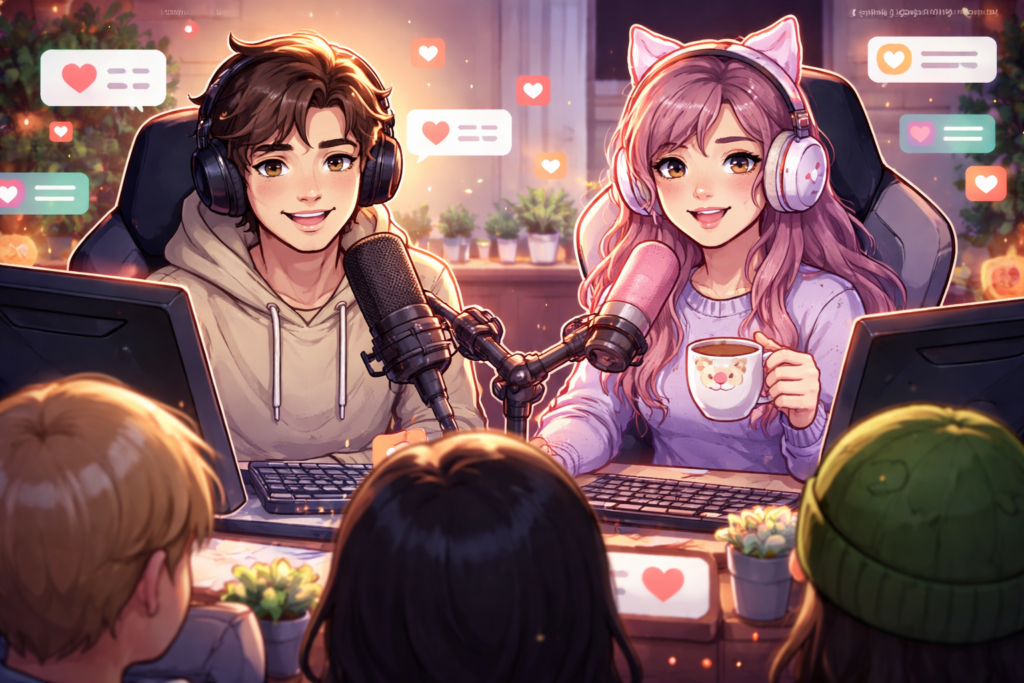
If you ask a viewer why they watch a specific streamer, the answers are usually vague: “it feels comfortable,” “fits my mood,” “I like the vibe.” Rarely do people mention content quality, skill level, or production value. This isn’t accidental. Attachment to a streamer is almost never formed rationally.
Viewers don’t choose the best streamer. They choose the one they resonate with.
Rhythm Matters More Than Content
The same stream can feel comforting to one person and unbearably dull to another. The reason isn’t the topic or the quality, but the rhythm. Speaking pace, pause length, reaction frequency, even the way someone stays silent — all of this either aligns with a viewer’s internal rhythm or it doesn’t.
When the rhythm matches, the stream doesn’t require effort. It can play in the background, be returned to repeatedly, or be watched without constant attention. This lack of tension keeps viewers longer than interest in the topic itself.
Universality Doesn’t Create Attachment
Trying to appeal to everyone almost always leads to neutrality. A neutral stream doesn’t irritate anyone, but it also doesn’t create connection. Attachment forms around specificity: repeated reactions, a recognizable perspective, and a consistent stance.
Even disagreement can strengthen attachment if the streamer is consistent. At that point, the streamer stops being a function and becomes a character.
Predictability Creates a Sense of Safety
Viewers don’t value surprise as much as they value predictability with variation. A favorite streamer reacts roughly the way viewers expect. They may surprise occasionally, but they don’t break their own internal logic.
Sharp changes in behavior or communication style often lead to audience loss — even when the content objectively becomes “better.”
Attachment Forms Around a State, Not a Personality
Viewers return not to a person, but to the state they experience alongside them: calm, irony, background presence, or a sense of company. That’s why the same streamer can feel unappealing at one time and perfect at another.
Successful streamers intuitively understand the state they transmit and don’t try to broadcast everything at once.
Vulnerability Works Better Than Charisma
An overly polished and confident streamer creates distance. Small uncertainties, doubts, honest pauses, or admitting not knowing something create a sense of reality. This lowers the barrier between the viewer and the screen.
This isn’t about performative openness, but about natural human imperfection. Artificiality is recognized instantly.
Chat Strengthens Connection, but Doesn’t Create It
An active chat is not the cause of attachment. It only amplifies what already exists. If the streamer resonates, chat becomes a space of belonging. If not, no amount of activity will keep viewers.
Viewers don’t love streamers who reply to everyone. They love those they feel comfortable being silent with.
Stable Presence Matters More Than Growth
Attachment forms through consistent presence in a viewer’s life. Not through schedules, but through the feeling that the streamer reliably exists. They become part of a routine, a familiar background, a marker of time.
This is why sudden disappearances break the connection more severely than bad streams.
A Conclusion Without Moralizing
Viewers don’t need to explain why they like a specific streamer. They simply return — often against logic and comparison.
In streaming, viewers don’t love the best, the loudest, or the most polished. They love those with whom a quiet, stable resonance has formed. It can’t be copied by formula — and that’s exactly what makes a streamer irreplaceable.