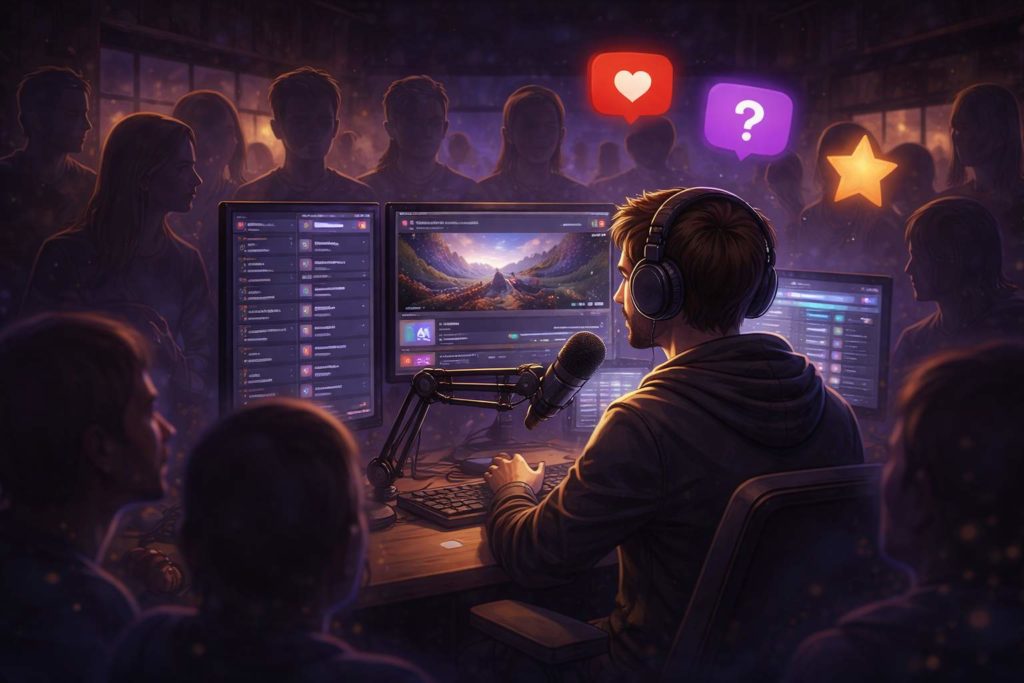
There is a common belief that viewer retention on Twitch is directly tied to chat activity. It seems logical: if people are typing, asking questions, and reacting — the stream must be engaging. But in reality, the process works the other way around: first, the viewer decides to stay, and only then does interaction begin.
That’s why the question “how to retain viewers on Twitch” is often reduced to communication, while ignoring a much earlier moment — the first seconds of perception. A viewer doesn’t join to talk. They join to decide whether the stream is worth their time. And that decision happens before the first message is ever sent.
What Actually Retains a Viewer in the First 30 Seconds
When someone opens a stream, they don’t analyze it deeply. They instantly read a few signals: is there movement, is there a voice, does it feel like something is happening right now. If the stream feels alive and active, the chance of staying increases dramatically. If there are pauses, weak reactions, or a sense of emptiness, the viewer leaves — often without even realizing why.
Retention starts before what we usually call “content.” It starts with continuity. When a streamer talks, reacts, and comments without long gaps, it creates a flow the viewer can step into. Without that, even interesting gameplay or topics don’t get a chance to engage.
Why Silence Kills Retention Faster Than Mistakes
Many streamers are afraid of speaking imperfectly. They overthink phrasing, delivery, and clarity. This leads to pauses, hesitation, and silence. But for a viewer, silence is not neutral — it’s a signal to leave.
Even imperfect, natural speech retains attention better than careful silence. It creates presence. Twitch is a platform of continuous attention, and any break in that flow works against retention.
Why “Interesting Content” Alone Doesn’t Retain Viewers
Another common misconception is that if the game is interesting or the streamer is doing something unique, viewers will stay. But interest is not just about what happens — it’s about how it’s presented.
The same moment in a game can either pass unnoticed or become a retention point depending on the streamer’s reaction. Without emotion, commentary, or engagement, the viewer doesn’t get the extra layer that holds attention.
That’s why a stream with average gameplay but strong, live delivery often retains better than “great content” with no reaction.
Why Viewers Need to Instantly Understand Why to Stay
Every viewer is subconsciously asking one question: what do I get if I stay a few more minutes? And the answer must be clear immediately, without explanation.
It can be atmosphere, personality, pacing, or the feeling that “something interesting is happening here.” But if that signal is missing, the stream feels neutral — and neutral does not retain.
Retention is not about convincing with words. It’s about creating a feeling that doesn’t need explanation.
How Deep Retention Is Built (Not Just Random Watch Time)
There’s a difference between a viewer staying for a couple of minutes and staying long-term or returning. The first is random. The second is structured.
When a stream has internal dynamics, progression, and direction — when the streamer leads the experience instead of just reacting — it creates a sense of movement. The viewer begins to feel that leaving means missing something.
This is what turns passive viewing into intentional watching.
Why Chat Interaction Only Works on Top of a Strong Foundation
Chat amplifies retention — it doesn’t create it. If the stream itself doesn’t hold attention, even an active chat won’t fix the problem. People may type, but new viewers will still leave.
When the foundation is already there — flow, energy, presence — chat becomes a multiplier. It adds depth, builds a sense of community, and increases engagement.
Only in this state does interaction actually drive growth.
Why Retention Is About Habit, Not Just the Moment
Another important layer is consistency. Even if a stream retains viewers in the moment, it doesn’t guarantee they will return. For that, the channel must become a predictable point in the viewer’s routine.
If streams are consistent — in schedule, tone, and experience — a habit forms. Viewers return not by accident, but because they know what they’ll get.
This is where retention turns into a real audience.
What Actually Retains Viewers on Twitch
Not a single trick. Not a gimmick. Not a specific tactic.
But a combination of factors: continuous flow, live reaction, a sense of presence, clear dynamics, and consistency.
When a stream stops being a collection of moments and becomes a process the viewer can immerse in.
At that point, retention stops being a problem to solve.
It becomes a natural result of how the stream is built.