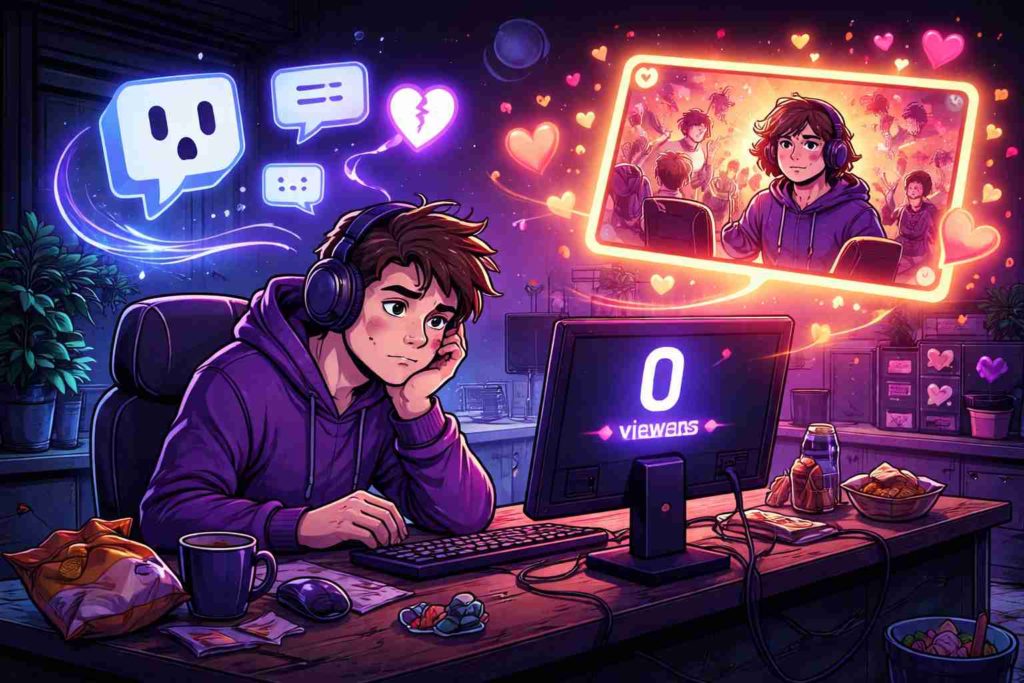
When you look at Twitch from the outside, it seems simple: some streams get viewers because they are interesting, and others don’t because they are boring. This explanation feels logical and convenient because it gives a clear reason.
But if you look deeper, the reality works differently.
There are objectively weak streams that still get viewers. And there are streams with good presentation, strong ideas, and solid quality that remain unseen. This breaks the simple model of “interesting = watched.”
In reality, viewers don’t make decisions based on objective quality. They decide based on signals they read in the first seconds.
And those signals determine whether they stay or leave.
Why Viewers Don’t “Evaluate” a Stream — They Decide Instantly
When someone opens a stream, they don’t analyze it as content. They don’t think, “how well is this made?” or “does this have potential?” They don’t have the time or motivation for that.
They simply watch for a few seconds and decide: stay or leave.
This is not a logical process, but a reaction. Is there movement? Is there a voice? Does it feel like something is happening right now?
If those signals are missing, the brain reads the stream as “empty” and moves on.
And this happens faster than you think — sometimes in just 3–5 seconds.
Why a “Dead Frame” Kills Even a Good Stream
One of the most common reasons for low retention is the feeling that nothing is happening on screen.
The streamer may be interesting, the game may be good, and the idea may be strong — but if, at the moment a viewer joins, they see a static image with no reaction, no movement, and no voice, they won’t stay.
The problem is that the viewer doesn’t see potential. They see the current moment.
If that moment doesn’t signal “something is happening,” the stream feels inactive.
And this kills retention before the content even has a chance to unfold.
Why Viewer Count Itself Affects the Desire to Watch
There is an effect that is rarely discussed but always works: people are more likely to join where others already are.
A stream with zero viewers looks like an empty space. There is no confirmation that it is worth watching.
A stream with even a small audience creates the feeling that something is already happening.
This is not a rational decision. It is a behavioral pattern. Viewers subconsciously trust the choices of others.
That is why viewer count affects not only the algorithm, but also perception.
Why the Entry Point Is the Weakest Part of Most Streams
Many streamers think about their content as a whole, but ignore the entry point. And that is exactly what determines whether a viewer will continue watching.
If a stream starts slowly, if there is no clear sense that something is happening right now, viewers don’t wait.
They are not obligated to wait until it becomes interesting.
This is critical because Twitch offers endless choice. Leaving takes a fraction of a second.
If the entry does not hook immediately, the stream simply gets no chance.
Why Predictability Retains Better Than “Interest”
There is a paradox: it’s not only important whether something is interesting right now, but whether the viewer understands what will happen next.
If a stream feels chaotic, unclear, or unstructured, even interesting moments don’t hold attention for long.
But if there is a sense of sequence — what is happening, why, and what comes next — viewers stay.
Predictability creates comfort.
And comfort retains better than isolated “exciting” moments.
Why Audio and Visual Quality Matter More Than You Think
Technical quality is rarely discussed as a key factor, but in practice it plays a huge role.
If the sound is unpleasant, inconsistent, or noisy, viewers leave faster — even if the content is good.
If the image is too dark, overexposed, or unstable, it creates discomfort.
This is not always consciously noticed. People just feel that “something is wrong” and close the stream.
That’s why comfort of perception is not a bonus — it’s a foundation.
Why Streamer Reaction Matters More Than Content
Content can be copied. The game can be the same. The format can be replicated.
But reaction is what creates the feeling of a “live” stream.
If the streamer does not react, engage, or show presence, the stream becomes background noise.
And viewers don’t feel a reason to stay.
Even simple things — voice, commentary, reactions — create a sense of presence.
And that is what retains attention.
Why Streams Don’t Get Watched Not Because They Are “Bad”
It is important to understand: most streams are not ignored because they are bad.
They are ignored because they fail to provide enough signals in the first seconds.
No movement.
No reaction.
No viewer count.
No sense of process.
As a result, the viewer has nothing to latch onto.
The content may be decent or even good, but it never gets the chance to show itself.
What Actually Makes a Stream Watchable
The difference is not in “genius” or uniqueness.
The difference is that one stream immediately shows it is alive, while another does not.
Where there is movement, reaction, a clear process, some viewer presence, and comfortable visuals — viewers stay.
Where these are missing, they leave, even if there is potential.
And that is why the answer to “why some streams get viewers and others don’t” is not about content quality.
It is about the signals a viewer receives in the first seconds.