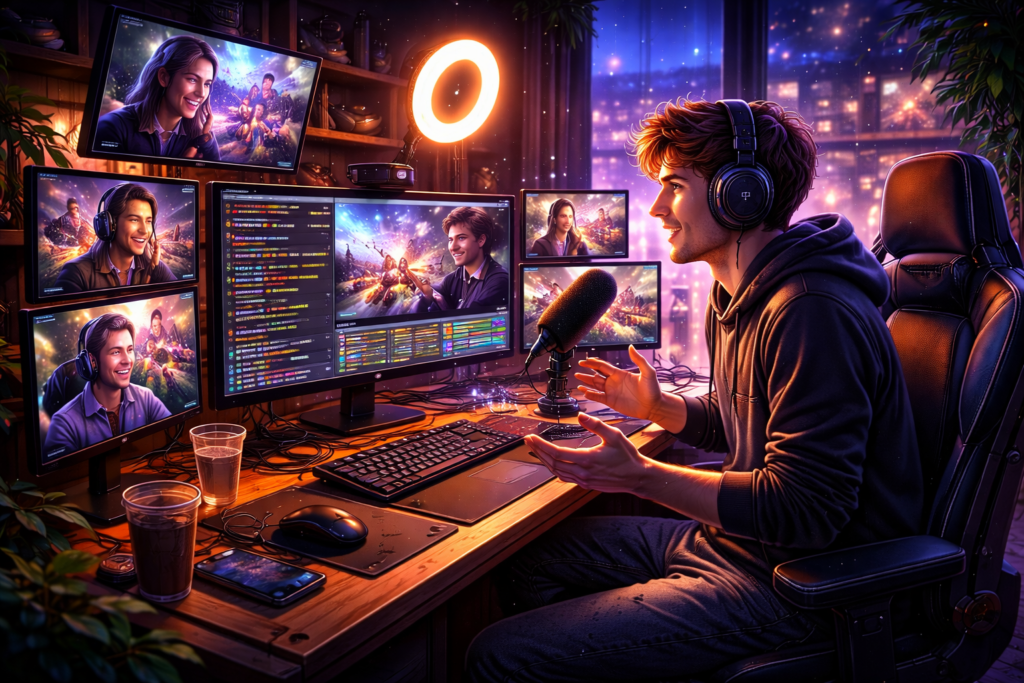
Not long ago, a streamer looked like a side product of platforms: a person with a camera, a microphone, and a chat, existing somewhere next to “real” media. News was produced by editorial teams, meaning was shaped by publications, and streaming was mostly a form of entertainment. By the mid-2020s, this hierarchy began to break down — not abruptly and not through loud declarations, but through everyday viewer behavior.
The streamer stopped being a format. They began performing the functions of media — without an office, without an “issue release,” and without a clear separation between on-air and off-air.
Media Without Editions or Deadlines
Traditional media lives in cycles. There is a date, a release, a publication, and a reaction. Even online outlets still think in terms of articles and news agendas. A streamer exists differently. There is no moment of release — they are either available or they are not. Content does not appear; it continues.
This continuity turned out to be unexpectedly closer to how people consume information today. Viewers no longer wait for an “important article.” They check in to see what is happening, listen to a voice, sense the mood. The streamer becomes not a source of news, but a point of orientation — a place where events receive interpretation in real time.
Trust Built Without Text
Traditional media builds trust through structure: editorial standards, sources, fact-checking. Streamers rely on a different mechanism. Trust emerges from repeated presence. The same person, the same voice, the same way of reacting — day after day.
The viewer does not have to agree with everything the streamer says. What matters is understanding how they think. This creates an effect that is difficult to reproduce in text or even in recorded video: a sense of predictability in a live format.
This is why streamers increasingly become mediators of complex topics — from gaming and technology to politics and economics. Not because they are experts, but because they are understandable.
Presence Matters More Than Format
One of the key differences between streamers and traditional media is the absence of rigid formats. A stream can be a conversation, gameplay, news reading, reactions to external content, or simply background noise. The format changes without announcements or explanations.
On platforms like Twitch and YouTube, this has been evident for years: viewers stay not because of the topic, but because of presence. Content becomes secondary to the feeling of “I know what will happen here.”
Media stops being a product and becomes a mode of communication.
Speed of Reaction as a Media Advantage
Traditional media reacts quickly, but still with delay. An article must be written, facts verified, published, and read. A streamer reacts instantly — sometimes too instantly, with pauses and mistakes, but within the same time layer as the event.
This is especially noticeable during crises or periods of uncertainty. People come not for precise information, but for shared experience. The streamer reads the news together with the audience, thinks out loud, doubts, changes their mind in real time. This is perceived not as weakness, but as honesty.
The Audience as a Co-Author
In traditional media, the audience reacts after the fact: comments, letters, shares. In streaming, the audience exists inside the process. Chat messages, reactions, questions, donations — all influence the course of the stream.
This influence does not have to be direct. Even a silent audience sets the rhythm. The streamer senses when to change direction, when to pause, when a topic does not resonate. Content is co-created, even if this collaboration is never formally recorded.
Media stops being one-way and becomes negotiable.
An Economy Without Intermediaries
A streamer is one of the few media forms where the connection between creator and money is almost direct. Subscriptions, donations, and paid access operate without complex advertising chains. This makes streamers less dependent on external sponsors and more sensitive to audience response.
At the same time, the streaming economy does not require television-scale reach or large editorial teams. A stable core audience is enough. As a result, media emerges that does not strive for mass appeal, yet exists sustainably for years.
This shifts the definition of success. Maximum audience size matters less than stability.
Platforms as Infrastructure, Not Editorial Offices
Although streamers depend on platforms, platforms increasingly avoid acting as editors. They provide tools, algorithms, and rules, but do not directly shape the agenda.
This is especially visible on TikTok, where streams and short videos intertwine, reinforcing each other and creating a sense of constant presence. A streamer can start as an entertainment creator and later discuss complex topics — without changing their “genre.”
The media of the future is not dictated from above. It grows out of practice.
Personality as Navigation in Chaos
In a world overloaded with information, value shifts from completeness to orientation. A streamer does not need to know everything. They matter as a filter: what is important, what can be ignored, what deserves reflection.
Viewers increasingly use streamers as navigation points. Not “what happened,” but “how to relate to it,” “what to pay attention to,” “what actually matters here.” This does not eliminate traditional media, but changes its role — outlets become sources, while streamers become interpreters.
A Boundary That Is Still Unsettled
Despite all this, streamers have not yet fully replaced traditional media. They face limitations: platform dependence, burnout risks, lack of editorial support, legal vulnerability. Yet these limitations keep the form flexible.
Streaming is still searching for its boundaries — between personal and public, improvisation and responsibility, conversation and influence. This search unfolds in front of the audience, without a final version.
An Ordinary Evening
Sometimes a stream simply runs. There is no major topic, no event, no reason. Someone joins, listens for a few minutes, leaves, returns later. Nothing is fixed, nothing is archived as “important.”
And it is precisely in these moments that the streamer’s media function becomes visible — not by delivering news or summaries, but by maintaining a sense of shared present time, where people can exist together.