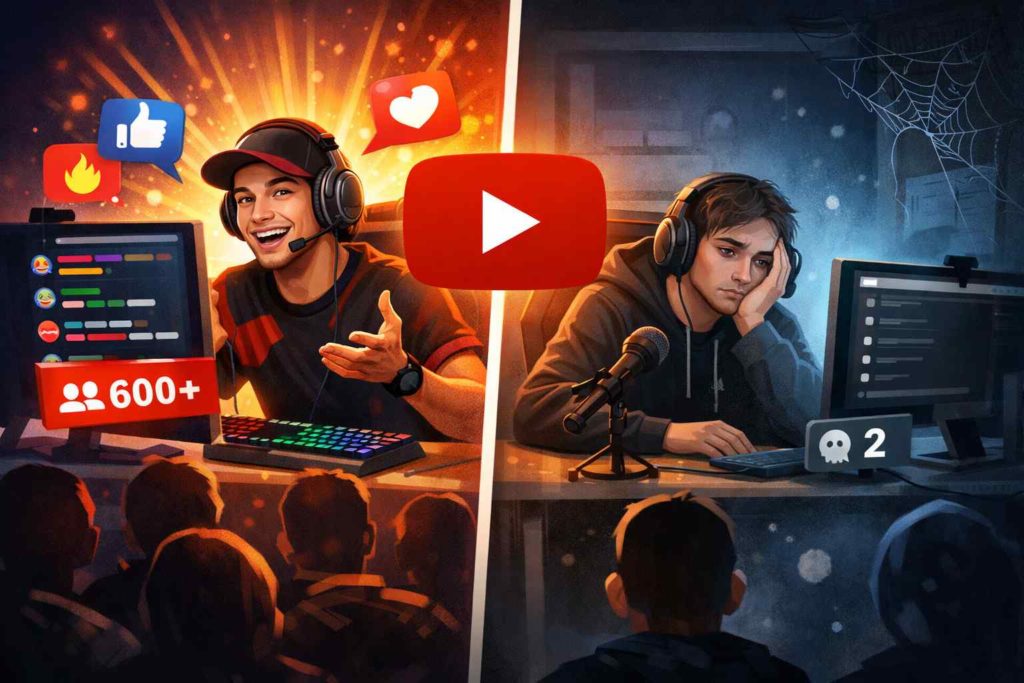
Sometimes it’s enough to open the live streams section on YouTube to notice something strange. Two streams can be broadcasting the same game, start at almost the same time, and look very similar: the same graphics, a similar microphone, a similar camera setup. But one has 600 viewers, an active chat, and a constant flow of new people. The other has 3 viewers, one of whom is probably the streamer.
At first glance, it may seem like the difference comes down to charisma or luck. But if you look at it through the lens of platform mechanics, it becomes clear: promoting YouTube streams is not random. It is a combination of viewer behavior, algorithm signals, and early engagement indicators.
A live broadcast on YouTube follows different rules than a regular video. And if you don’t understand those rules, even good content may never get a real chance to reach an audience.
What Happens to a Stream in the First Minutes After Going Live
When a livestream just starts, YouTube essentially knows nothing about it. The algorithm sees a new broadcast but does not yet understand whether people find it interesting.
At this moment, the system begins testing the stream with a small audience. These could be channel subscribers, users who recently watched similar streams, or people interested in a particular game or topic.
Then an important process begins. The algorithm starts analyzing viewer behavior.
It looks not only at the number of viewers but also at what they do: whether they stay on the stream, write messages in chat, bring new viewers in, or return after leaving.
If people enter the stream and leave quickly, the broadcast almost immediately stops being recommended further.
If viewers stay and interact, the stream begins receiving more impressions.
This is why YouTube livestream promotion often begins long before the stream itself becomes popular.
Why Empty Streams Almost Never Grow
Imagine a typical situation.
You open a list of live streams for a game. Several broadcasts appear in front of you.
- One shows 120 viewers.
- Another shows 40 viewers.
- The third shows 2 viewers.
Most people will not even click on the stream with two viewers.
This is not a conscious decision. It is basic audience psychology. People instinctively gravitate toward places where an audience already exists.
YouTube understands this. That is why the algorithm takes into account so-called social signals.
The number of viewers on a stream is one of those signals. It influences not only people but also the platform itself. When a broadcast starts gaining viewers, the system receives confirmation that the content attracts interest.
And the opposite is also true. When a stream stays empty for a long time, the algorithm concludes that the audience is not responding.
This is why many beginner streamers face a vicious circle. To attract viewers, a stream needs to look active. But for it to look active, it needs viewers first.
How YouTube Decides Which Streams to Recommend
YouTube livestream promotion happens through several recommendation layers.
First Layer — Subscribers
When you start a stream, the platform sends notifications to people who are subscribed to your channel. However, even this does not guarantee they will join. Notifications are often lost among many other videos and broadcasts.
Second Layer — Search
Many viewers discover streams through YouTube search. This is especially true for gaming streams. Someone might search for a specific game, update, or new mode.
If the stream title and description match what users are searching for, the broadcast may appear in search results.
Third Layer — Recommendations
This is the most important traffic source. The majority of viewers usually come from recommendations.
YouTube analyzes user interests and shows streams that might match those interests. But to appear in recommendations, the broadcast must demonstrate early engagement signals.
The algorithm analyzes viewer retention, chat activity, stream clicks, and average watch time.
If these metrics grow, the stream starts appearing in feeds more frequently.
Why Chat Activity Matters for Stream Growth
Many beginner streamers underestimate the importance of chat.
They often think the most important metric is the number of viewers. But for algorithms, chat activity is one of the strongest engagement signals.
When messages appear in chat, YouTube receives confirmation that the stream is not just being watched but actively discussed. That means deeper engagement.
Imagine two streams with the same number of viewers — 50 people.
- In the first stream, two chat messages appear in ten minutes.
- In the second stream, fifty messages appear in the same ten minutes.
Even with the same viewer count, the second stream will look significantly more alive to the algorithm.
This directly affects stream promotion.
The more interaction there is between viewers and the streamer, the higher the chance that the broadcast will receive additional traffic.
How Viewers Decide Whether to Stay on a Stream
When someone opens a new livestream, the streamer has very little time to capture attention.
Sometimes only a few seconds.
A viewer evaluates several things at once: audio quality, the streamer’s reactions, chat atmosphere, and the pace of the stream.
If the streamer is silent, the chat is empty, and the gameplay continues without commentary, many viewers simply close the tab.
On the other hand, even a simple stream can retain viewers if it feels interactive and alive.
For example, when a streamer responds to new messages immediately or comments on what is happening in the game, viewers feel involved.
This increases watch time — one of the most important factors for stream growth.
Why Consistent Streaming Helps Channels Grow
Livestreams have one key feature that distinguishes them from regular videos.
They create habits.
If someone randomly discovers a stream and enjoys the atmosphere, they may return again. But for that to happen, streams need to be scheduled regularly.
When a streamer goes live at the same time several days a week, viewers start perceiving it as a schedule.
Gradually, a core audience forms. People come not only for the content but also for the community.
The algorithm responds to this as well.
When the platform sees that the same viewers regularly return to streams, it begins to treat the channel as a stable source of engaging content.
This increases the chances of the stream being promoted in recommendations.
Why Even Small Engagement Can Trigger Growth
Sometimes it seems like a stream needs a large audience from the start to grow.
In reality, the situation is slightly different.
Even a small group of viewers can provide the first engagement signals.
Five viewers actively chatting and watching the stream for a long time can be more valuable to the algorithm than twenty random viewers who leave after a minute.
YouTube analyzes not only the number of viewers but also the depth of their engagement.
If viewers watch for a long time, return to the stream, and interact with the content, the system gradually expands the audience.
At first it may be dozens of additional impressions. Later it may become hundreds.
Sometimes stream growth looks almost invisible at first. But after several broadcasts, the audience can begin to grow much faster.
When a Stream Finally Starts Growing
There is a moment many streamers notice only later.
Growth rarely happens immediately.
The first streams often attract almost no viewers. That is normal. The algorithm simply does not know the channel yet.
Over time, however, YouTube collects data: who watches the streams, how long they stay, and what topics the audience reacts to.
Once enough data is collected, the system can more accurately match the stream with the right viewers.
And suddenly the stream may begin receiving more traffic.
Not because the content suddenly changed, but because the platform finally understands who should see it.
Why Stream Promotion Is a Process, Not One Viral Broadcast
Many streamers hope for one “viral” stream.
Sometimes it happens. But most of the time channel growth looks different.
It is the gradual accumulation of signals: viewers stay longer, chat becomes more active, and people start returning.
Each stream adds new data for the algorithm.
Over time, the platform begins to treat the channel differently. It recognizes that the streamer can retain viewers.
And that means the broadcasts can be shown to more people.
This is the real logic behind YouTube stream promotion.
Not one lucky broadcast.
But a series of streams that gradually create the feeling of a living channel — a place viewers return to not by accident, but because they genuinely enjoy being there.