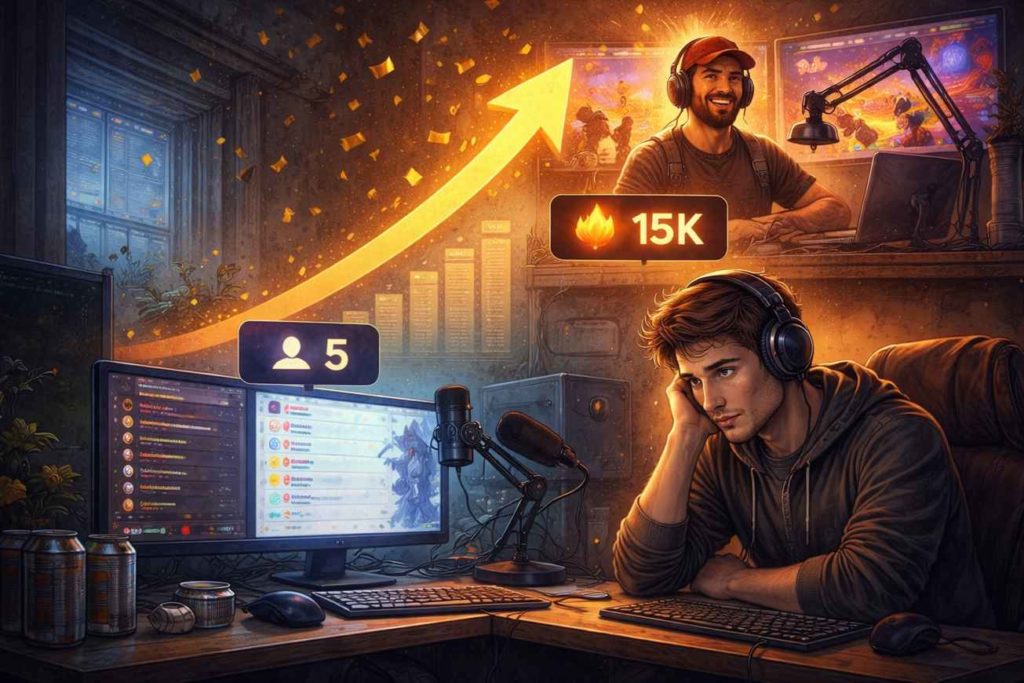
At first glance, the answer seems obvious: bigger streamers have more viewers, so they win. They have higher concurrent numbers, more active chat, more resources, and better equipment. It looks like a simple difference in scale.
But if you look deeper, it becomes clear that it’s not really about the number of viewers.
It’s about how attention is distributed.
And this is what makes the gap between small and large channels not linear, but self-reinforcing.
Why Twitch Amplifies Already Popular Streams
The platform does not distribute attention evenly. It relies on viewer behavior: where people click, where they stay, and where they return.
If a stream already gets clicks, it moves higher. If it moves higher, it gets even more clicks. This creates a feedback loop.
Large streamers sit at the top of the list, where most of the traffic is concentrated. They receive more clicks simply because of their position.
Small streams sit lower, where traffic drops sharply.
And this is not just a difference — it’s a gap.
Why the First Click Matters More Than Stream Quality
A viewer first chooses which stream to open, and only then evaluates its quality.
This means even a good stream doesn’t matter if it doesn’t get clicks.
Big streamers receive clicks automatically — thanks to position, recognition, and habit. Small streamers have to earn them.
But the problem is that they have fewer opportunities to do so.
As a result, they lose before the stream even begins.
Why Big Streamers Have a “Trust Buffer”
When viewers enter a well-known stream, they already expect a certain level of quality. They are willing to give it time.
Small streams don’t have that advantage.
If there is no clarity, movement, or voice in the first seconds, viewers leave. They have no reason to wait.
This creates different expectations.
A large streamer can afford pauses, slower pacing, even moments of silence. A small streamer cannot.
Why Chat Amplifies the Gap
An active chat makes a stream feel alive. When viewers see movement, they are more likely to stay.
Big streamers already have chat activity that sustains itself. It keeps the stream dynamic even during pauses.
Small streamers often have empty chat. This creates the opposite effect: the stream feels “dead,” even if it isn’t.
This affects retention.
And retention affects category position.
Why Returning Viewers Matter More Than New Ones
Large streamers don’t start from zero every time they go live. They have a base — people who return.
This creates an initial viewer count.
That initial number pushes the stream higher. A higher position brings new clicks. New clicks drive growth.
A small streamer starts from scratch every time.
Without initial viewers, they stay at the bottom. Without position, no clicks. Without clicks, no growth.
Why Stream Formats Differ Between Small and Big Creators
A common mistake is copying large streamers. But their format is built for a different stage.
They optimize for retention.
Small streamers need to optimize for entry.
These are different goals.
If you use a retention-focused format without incoming traffic, the stream won’t grow.
Why Big Streams “Feel Better,” Even When They Aren’t
There is a perception effect: when a stream is already popular, it feels higher quality.
Viewers see high numbers, active chat, fast reactions — and automatically assume it’s “good.”
Even if objectively it’s not that different.
Small streams are judged more strictly. Flaws are more noticeable because there is no external validation.
Why Small Streamers Don’t Actually Compete with the Top
This is important: small streamers rarely compete directly with top creators. They compete with others at their level.
But due to platform structure, it doesn’t feel that way.
It seems like the problem is the big channels. In reality, the competition happens within your own layer — for limited clicks and early retention.
That’s where growth is decided.
Why the Gap Can Be Reduced but Not Skipped
You can’t “jump” this gap in one move. There is no trick that instantly puts you on the same level as big streamers.
But you can change the conditions.
Work in categories where traffic is accessible.
Build a format that retains viewers from the first seconds.
Create consistency that drives returning viewers.
This doesn’t remove the gap, but it reduces its impact.
What It Really Means to “Lose to Big Streamers”
It’s not about content quality.
It’s about lack of position, incoming traffic, and a viewer base.
Big streamers win not because they are better at everything, but because they are already inside a system that amplifies their results.
Small streamers are outside that system.
Growth begins when a stream stops being isolated and starts getting repeated entries.
That’s the moment when the gap begins to shrink.