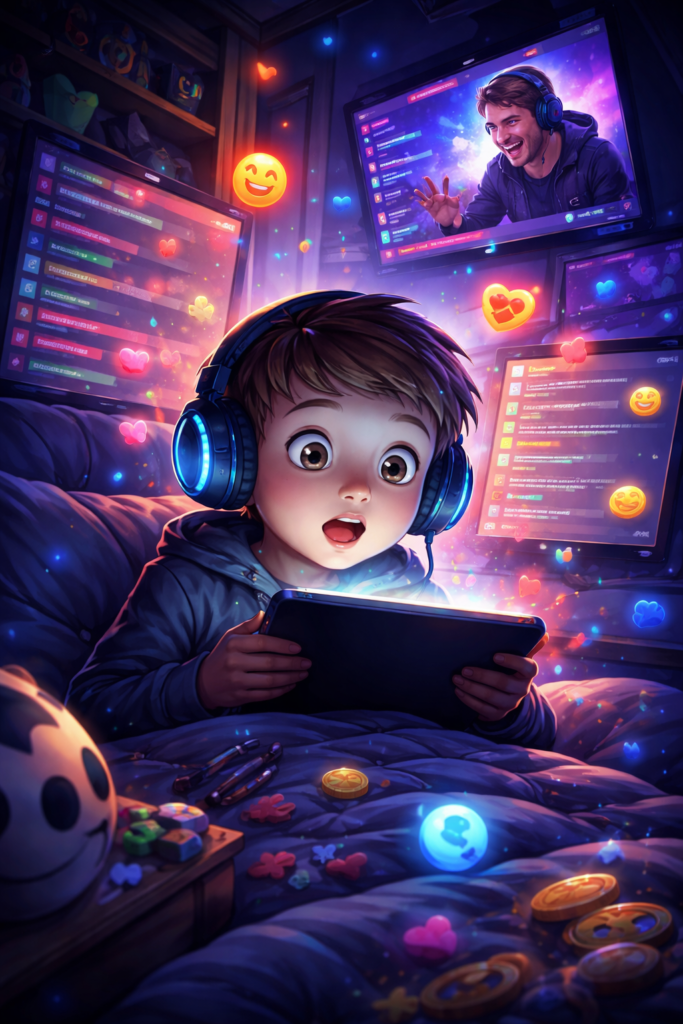
Livestreaming rarely looks dangerous in the moment. A child sits with a tablet, wearing headphones, barely moving — everything appears calm. But unlike regular videos, a stream is not just content, it is a process. It unfolds in real time, without editing or pauses, and the child is drawn not into a story, but into an environment.
The key difference is that the child is not simply watching. They are present. They wait for reactions, catch remarks, follow the chat, and feel involved in what is happening. This sense of participation is what makes livestreaming far more influential than recorded videos or short clips.
What Keeps Children Engaged in Livestreams
Children often cannot explain why they “just like it.” In reality, what holds their attention is the feeling of being included. A streamer may casually read a username, reply to a message, or make a joke toward the chat — and that is enough to create a sense of personal connection. Even if this connection is illusory, it feels real to a child’s mind.
The second factor is unpredictability. A livestream always carries anticipation: something unexpected might happen at any moment. It could be a sudden emotional reaction, an argument, a loud response, or an unexpected guest. For a child, this format works more powerfully than any cliffhanger.
The chat itself becomes a separate attraction. Often, children follow the chat even more closely than the stream. It moves faster, feels harsher, and is emotionally charged. This is where children absorb communication norms that later transfer into their offline behavior.
Where the Real Risks Begin
The issue with livestreaming is not “bad streamers,” but the format itself. Live speech almost always crosses boundaries. Even a careful creator can lose control, use sharp language, or touch on adult topics. Moderation cannot keep up, and the child hears it all in real time — without context or explanation.
Over time, boundaries shift. What once felt rude or unacceptable begins to feel normal. Sarcasm, public ridicule, and aggressive humor stop being recognized as problems and instead become a communication style.
Another layer of risk is donations. Even if a child has no access to money, they clearly see the connection: pay, and you are noticed. Don’t pay, and you remain invisible. This builds an early model of paid attention and devalues presence without financial contribution.
There is also a subtler effect — the sense of constant presence. Streams often last for hours, and children struggle to notice fatigue. They stay “just a little longer” out of fear of missing something important. As a result, sleep, focus, and emotional balance suffer.
Why Simple Bans Do Not Solve the Problem
Banning livestreaming almost never works as adults expect. The child does not stop watching — they stop showing. Alternative devices appear, viewing shifts to friends’ homes, and secrecy replaces openness. Livestreaming remains, but conversation disappears.
It is important to understand that for a child, livestreaming is a social experience. People discuss, argue, joke, and react together. A complete ban means exclusion from a social environment, and children rarely choose isolation if participation is still possible.
How to Set Rules Without Pressure
A healthy approach starts not with control, but with curiosity. Not “what are you watching,” but “why is this interesting to you.” When a child realizes they are not being judged, they begin to explain — and these conversations reveal where comfort and risk actually lie.
It is crucial to separate livestreaming itself from its forms. On platforms like YouTube or Twitch, experiences can differ drastically. One channel offers calm gameplay, another constant shouting and provocation. For a child, these are all “streams,” but for an adult, they represent entirely different environments.
Time boundaries are far more effective than content bans. When livestreaming has a defined place in the schedule, it stops feeling endless. Removing streams from late evening hours is especially important, as stimulation directly affects sleep.
Donations require a separate conversation. Children need to understand that a streamer’s attention is part of the format, not a measure of personal value. Not donating does not make them less important. Without this explanation, social pressure operates on its own.
Age Alone Does Not Solve Everything
Younger children often treat streams as background noise, yet already copy communication styles from chat. During early adolescence, involvement peaks — this is when imitation, repeated phrases, and the desire to “be like them” appear. Older teenagers may seem more critical, but the influence of the environment still exists, only less visibly.
Age matters, but it does not guarantee safety. Context and adult guidance remain the deciding factors.
Livestreaming is not just a video format. It is a live social stage with its own rules, and children enter it before they learn how to recognize those rules. Without an adult nearby to help interpret them, children adopt the loudest and brightest ones — and those are rarely the most considerate.