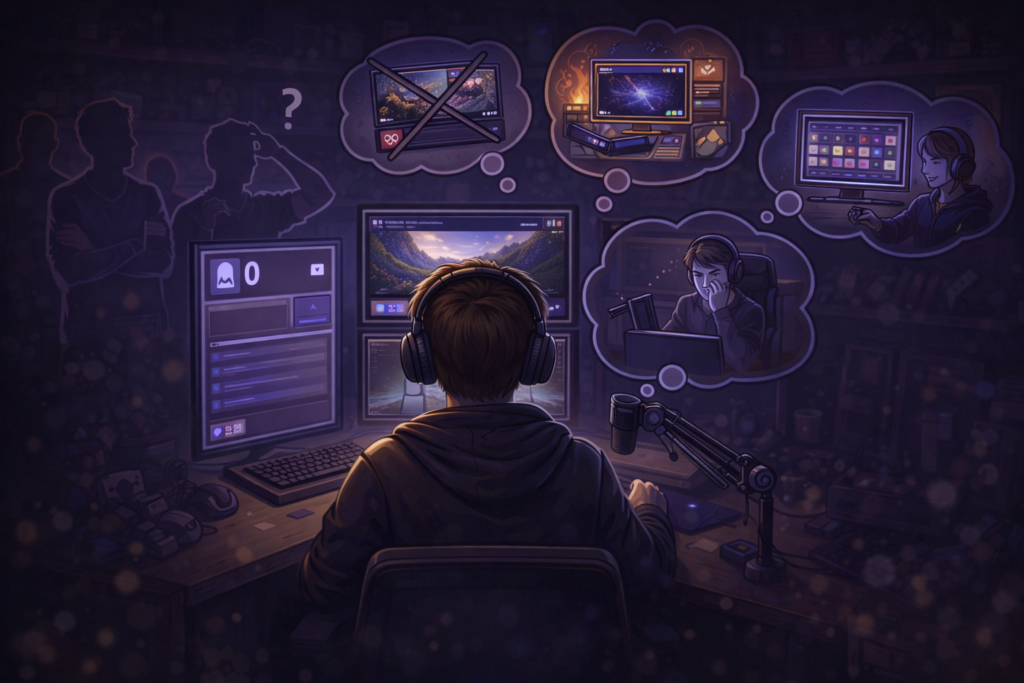
When someone starts streaming on Twitch, they almost never see their mistakes directly. Everything looks fine: the stream is live, the game is running, audio works, the visuals are stable. Sometimes a few random viewers even appear, reinforcing the feeling that everything is being done correctly.
This is exactly why the early stage often drags on — not because the streamer is doing something critically wrong, but because their actions don’t generate enough impact for growth, while also not failing completely.
And this is the core difficulty. Beginner mistakes on Twitch are not obvious failures — they are subtle limitations that prevent a channel from moving forward. They don’t break the stream, but they make it invisible, unengaging, and unable to build an audience.
The Mistake of Expecting Viewers to “Just Come”
One of the most common assumptions is that simply going live is enough to attract viewers. It feels logical: if you stream consistently and create “decent” content, the platform will eventually bring people in.
But Twitch doesn’t work that way. It amplifies existing momentum — it doesn’t create it from zero.
As a result, a streamer goes live, sees zero viewers, and assumes it’s temporary. They keep streaming in the same way, expecting things to improve on their own. But without any shift — in behavior, category, or presentation — nothing changes, and the channel stays stuck at the starting point.
The Silent Stream Problem at Zero Viewers
A very common situation: as soon as a streamer notices that no one is watching, they start talking less — or stop talking entirely. Internally, it feels logical: “why talk if no one is here?”
But for any random viewer who might click on the stream for a few seconds, this becomes an immediate reason to leave.
The problem is that these short visits often go unnoticed. The streamer sees zero and assumes no one came, while in reality people may have clicked in and left due to the lack of activity.
This creates a loop: no activity leads to no retention, no retention leads to no growth.
The Mistake of Choosing the Most Popular Games
Many beginners choose top categories, assuming more viewers means more chances to get noticed. Technically, that’s true — but these categories also have the highest competition.
A new channel ends up at the very bottom of the list, where no one sees it.
Even a high-quality stream gets no opportunity to connect with viewers. This creates the illusion that the content is the problem, when in reality the issue is visibility. Without visibility, nothing inside the stream matters.
The Problem of an Unstructured Stream Format
When a streamer tries everything — different games, styles, schedules — it feels like flexibility. But to the viewer, it looks like a lack of direction.
They don’t know what to expect and don’t build a habit of returning.
Growth on Twitch is not built on isolated successful streams — it’s built on consistency. Without it, every stream feels like a one-off event, and audience accumulation never happens.
Overvaluing Stream Design and Overlays
Many beginners spend a lot of time on visuals: overlays, animations, panels, and effects. It creates the impression that a “professional look” will retain viewers.
In reality, design plays a secondary role.
If the stream itself lacks energy, no visuals can compensate for it. In some cases, overloaded design even distracts from the core experience.
Ignoring Viewer Behavior
Another critical mistake is focusing only on numbers instead of behavior. Streamers look at viewer count and treat it as the main metric, ignoring deeper signals: when people join, when they leave, and what keeps them watching.
Without this understanding, it’s impossible to improve. The channel continues operating the same way, even if it doesn’t work, simply because there’s no analysis of audience response.
Waiting for a “Breakthrough Moment”
Many streamers expect a sudden breakthrough: one successful stream, a recommendation boost, or rapid growth.
This creates a false belief that you just need to “wait for your moment.”
In reality, growth rarely happens like that. It comes from gradual changes that are barely noticeable at first. Ignoring this and waiting for a sudden spike often leads to quitting before real progress begins.
The Most Dangerous Mistake: “Everything Seems Fine”
The most dangerous state is when the stream feels “okay.” There are no obvious issues, nothing is broken, everything works.
But there is also no reason for a viewer to stay.
Such a stream doesn’t repel — but it doesn’t engage either. It creates no negative reaction, but also no interest.
This is exactly where most beginner channels get stuck.
What All These Mistakes Have in Common
At a deeper level, these mistakes are not about equipment or technical setup — they are about understanding the platform.
Twitch is not a place where simply “being live” is enough. It’s an environment where you must create a signal that is both noticeable and engaging.
As long as a streamer behaves as if presence alone is enough, the channel will not move forward.
Growth doesn’t start when all mistakes disappear.
It starts when you understand how viewers experience your stream — and begin adapting your behavior to match that perception.