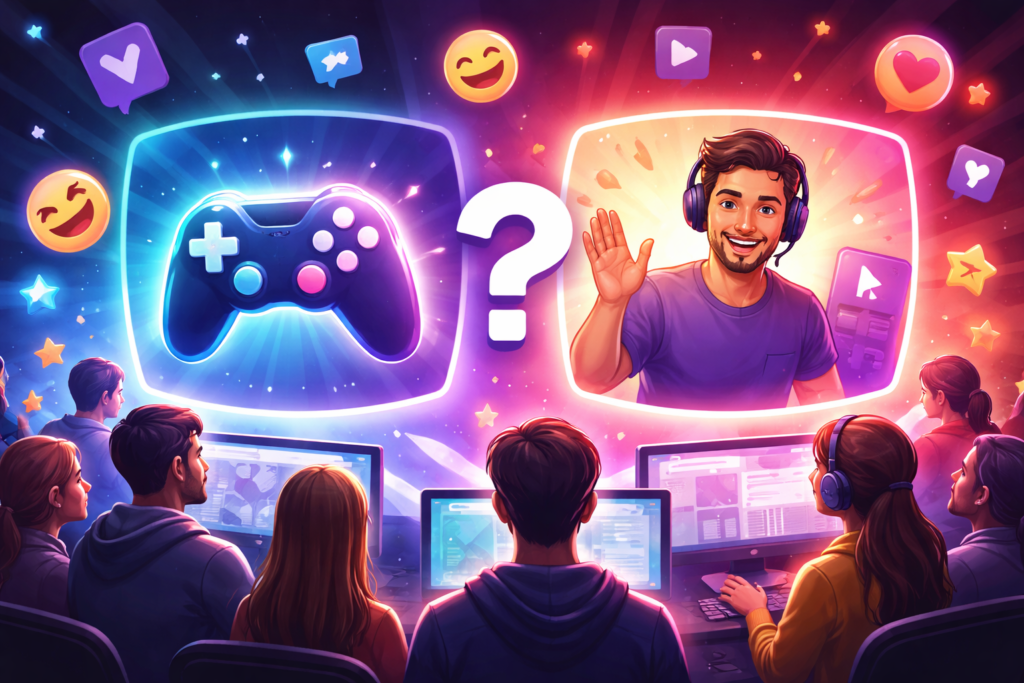
This question sounds simple, but it is almost always asked incorrectly. It seems like you have to pick a side: either you focus on the game or on the personality. Some believe skill and in-game content matter most, while others think everything depends on charisma and communication. In reality, Twitch doesn’t work as a choice between two extremes. Viewers don’t separate these elements in their minds. They experience a stream as a single impression, where the game and the streamer are intertwined but serve different roles.
That’s why channels built entirely around just one of these elements often hit a ceiling. They are either interesting but quickly lose momentum, or stable but unable to grow.
Why the Game Is Almost Always the Entry Point but Not the Reason to Stay
In most cases, viewers discover a stream through the game. They search for a specific title, browse categories, and rely on thumbnails and previews. The game provides context: what is happening, what kind of stream to expect, and the overall pace. It simplifies the decision to click.
But the problem is that the game alone almost never retains viewers. If someone only cares about gameplay, there is always a stronger player, a bigger streamer, or a more dynamic broadcast available. Competing purely on “playing well” is nearly impossible, especially at the early stages.
That’s why the game works as a reason to enter, but not a reason to stay.
Why Personality Retains but Doesn’t Always Attract
Personality is what creates connection. It includes communication style, reactions, pacing, humor, and the ability to turn what’s happening into something engaging. It makes viewers interested not just in the game, but in the person behind it.
However, there is a downside. If a channel relies only on personality without a clear context, it becomes harder for new viewers to enter. They need more time to understand the format, figure out who you are, and get used to your delivery. This lowers the chance of the initial click.
So personality keeps viewers, but doesn’t always bring them in on its own.
Where Real Growth Actually Happens
Growth begins at the point where the game and personality work together instead of competing. The game provides structure and clarity for entry. Personality fills that structure with meaning and retention.
When this balance is missing, the channel starts to decline. Too much focus on the game makes the stream replaceable. Too much focus on personality without structure makes it hard to access.
In both cases, viewers don’t stick around.
Why the Same Game Produces Different Results for Different Streamers
You can take the same category, the same format, and even a similar skill level — and still get completely different results. The reason is that viewers don’t perceive the event itself, but the interpretation of that event.
One streamer plays silently, and viewers see only gameplay. Another plays the same game but comments, reacts, and builds a narrative — turning the same process into an engaging experience.
This difference is what creates retention.
Why “Just Be Yourself” Doesn’t Work the Way People Expect
A common piece of advice is to “just be yourself.” It sounds right, but on Twitch it needs clarification. Being yourself without understanding how it translates on screen often leads to a lack of structure.
You might be an interesting person, but if that doesn’t come through clearly — through speech, reactions, and presentation — it won’t translate into viewer retention.
That’s why personality on Twitch is not only about who you are, but how you express it during the stream.
Why Viewers Come Back for More Than Just the Game or the Streamer
When viewers start returning, they no longer think in terms of “game” or “personality.” Instead, they form a simpler perception: this is a place where it feels good to spend time.
At that point, the game becomes the background, and the streamer becomes the guide — but they are no longer separated.
This is where a channel becomes stable and sustainable.
What Matters More on Twitch in the End
Formally, the game brings viewers in, and personality keeps them. But in reality, the key is not choosing one over the other — it’s understanding their roles.
- The game without personality doesn’t create attachment.
- Personality without structure doesn’t create entry.
What works is not opposition, but combination.
And when a stream stops being just “gameplay” or just “chatting” and becomes an experience where viewers have something to connect to and a reason to stay, the question of what matters more loses its meaning.
Because the viewer has already made their choice — they stayed.