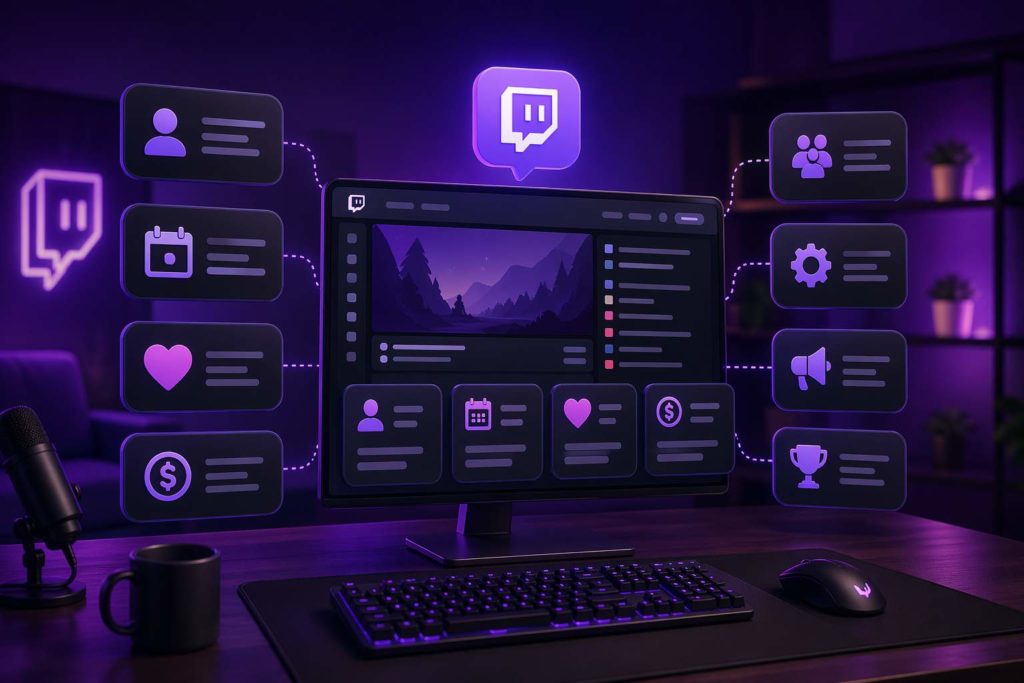
Twitch panels are often treated as an afterthought. After setting up the stream, buying a microphone, and choosing a game, a streamer goes to the “About” section and fills it with random things: a short bio, a donation link, rules, and a couple of social media buttons. Visually, the channel looks “complete,” but in reality, nothing changes — viewers don’t stay, and subscriptions don’t grow.
The problem is that panels are treated as separate blocks instead of a system. In practice, they are the second level of interaction after the stream preview. A person has already clicked on the stream, got interested, and is now trying to decide whether to stay and come back.
If the panels don’t provide that answer, the interest quickly disappears.
Why Panels Are Not Information but Navigation
When a viewer opens a channel, they don’t read everything. They don’t study the text like an article. They scan it. Their goal is to understand where they are in just a few seconds.
Panels work as navigation at this moment. They must quickly explain three things: who you are, what happens on your stream, and why it’s worth watching.
If panels turn into walls of text or disconnected blocks, the brain cannot quickly form a clear picture. Even if there is useful information, it won’t be processed.
What matters is not how many panels you have, but how clear they are.
The First Panel Matters More Than All Others
The most common mistake is starting with donations, links, or formal descriptions. From the streamer’s perspective, it makes sense — you want to show support options right away. But the viewer hasn’t yet decided whether they will stay.
The first panel must answer the main question: what kind of stream is this?
Not “hi, I play different games,” not “welcome to my channel,” but clear positioning. What format you stream, what type of content you create, what exactly happens here.
Without this, everything else loses meaning. The viewer won’t explore further.
Why the “About Me” Panel Usually Doesn’t Work
One of the most common panels is “About Me.” Usually, it includes a short text: name, age, hobbies, when you started streaming. From the streamer’s point of view, it feels important. But for the viewer — it isn’t.
The viewer doesn’t come to get to know you. They come to decide whether the stream is worth watching. Personal information starts working only after interest is already formed.
That’s why “About Me” should not be first and should not take a central role. If it exists, it should reinforce the format, not replace it.
Which Panels You Actually Need
The effective set of panels is defined not by quantity, but by logic.
- First — positioning. A clear explanation of your format: what you stream, how it works, what makes it different. This is the foundation.
- Second — how to engage. Schedule, activity, communication style, stream specifics. Everything that helps a viewer integrate into your content.
- Third — social connections. Where else to find you, how to follow updates, how not to miss a stream.
- Only after that — donations, rules, and technical details.
If this order is broken, the viewer loses interest before reaching what matters.
Why Too Many Panels Reduce Clarity
It may seem that the more panels you have, the better. More information, more completeness. But in reality, the opposite happens.
When there are too many panels, attention gets scattered. The viewer doesn’t know where to look, so they end up reading nothing.
Panels should be concise. Less is better, if it’s clearer. Every block must have a purpose and be part of the overall logic.
If a panel doesn’t answer a viewer’s question, it’s unnecessary.
Visual Design: When It Hurts Instead of Helps
Panels are often designed in a unified style: the same icons, fonts, and colors. It looks clean, but it doesn’t always help.
If visuals become more important than meaning, panels turn into a set of images. Attractive, but unclear.
Design should support navigation, not distract from it. Contrast, readability, and simplicity matter more than “design for the sake of design.”
Connection with Preview and Banner
Panels do not exist in isolation. They continue what started in the preview and banner.
If your preview promises an energetic, engaging stream, but the panels feel dry and formal, there is a disconnect. The viewer senses inconsistency.
If everything shares the same feel, the channel is perceived as cohesive. This increases trust.
How to Know If Your Panels Work
The main indicator is viewer behavior. If people enter, stay, subscribe, and return — the panels are doing their job.
If they click but leave quickly, the issue might be here. They didn’t find the answer they were looking for.
Testing is important. Simplify text, change the order, remove unnecessary elements, and observe how it affects behavior.
Panels as Part of Growth, Not a Final Step
There is a belief that panels are the final stage, something you fix after your channel grows. On Twitch, this is not true.
Panels are part of the funnel. They work at the moment when a viewer is already interested. And they determine whether the viewer moves forward.
You can stream consistently for a long time and still lose people at this stage — simply because your channel doesn’t explain itself.
Panels are not about “making things look nice.” They are about making sure a viewer instantly understands where they are and why they should come back. And that is what turns random clicks into a loyal audience.