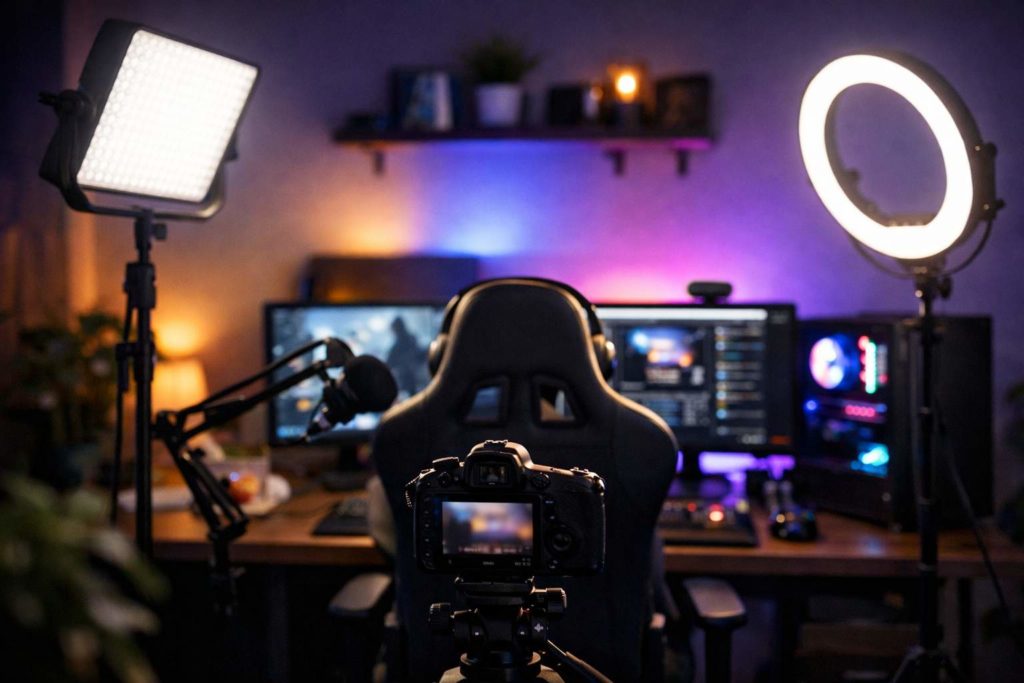
When a streamer first starts thinking about lighting, it almost always begins with searching for the “best light.” People compare ring lights, watch reviews of LED panels, choose power levels, color temperatures, and brands. It creates the impression that a high-quality image is simply a matter of buying the right equipment.
But very quickly, a strange effect appears: the gear is there, yet the image still looks “off.” The face is either overexposed or flat, the background disappears, the colors feel unnatural. And it starts to seem like something else needs to be purchased.
In reality, the problem is almost never the light itself.
Lighting in a stream is not an object — it’s how light behaves in the frame. How it falls, how it spreads, how it interacts with your face, background, and camera. That’s what determines whether your stream feels comfortable to watch or becomes tiring after just a few minutes.
That’s why you can see a streamer with cheap lighting whose image looks clean and “premium,” and another with much more expensive equipment who looks like they’re just being blasted by a spotlight.
Why Front-Facing Light Ruins Your Image, Even If It’s Expensive
The most common mistake is placing the light source directly in front of you. The logic is simple: your face needs to be visible, so you shine light straight at it.
As a result, the face does become bright, but everything that makes the image feel alive disappears. Shadows are gone, depth is lost, skin looks flat, and the eyes lose their dimension.
This kind of lighting makes a person look visually “stuck” to the camera.
And it’s not just an aesthetic issue. Viewers pick this up instantly. A flat image holds attention worse because it lacks depth. There’s nothing for the eye to focus on.
An interesting detail: even if a viewer can’t explain what’s wrong, they leave faster from streams with this type of lighting. Simply because it’s less comfortable to watch.
Why Light Direction Matters More Than Power
Light only starts working when it has direction. When it doesn’t just “shine,” but actually shapes the subject.
If you move the source slightly — higher, to the side, at an angle — shadows appear. And those shadows create facial depth. Cheekbones, nose, and eyes start to look different.
This makes the image feel alive.
And here’s the key paradox: a weaker light placed correctly almost always looks better than a powerful light pointed straight at your face.
Because viewers don’t perceive brightness — they perceive shape.
Why One Light Source Is Almost Never Enough
When there’s only one light source in the frame, it creates a harsh contrast. One side is lit, the other falls into deep shadow.
Sometimes this can look cinematic, but for streams it more often creates discomfort. The face looks uneven, the image feels harsh.
This is where the second role of lighting appears — not to illuminate, but to soften.
The second light doesn’t need to be strong. Its job is to reduce harshness. To soften shadows and create smoother transitions.
This creates a clean, balanced look.
And this is the moment when a stream stops looking like “just turning on a camera” and starts feeling like a designed frame.
Why Background Lighting Matters More Than You Think
A very common mistake is completely ignoring the background. All light is focused on the face, while everything else remains in darkness.
The result is a strange effect: the person exists, but the space around them does not.
This makes the stream feel visually poor.
The background is not just decoration. It tells the viewer where you are and what kind of atmosphere you have. It creates depth, separates layers, and makes the image feel more dimensional — not just because of your face.
Even a subtle light behind you can completely change the perception. It creates separation: you — and the background.
And suddenly, the stream looks more premium, even without extra investment.
Why Mixed Lighting Ruins Your Image, Even If You Don’t Notice It
One of the most subtle issues is color temperature.
Your monitor emits cool light. Your lamp may be warm. The room can add another tone. As a result, your face is lit by multiple colors at once.
The camera tries to balance this and ends up producing strange results: skin looks gray, yellowish, or unnaturally pale.
This is a case where the streamer may not notice the issue, but the viewer feels discomfort.
When all lighting is consistent in temperature, the image becomes cohesive. It doesn’t distract, doesn’t break perception, and looks clean.
And this affects retention more than it seems.
Why Lighting Consistency Matters More Than Perfection
There’s an important detail that only becomes noticeable over time.
Viewers don’t get used to how perfect your lighting is — they get used to it being consistent every stream.
If lighting constantly changes — brighter today, darker tomorrow, different color next time — it creates a sense of chaos, even if the streamer doesn’t notice it.
Stable visuals create a sense of control.
And that’s what feels “professional.”
Why Lighting Is Connected to Streamer Behavior
Lighting is not a static setup. It only works within a certain zone.
If a streamer constantly moves — leans back, shifts position, leaves the frame — the lighting breaks. The face goes into shadow, becomes overexposed, or disappears.
This creates visual noise.
So good lighting is also about habit: staying within your working zone and understanding your frame.
This is no longer just technical — it’s behavioral.
Why Expensive Lighting Doesn’t Solve the Problem
Many try to fix bad visuals by buying more expensive lights.
But there’s a simple rule: equipment amplifies what’s already there.
If your lighting is wrong, a more expensive light will make it even more obvious. Overexposure becomes stronger, shadows harsher, mistakes clearer.
And on the other hand, even simple lighting can look good if placed correctly.
So the order is always the same: logic first, equipment second.
What You Actually Need for Good Twitch Lighting
Not maximum brightness.
Not a full studio setup.
Not expensive brands.
But an understanding of how light behaves in your frame.
When you have direction, balance, background separation, consistent color temperature, and stability — your image becomes comfortable.
The viewer doesn’t analyze your lighting. They simply stay because it feels good to watch.
And that’s when you realize: good lighting is not what stands out.
It’s what doesn’t get in the way.