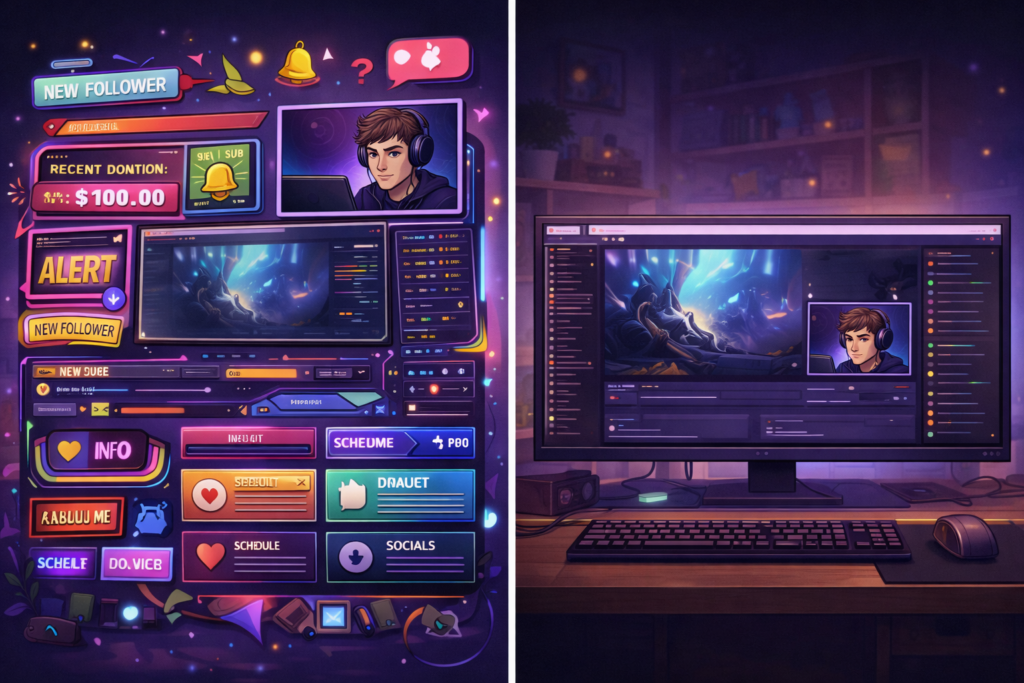
There is a common belief that a well-designed Twitch channel means expensive overlays, complex animations, and a максимально “packed” screen. Beginners often try to include everything: frames, alerts, panels, graphics, effects. It feels like the more visuals you add, the more “professional” the channel looks.
But in reality, viewers evaluate design very differently. They don’t think about how much your overlays cost. They don’t analyze your layout like a designer. They land on your channel and instantly process one thing: is it comfortable or not, clear or confusing, clean or messy.
And this is what creates the feeling of “professionalism” — not the number of elements.
Why Overloaded Design Looks Worse Than Simple Layouts
One of the most common mistakes is trying to add everything at once. Bright frames, animated alerts, complex backgrounds, multiple fonts, mixed panel styles. As a result, the channel stops looking like a unified space and starts feeling like a collection of random decisions.
The viewer may not articulate it, but they feel it instantly. The eye doesn’t know where to focus. Attention gets scattered. Instead of “this looks great,” the impression becomes chaos.
The paradox is that a clean, simple channel almost always looks more expensive and more professional than an overloaded one.
Because it doesn’t interfere with perception and doesn’t compete with the stream itself.
How Viewers Scan Your Channel in the First Seconds
When someone opens a Twitch channel, they don’t study it step by step. They scan it. First the stream screen, then the streamer’s face (if there is a camera), then the overall balance: does the graphics interfere, is it clear what’s happening, is there visual noise.
If everything feels calm and readable, the channel earns instant trust.
If the image is overloaded, the viewer gets tired faster and leaves — often without realizing why.
This is an important point: design doesn’t work as decoration. It works as a perception filter.
Why Consistent Style Matters More Than “Beautiful Elements”
Many creators build their design from different sources: one style for panels, another for overlays, a third for fonts. Each element might look good on its own, but together they don’t create cohesion.
A professional channel almost always feels unified. It looks like everything follows one logic: consistent colors, similar shapes, aligned fonts, and the same level of visual intensity.
Viewers pick this up subconsciously. They don’t think “this is good branding,” but they feel that the channel is well put together.
Why Your Overlay Should Not Be the Main Element
A very common mistake is making the overlay the central focus of the screen. Complex frames, large blocks, graphics that cover the gameplay or the facecam. As a result, the stream looks like design with content inside — instead of content supported by design.
But viewers don’t come for the visuals. They come for the experience: gameplay, reactions, interaction.
If the design starts competing with that, it becomes a problem.
Even if it looks beautiful.
A good overlay is almost invisible. It supports structure without stealing attention.
Why Panels Are Not a Formality but a Trust Point
Many streamers underestimate panels below the stream. They treat them as optional or copy generic templates. But this is often where a viewer decides whether to follow or come back.
Because panels answer simple but critical questions: who you are, what your channel is about, when you stream, how to interact with you.
If panels look messy, inconsistent, or incomplete, the channel feels temporary and unfinished.
On the other hand, even a simple but structured information block increases the sense of stability.
Why Colors and Contrast Matter More Than “Beauty”
Many choose colors based on personal preference. But in streaming, readability and contrast matter more.
If text is hard to read, elements blend together, or everything is too bright or too dark, the viewer gets tired faster.
This may not be obvious immediately, but it affects perception.
Professional design almost always uses a limited color palette. A few colors, clear accents, and enough contrast.
This creates a sense of control.
Why Design Won’t Fix a Weak Stream — but Can Enhance It
There is a dangerous illusion that a beautiful channel can compensate for everything else. That if you design it “like top streamers,” viewers will stay longer.
But design doesn’t work independently from content. It doesn’t retain viewers if the stream itself is weak. It doesn’t create interest. It amplifies what already exists.
If the stream is engaging, design makes it easier to consume.
If the stream is weak, design only hides it slightly — but doesn’t solve the problem.
That’s why the right approach is not “perfect design first, stream later,” but developing both in parallel.
Why “Professional” Is About Perception, Not Budget
The most interesting part is that viewers almost never distinguish between expensive design and clean, simple design. They don’t know how much you paid. They don’t compare design prices.
They just feel whether everything fits together or not.
This feeling comes not from effects, but from logic.
When there is nothing unnecessary.
When elements don’t conflict.
When the channel feels like a unified space, not a mix of random decisions.
In that sense, a professional Twitch channel is not about “making it look cool.”
It’s about removing everything that interferes with perception and keeping only what supports the stream.
And that’s when design stops being decoration and starts working.