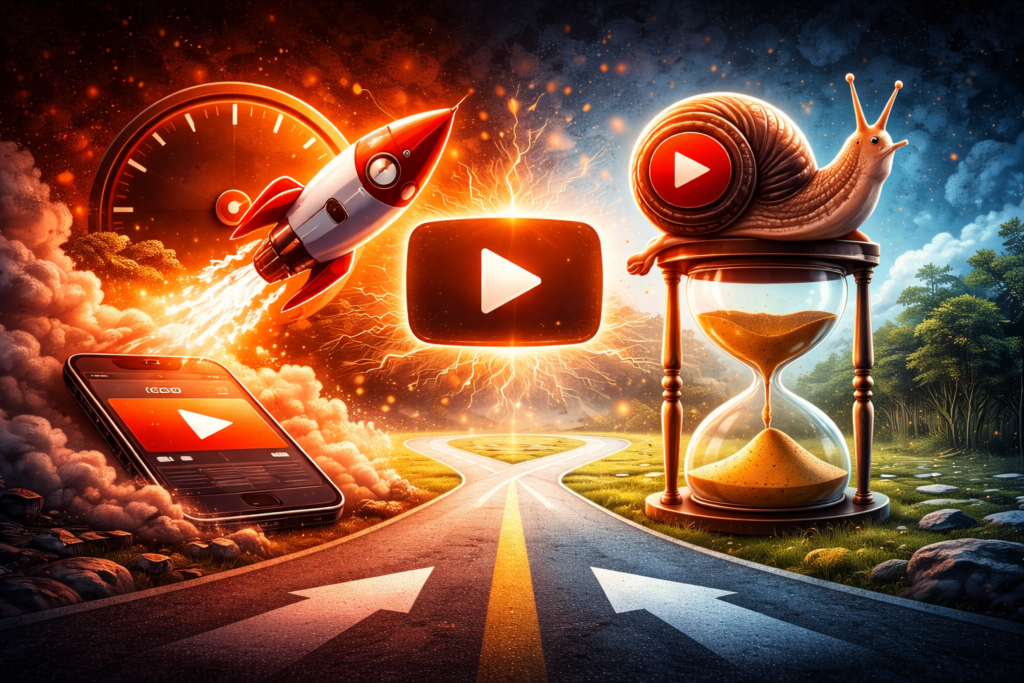
The speed of buying YouTube views may seem like a technical detail, but in reality it is a strategic decision. Some creators choose “fast” because they want immediate results. Others lean toward “slow” out of caution. Almost no one asks the key question: what is the actual purpose behind purchasing views?
View velocity is not inherently good or bad. It either aligns with your objective — or it undermines it.
Why Fast View Boosting Is So Attractive
Fast view delivery promises what many creators and businesses lack — instant feedback. A video is published, and within hours it shows thousands of views. The empty page effect disappears. The channel looks active. There is a sense of momentum and control.
In certain scenarios, this approach works perfectly. If the video functions as a showcase, part of a sales funnel, external advertising, or a landing page asset, speed becomes the priority. A visitor clicks the link and sees visible engagement. They register activity — not the timeline behind it.
In such cases, fast view boosting solves the task. It delivers perception and social proof, not internal platform growth.
Where Fast Delivery Becomes a Limitation
Problems arise when fast view spikes are used as an attempt to trigger algorithmic expansion. A sharp increase without sustained engagement distorts the data pattern. YouTube’s system detects activity but does not see consistent behavioral signals.
This does not automatically lead to penalties, but it does lead to caution. The platform hesitates to expand distribution because it lacks clarity about audience relevance. As a result, the impact of fast boosting often ends when the spike ends.
This is where creators feel: “It worked — and then it stopped.”
The Strength of Slow View Growth
Slow, distributed view delivery may appear less dramatic, but it mirrors organic patterns more closely. Views accumulate over time. The video does not look artificially inflated. It appears to gain interest gradually.
This matters not only to algorithms but also to human perception. Gradual growth feels natural. It avoids anomalies and aligns better with real user behavior.
If the objective is to support a new video launch, remove the zero-view barrier, give the system time to collect early signals, and allow real viewers to engage, slower pacing is often more effective. It does not attempt to impress — it creates a stable background for authentic engagement to emerge.
Why Slow Boosting Feels Less Impressive
The main drawback of slow delivery is psychological. There is no dramatic spike, no immediate “wow” effect. For some, it may seem underwhelming.
But slow pacing sells a scenario, not emotion. It leaves space for real audience behavior to integrate naturally without triggering skepticism or distortion.
If your goal is not just to display numbers but to integrate a video into a realistic viewing rhythm, this approach becomes critical.
When Fast View Boosting Makes Sense
Fast delivery is appropriate when:
- the video operates outside recommendation-driven growth
- visual presentation matters immediately
- views are needed as instant social proof
- organic expansion within YouTube is not the priority
In these situations, speed is an advantage. There are no expectations from the algorithm — only a defined short-term objective.
When Slow Delivery Wins
Slower pacing works better when:
- the video is new and has no performance history
- you want to avoid discouraging real viewers
- a smooth launch is required without sharp anomalies
- view boosting supports growth rather than replaces it
Here, the value lies not in hourly volume, but in how those views are distributed over time.
The Core Mistake: Choosing Speed Without Context
The most common mistake is selecting fast or slow delivery without understanding the objective behind buying views. This leads either to impressive numbers without continuity or disappointment in a “slow” service.
View boosting is not universal. It amplifies what already exists. If the goal is visual impact, amplify it with speed. If the goal is structured launch stability, amplify it with gradual pacing.
So What Is Actually Better?
The best option is not “fast” or “slow.” It is appropriate.
The right pacing:
- matches your objective
- does not create unrealistic expectations
- does not interfere with genuine audience behavior
- works alongside content rather than replacing it
When delivery speed aligns with strategy, it stops being controversial. It becomes a practical tool — not magical, not dangerous, simply useful in the right context.
That is how it should be viewed if you want real results, not just the illusion of movement.