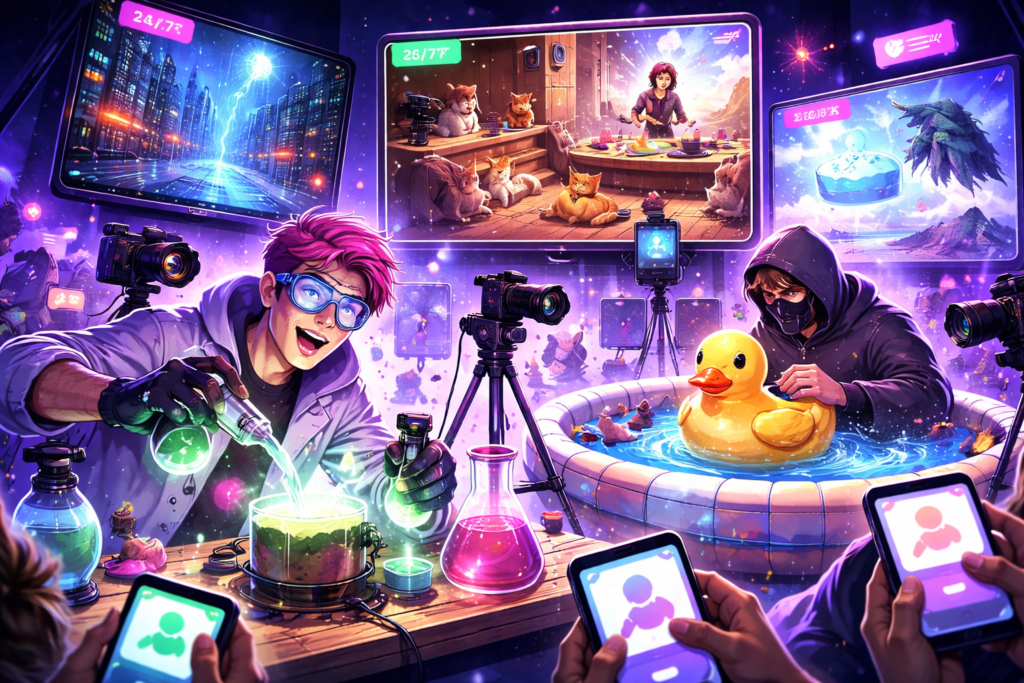
Modern streaming has long gone beyond games and talk shows. By 2026, it is hard to impress viewers with just a camera and a microphone. That is why unusual streaming formats are playing an increasingly important role, breaking familiar expectations and offering a new kind of experience. This is not about shock value, but about finding formats that can hold attention in an oversaturated content landscape.
Unusual streams work differently. They do not always attract record-breaking viewer counts, but they often build a more engaged and loyal audience. Viewers come not just to watch, but to experience something.
Why Viewers Are Drawn to Unusual Streaming Formats
The main reason viewers are attracted to unusual streaming formats is the element of surprise. When someone opens a stream and cannot immediately understand what to expect, curiosity is triggered. This feeling has become rare in an era of predictable formats.
By 2026, audiences are tired of repeated scenarios. Even favorite genres lose appeal if they do not evolve. Unusual streams create a sense of novelty and the feeling that you have ended up somewhere unexpected — a powerful attention-retention trigger.
Streams Without a Host: When Content Lives on Its Own
One of the most unconventional formats in recent years is streams without an active host. The camera may be pointed at a street, a workspace, an aquarium, a server, or any process that unfolds on its own.
Viewers watch these streams not for a personality, but for a state of mind. This is a meditative format often used as background content. Paradoxically, the lack of active action can keep viewers watching longer than highly dynamic broadcasts.
Experimental Streams and Social Observations
Another unusual streaming format is broadcasts built around experiments. These may include behavioral tests, time-based limitations, or conditions that change based on audience actions.
Viewers are interested because the outcome is unknown. These streams rely on anticipation — “what will happen next?”. In 2026, uncertainty itself becomes a valuable resource.
Streams With Absurd Logic and Broken Genre Rules
Some unusual streaming formats deliberately break conventional logic. These include streams without explanations, non-linear narratives, or broadcasts where the rules change mid-stream.
Such formats are not for everyone, but they attract a dedicated audience. Viewers feel they are participating in something experimental and unconventional, creating a sense of belonging to a niche community and increasing loyalty.
Why Unusual Streams Often Outperform Traditional Ones
At first glance, a strange format may seem risky. However, unusual streams often show stronger audience retention. The reason is simple: viewers do not know what to expect, so they stay longer.
In traditional formats, audiences quickly understand the structure and decide whether to keep watching. In unconventional streams, that decision is delayed because every moment may bring something unexpected.
How Unusual Formats Help Streamers Stand Out
In a highly competitive environment, an unusual format allows streamers to stand out without major resources. Expensive equipment or large popularity are not required — just an idea and an understanding of the audience.
In 2026, many streamers use unconventional formats as an entry point. Even if their main content remains familiar, unusual streams help attract new viewers and expand reach.
Risks and Limitations of Unconventional Formats
Unusual streaming formats require a delicate balance. If viewers do not understand what is happening and feel no emotional connection, they leave quickly. Strangeness must be supported by a clear idea.
These formats are also harder to scale. What works as an experiment does not always fit a regular schedule, so unusual streams are often used as special events.
Why Unusual Streams Are Becoming Part of Streaming Culture
By 2026, streaming is not just entertainment but a form of digital art. The most unusual formats reflect a desire to experiment, push boundaries, and explore new forms of interaction.
Viewers increasingly see streams not as products, but as processes. They want to witness something unique, even if it feels strange or not fully explained.
How Unusual Formats Change Audience Expectations
Over time, unconventional streams raise audience expectations. Viewers begin to seek not only comfort, but also emotion, surprise, and new experiences.
As a result, unusual streams do not replace traditional formats, but push the entire streaming industry to evolve.