Not long ago, streaming was closely associated with a specific person. Viewers waited for them, adjusted to their schedule, accepted pauses, fatigue, and breakdowns as part of the persona. Even silence on stream was perceived as a form of presence.
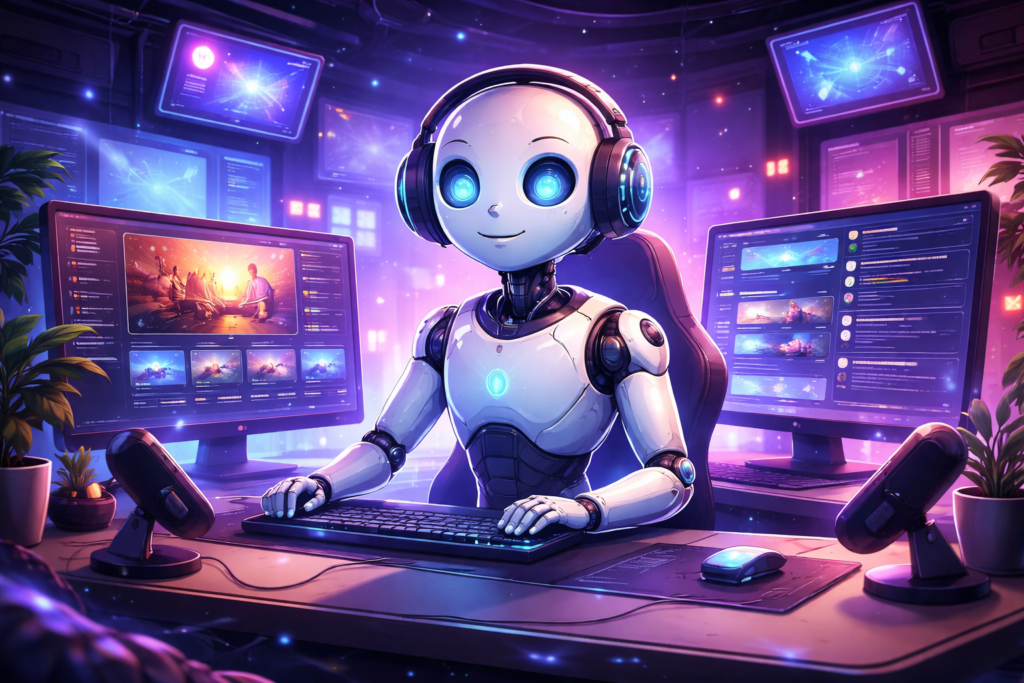
But in the mid-2020s, platforms began to feature broadcasts built on a different logic: a steady speaking pace, consistent engagement at any hour, and no emotional drops. This was not a new streaming style, but a new type of subject—a streamer without a biography, without sleep, and without an end to the broadcast. An artificial intelligence that does not “go live,” but exists inside the stream continuously.
Why AI Entered Streaming at All
For a long time, streaming was considered the last stronghold of “human presence.” It required real-time reactions, audience awareness, and improvisation. It seemed like automation simply did not belong here.
Reality turned out to be simpler. Most views on platforms like Twitch and YouTube are not driven by focused attention, but by background presence. People turn on streams while working, gaming, commuting, or doing household tasks. They are not so much watching as they are staying near the stream.
In this mode, charisma matters less than stability. Not personality, but the feeling that the flow never stops. This is where AI turned out to be unexpectedly natural.
The AI Streamer as an Interface, Not a Character
It is a mistake to compare an AI streamer to a human and ask whether it can be “interesting.” That is not its function.
In streaming, AI works as an interface: it reacts, responds, comments, maintains conversation, and fills pauses. This is closer to radio or navigation than to a show. Viewers do not expect emotions or charisma—they expect appropriate responses and a sense of continuity.
In this sense, AI does not replace streamers. It occupies a niche that previously existed but was never fully articulated.
A Stream Without a Beginning or an End
The most noticeable shift is not about content, but about time. Human streams follow schedules. AI does not.
An AI streamer does not “start” or “end” a broadcast. It exists as a constant point of entry. Viewers do not join a specific show at a specific moment—they enter a state that is always available.
This changes viewing habits. The anticipation of a start disappears, along with the fear of missing something and dependence on time zones. The stream becomes something like an open tab that can be returned to at any moment.
Why Viewers Stay Even Knowing It Is Not Human
At first glance, awareness of the streamer’s artificial nature should reduce engagement. In practice, the opposite often happens.
AI does not get irritated, ignore chat, drift into personal topics, or burn out. It responds to everyone, all the time. For part of the audience, this is more comfortable than interacting with a human streamer who has moods, fatigue, and limits to their attention.
As a result, trust is built not on sympathy, but on predictability.
The Economics of Streaming Without Personality
The most difficult question is money. Why should viewers pay someone without a life, a story, or a character?
The answer is gradually shifting. People are not paying for personality, but for function: a constant stream on a specific topic, personalized interaction, fast responses, and a sense of availability.
The AI streamer stops being an idol and becomes a service with elements of entertainment. Not an object of admiration, but a convenient way to spend time.
Where AI Feels Most Confident
There are areas where the human factor is not an advantage, but a limitation. These include educational streams, explanations of complex systems, game mechanics, and news or analytical flows. In these cases, speed of response, knowledge volume, and stability matter more than emotional intensity.
In these domains, AI does not compete with human streamers directly. It addresses a different type of demand—utilitarian, but still social.
The Boundary AI Has Not Crossed Yet
For all its efficiency, AI remains too stable. It lacks awkward pauses, spontaneous conflicts, and real risk. And this is exactly what draws part of the audience to human streamers.
Human streaming is valuable not only because of content, but because of the possibility of failure. That unpredictability is still beyond algorithms.
When Streaming Stops Being an Event
In the end, the AI streamer is neither an event nor a threat—it is a background. It is rarely discussed, rarely debated, and rarely anticipated. It is simply opened, like a weather tab, a chat window, or radio—something that does not demand attention but creates a sense of presence.
And perhaps this is the real shift: streaming no longer has to be the center of attention. It can become an environment. And when the environment no longer requires a human, the human becomes noticeable only where they are truly needed—not for consistency, but for breakdowns, mistakes, and unexpected turns.