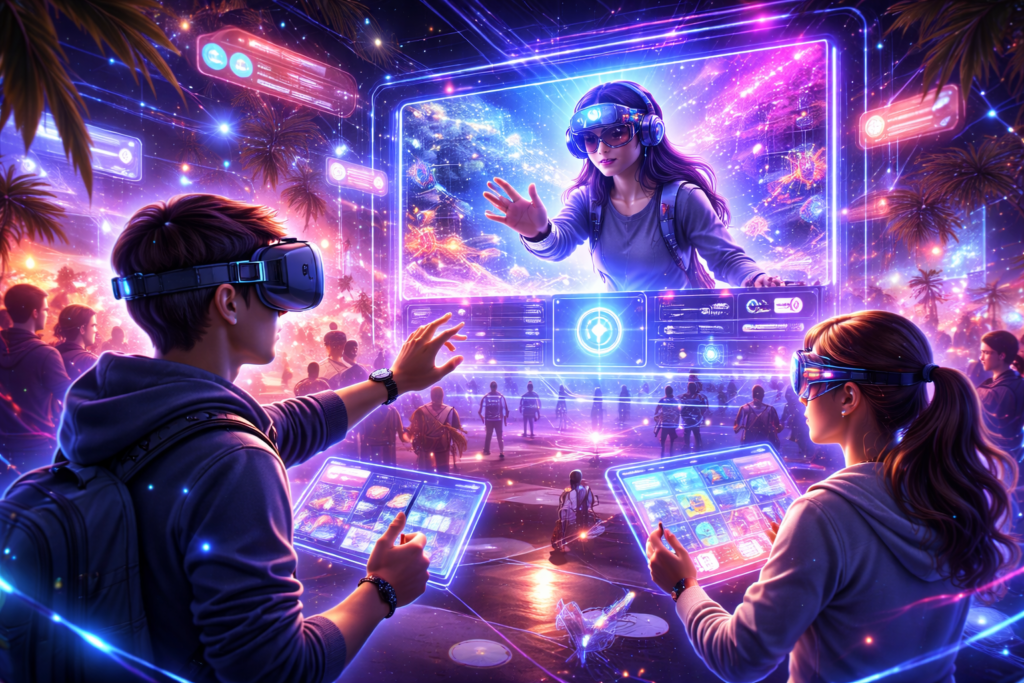
For a long time, AR and VR were seen as extensions of video: the same streams, just viewed through headsets. The camera feels closer, the effect deeper, the engagement higher. But as the devices became more familiar, it became clear that the most important change was not visual, but positional.
In AR and VR, a stream is no longer something you watch. It is something you are inside.
The Screen Stops Being a Boundary
A traditional stream is always framed: there is a shot, a viewer, and a distance between them. Even the most interactive broadcasts remain observation. In AR and VR, that distance disappears.
In augmented reality, the stream is layered onto the physical world. It does not replace a room, a street, or an office—it integrates into them. In virtual reality, the world is built entirely around the stream, and the viewer finds themselves inside the event rather than facing it.
This is not an enhancement of video effects, but a shift in perception: the stream is no longer “in front of your eyes,” it is “around you.”
Why AR Streams Look Simpler Than They Really Are
AR feels less radical than VR. The same camera, the same person, just with added layers—overlays, objects, animations. But this very subtlety is what makes AR important.
An AR stream does not require full immersion. It works in everyday contexts: in the kitchen, on the street, in a store, at an event. The streamer does not pull the viewer out of reality, but speaks directly with it.
This changes usage scenarios. AR streams easily become:
- instructions,
- guidance,
- commentary on what is happening here and now.
Streaming begins to compete not with video, but with explanation and navigation.
VR Streaming Is No Longer a “Broadcast,” but an Event
In VR, the situation is different. A stream almost always requires a deliberate choice: putting on a headset, entering a world, allocating time. As a result, VR streams are rarely background experiences. They are closer to events than to content.
Importantly, in VR the stream is no longer tied to a single camera. Viewers can:
- change their point of view,
- move closer or farther away,
- follow not only the streamer, but other participants.
This breaks the familiar hierarchy of “host and audience.” The streamer becomes one figure within the space, not its center.
How the Role of the Streamer Changes
In AR and VR, streamers increasingly do not need to speak continuously. Their task is to organize attention, not to hold it through constant narration.
They become:
- guides,
- reference points,
- event triggers,
- sometimes simply an entry point.
This is especially noticeable in VR, where viewers can be distracted by each other, explore the environment, wander away, and return. Control is lost—and that is not a flaw, but part of the format.
Why Chat Starts to Get in the Way
Text chat is a product of flat streaming. It compensates for the inability to act. In AR and VR, that compensation is no longer needed.
Messages are replaced by gestures, movement, shared actions, and visual reactions. The viewer responds not with words, but with behavior. This reduces noise and changes the dynamic: the stream becomes quieter, but denser.
That is why many AR and VR streams look strange from the outside—there is little talking, but a lot of presence.
Technology Adapts to Behavior
Companies like Meta and Apple invest in AR and VR not for flashy demos, but for new attention scenarios. Devices such as Vision Pro matter not as “screens on the head,” but as ways to embed streaming into everyday actions.
The less a stream requires a separate decision, the closer it moves to real life—and the less it resembles traditional media.
Metrics Stop Being Obvious
In AR and VR, familiar metrics struggle to apply: watch time, retention, clicks. A person can be present in a stream without looking at a single point. They can stay silent, show no explicit reactions, and still participate.
Engagement becomes physical and spatial. It is difficult to measure, but easy to feel—especially for those inside the experience.
The New Level Does Not Feel Like “Wow”
The most unusual thing about AR and VR streaming is the lack of a breakthrough moment. There is no point where you want to say, “This is the future.” Everything happens quietly: the stream simply stops interfering with reality and starts aligning with it.
Sometimes it feels like someone explaining something while standing next to you. Sometimes like an event where no one reminds you that a broadcast is happening. And the less this is verbalized, the more naturally the format works.
At some point, it becomes hard to say where the stream ends and the environment begins—because the question no longer feels important.