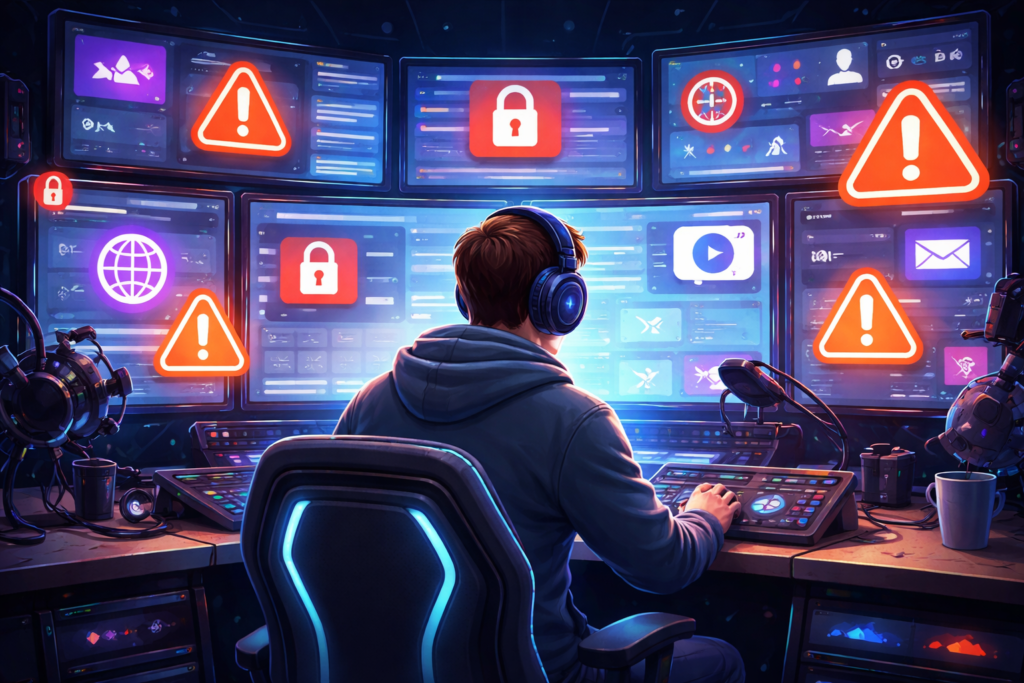
By 2026, streaming has fully moved beyond being “entertainment for enthusiasts.” It has become a form of public broadcasting and, as a result, an object of regulation. The key feature of modern restrictions is that they rarely appear as direct bans. More often, they take the form of subtle frameworks that streamers enter almost unnoticed — through platform rules, data requirements, audience responsibility, and interaction formats.
The most important shift of recent years is that streamers are increasingly viewed not as platform users, but as sources of influence. This change fundamentally alters the legal perspective.
When Streaming Stops Being “Personal”
In the past, streaming was perceived as a private activity: someone turned on a camera, and others chose to watch. By 2026, this approach no longer works. If a stream has a regular audience, monetization, and algorithmic distribution, it automatically falls into the category of public content.
This means the streamer becomes responsible not only for what they say, but also for the environment they create. Chat activity, donations, and audience reactions are increasingly treated as parts of a controlled space rather than spontaneous communication.
Platform Rules Matter More Than Formal Laws
Formally, most restrictions affecting streamers are introduced not by governments, but by platforms themselves. In 2026, however, these platforms function as the real regulators.
On YouTube, Twitch, and TikTok, streamers face multi-layered control systems: automated moderation, community guidelines, advertising requirements, and age and regional restrictions. Violating these rules rarely leads to court cases, but almost always results in demonetization, reduced reach, or account suspension.
As a result, streamers are forced to navigate platform logic rather than formal law — a logic that can change without public discussion or transparency.
Content as a Potential Risk
By 2026, the definition of “problematic content” has expanded significantly. It now goes far beyond direct violations such as violence, extremism, or illegal activity. Platforms increasingly focus on blurred categories like manipulation, misleading information, aggressive engagement tactics, and psychological pressure on audiences.
Advice-based content has become especially sensitive. Streamers discussing finance, health, psychology, or lifestyle topics are more frequently required to label content, add disclaimers, or apply age restrictions. While this is formally framed as audience protection, in practice it creates additional barriers to growth.
Age and Audience as Legal Factors
One of the most visible trends is increased control over who is watching a stream. If the audience may include minors, content requirements automatically become stricter.
This applies not only to topics, but also to presentation style: language, visuals, and interactive mechanics. Even donations and audience challenges are now evaluated through the lens of potential pressure on vulnerable viewers. Simply stating “18+” is no longer sufficient — active environment management is expected.
Monetization Under Scrutiny
Money remains the most sensitive area of regulation. In 2026, everything related to donations, subscriptions, paid reactions, and advertising is treated as a financial transaction rather than simple creator support.
This leads to stricter transparency requirements. Viewers must clearly understand what they are paying for, where the money goes, and what they receive in return. Hidden advertising, unlabeled native integrations, and manipulative calls to action increasingly result in platform sanctions.
Notably, automated and semi-automated streams are sometimes subject to even stricter standards than personal broadcasts. The absence of a live host does not reduce responsibility — it reinforces the systemic nature of the channel.
Geography as a Hidden Limitation
The global nature of streaming in 2026 remains largely an illusion. While streams may be accessible worldwide, compliance requirements depend heavily on the regions where audiences are located.
The same broadcast may be fully acceptable in one country and problematic in another. Platforms address this through localized blocks, feature limitations, delays, or demonetization. For streamers, this often appears as unexplained drops in reach or sudden restrictions driven by geographic regulation logic.
Algorithms as a Tool of Enforcement
It is important to understand that restrictions in 2026 rarely take the form of outright bans. Algorithmic pressure is far more common. Content is not removed — it simply stops being promoted. Streams are not blocked — they become invisible.
This changes streamer behavior. A creator may follow all formal rules and still be at risk if their content does not align with the platform’s preferred model of “safe” streaming. In this sense, algorithms function as a soft regulatory mechanism that bypasses legal procedures.
Self-Censorship as the New Norm
Under constant pressure from unclear rules and enforcement mechanisms, many streamers begin limiting themselves in advance. Not because something is explicitly prohibited, but because the boundaries are unclear. This results in content standardization, reduced sharpness, and fewer experiments.
The paradox is that while technical possibilities expand — new formats, tools, and monetization methods — the practical space for acceptable behavior narrows due to uncertainty and fear of sanctions.
When the Streamer Becomes an Administrator
By 2026, a streamer is no longer just a content creator. They are a moderator, editor, and environment administrator. They are responsible for chat behavior, communication tone, and the signals sent to the audience. Even silence or inaction can be interpreted as implicit approval.
This creates a new type of burden — managerial rather than creative — for which many streamers are unprepared.
An Ending Without a Stop Button
Sometimes a stream ends not because the creator presses “stop,” but because features disappear, ads are removed, and reach collapses. Formally, nothing has happened. The environment has simply become more restrictive.
In 2026, laws and restrictions for streamers rarely feel like external pressure. More often, they resemble a change in the air itself. Adapting to that air becomes not a separate task, but the background condition of streaming as a profession.