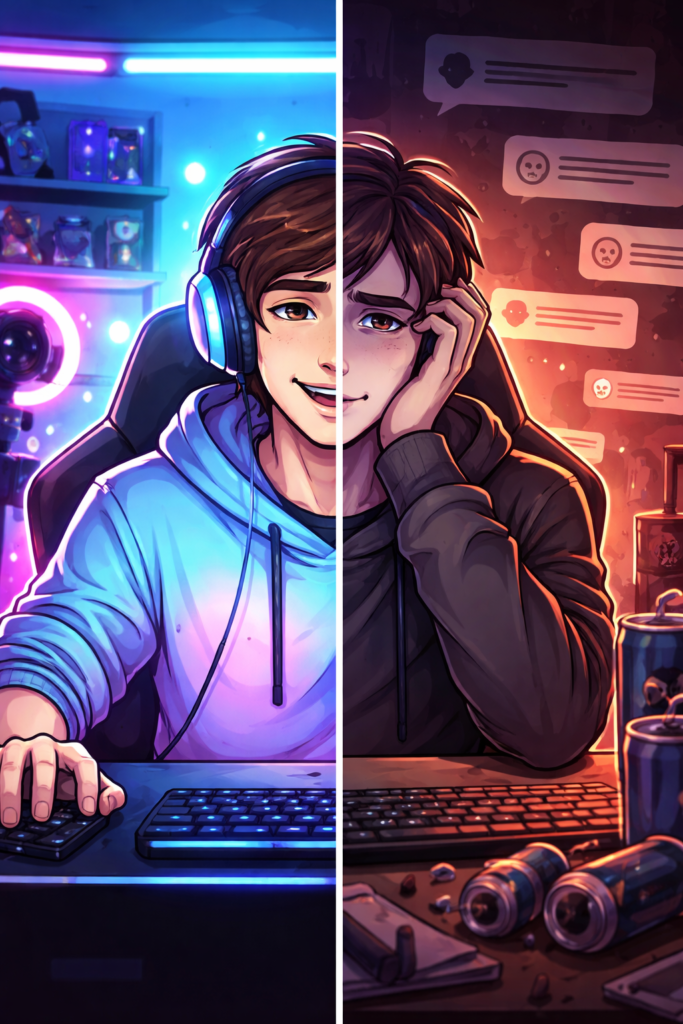
From the outside, streaming looks like an easy way to make money: a person starts a broadcast, talks, plays games, and earns income. This surface-level simplicity distorts how streaming is perceived as a profession. It is either idealized or dismissed as something unserious.
In reality, streaming becomes a profession at the moment it begins to systematically affect lifestyle, mental state, and self-esteem.
A Sense of Control as the Main Advantage
One of the key benefits of streaming is autonomy. Streamers independently choose their format, topics, schedule, and communication style. The absence of bosses and fixed working hours creates a strong sense of freedom.
However, this control comes without guarantees. Responsibility for income, mistakes, and exhaustion lies entirely with the streamer. Freedom does not remove pressure — it simply changes its source.
Instability as a Structural Drawback
Financial instability in streaming is obvious, but emotional instability is no less significant. Income, audience attention, and engagement constantly fluctuate. There is no steady baseline — only cycles of growth and decline.
Long-term exposure to this dynamic creates a habit of measuring self-worth through results: growth, drops, retention. Over time, this leads to chronic internal tension.
Work Integrated Into Identity
For many streamers, the profession is appealing because it does not require playing a role. They can speak in their own voice without adapting to formal standards. Work and personality do not directly conflict.
At the same time, this creates vulnerability. Failures are experienced not as professional mistakes, but as personal defeats. The boundary between professional evaluation and self-esteem gradually erodes.
Permanent Public Exposure Without Pause
Even off-stream, a streamer remains a public figure. Statements, reactions, and behavior can be discussed and interpreted. The profession does not end when the broadcast stops.
Without clear personal boundaries, streaming begins to occupy all areas of life, including rest and personal relationships.
Instant Feedback
Results in streaming are visible immediately. Reactions, messages, and audience engagement happen in real time. This creates a strong sense of relevance and direct impact.
For people who value live feedback, this can be a powerful motivational factor.
Dependence on Audience Reaction
Over time, that same feedback can create dependency. Mood begins to depend on chat activity, metrics, and viewership dynamics.
Without alternative sources of stability, emotional swings intensify. This is why experienced streamers often try to reduce the importance of metrics in relation to self-worth.
Format Flexibility and the Absence of a Single Path
There is no standard career trajectory in streaming. Formats, genres, and growth pace can change. Pauses, returns, and restructurings are possible without formal “resets.”
This flexibility allows the profession to adapt to changes in life circumstances.
No Clear Career Ceiling
At the same time, streaming lacks a clearly defined next level. Experience does not guarantee income, and success does not ensure stability.
At some point, streamers must independently answer the question of what comes next — without relying on an external structure.
Conclusion
Streaming is not a universal or lifelong profession. For some, it is a phase; for others, a core occupation; for many, a parallel form of work.
It offers autonomy and live connection, but requires strong psychological resilience. In streaming, those who succeed are not the ones who endure the longest, but those who know when and how to change the format — including the decision to step away.