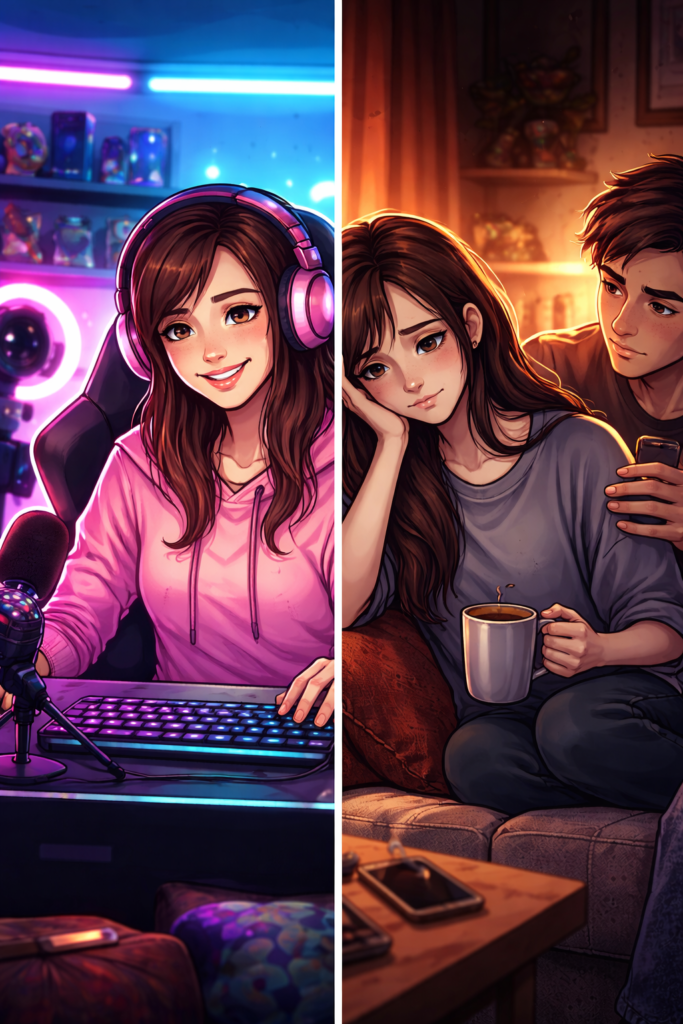
In public discourse, streamers’ personal lives are often described in simplified extremes. The most common narratives are either a person fully absorbed in streaming with no real relationships, or a carefully curated image of a “happy life on display,” where career and intimacy supposedly coexist without conflict. Neither scenario reflects reality.
Streaming does not automatically destroy personal relationships. Instead, it reshapes their structure, redistributes attention, and creates new points of tension that are not always immediately visible — especially to the streamer themselves.
Myth: If a streamer is at home, they are available
Working from home creates an illusion of presence. Physical proximity, however, does not equal emotional availability. Even off-stream, streamers often remain in work mode: analyzing metrics, replaying chat interactions, thinking about formats, or preparing for the next broadcast.
For a partner, this can feel like a lack of connection despite shared space. The person is physically present, but their attention is directed elsewhere. Over time, home stops functioning as a place of recovery and begins to feel like an extension of the studio. If this dynamic is not discussed openly, tension accumulates quickly.
Reality: Streaming consumes attention, not time
The primary resource streaming takes from personal life is not hours, but attention. Even a short broadcast can leave a strong emotional residue: excitement, irritation, anxiety, or emotional exhaustion.
The problem is that close partners often cannot see the source of these states. From their perspective, work has already ended. From the streamer’s perspective, it is still ongoing internally. This creates a sense of unexplained distance and triggers conflicts that are not directly tied to how much time is spent together.
Myth: Public visibility strengthens relationships
It is sometimes assumed that appearing together on stream or openly supporting a partner strengthens the bond. In practice, public visibility almost always introduces a third party — the audience.
Comments, expectations, interpretations, and comparisons begin to influence relationship dynamics. Even without overt negativity, this creates pressure: a partner stops being just a partner and becomes part of a public persona. This format is not suitable for everyone and requires high emotional resilience from both sides.
Reality: Boundaries must be built consciously
In streaming, personal boundaries do not form automatically. What can be discussed, what can be shown, and where the line between persona and private life lies all require deliberate decisions.
Problems arise when boundaries are not defined early. Audiences quickly internalize the level of access they are given and begin to expect it to remain constant. Revising these expectations later is difficult and often emotionally painful.
Streamers with more stable personal lives tend to minimize the use of relationships as content. This is not emotional distance or secrecy, but a strategy for protecting private space.
Myth: Loneliness is the inevitable cost of the profession
Streaming does not necessarily lead to loneliness, but it does reduce the number of compatible life scenarios. Not everyone is ready to share life with a profession where attention is unevenly distributed and public visibility is built into daily routines.
This is not about loss, but about filtration. There may be fewer relationships, but those that remain are more often based on a realistic understanding of lifestyle and professional constraints.
Reality: An audience cannot replace intimacy
One of the most dangerous distortions is attempting to compensate for a lack of personal closeness through streaming. Audience support does provide a sense of connection and validation, but it remains one-sided.
Viewers do not share responsibility, daily life, or emotional recovery. When a streamer begins to rely emotionally only on the audience, personal relationships weaken. In the long term, this almost always leads to emotional burnout.
Myth: A partner just needs to “accept streaming”
The phrase “just accept that this is my job” sounds reasonable, but rarely works. Streaming affects daily schedules, emotional states, public identity, and reputation. Acceptance without discussion means agreeing to undefined conditions.
Healthy relationships in this context are built not on silent acceptance, but on negotiation: about time, boundaries, levels of involvement, and what remains off-camera.
Conclusion
A streamer’s personal life is possible, but it does not form by default. It requires a higher level of awareness than traditional forms of employment.
Problems arise not because of streaming itself, but because of attempts to fit it into old expectations without changing the rules. Streamers benefit from regularly asking themselves what part of their identity is given to the stream — and what remains outside it.
Because a broadcast can be turned off. The consequences of blurred roles cannot.