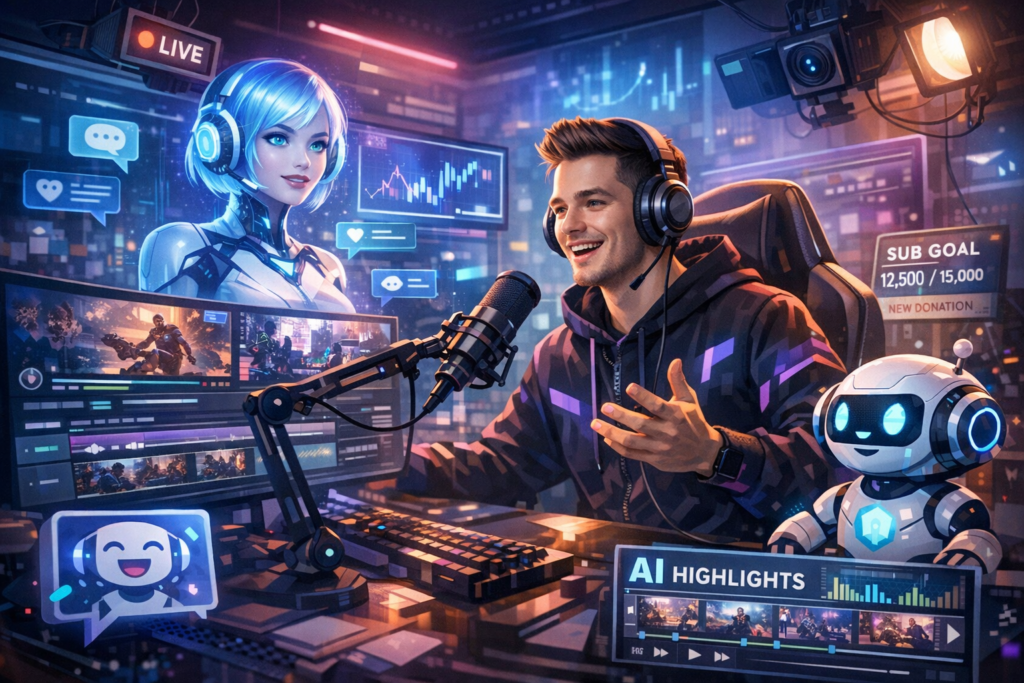
Just a few years ago, artificial intelligence in streaming seemed experimental and niche. By 2026, the situation has changed dramatically. AI has become a practical tool for streamers, as familiar as OBS or chat bots. It is now used not only by large channels, but also by beginner creators who want to grow faster and compete in an oversaturated media space.
Search queries such as “streamers and artificial intelligence,” “AI for streaming,” and “how streamers use neural networks” continue to grow steadily because the topic is no longer abstract. Today, AI directly affects income, content formats, audience engagement, and even how much time a streamer spends working outside live broadcasts.
Why Streamers Started Using AI at Scale
The main reason is time efficiency. In 2026, streaming for most creators is not limited to live broadcasts. It also includes clips, social media, channel branding, analytics, and communication with partners. Without automation, the workload quickly becomes overwhelming.
Artificial intelligence allows streamers to reduce routine tasks. It takes over processes that previously required hours of manual work, such as highlight editing, performance analysis, description generation, and chat management. This does not make streamers “lazy”; instead, it frees up time for creativity and direct interaction with the audience.
AI has also become a competitive tool. When thousands of channels on Twitch and YouTube fight for attention, those who adapt faster to algorithms and viewer behavior gain a clear advantage.
How Streamers Use AI Behind the Scenes
Most AI usage happens outside live broadcasts. This is where artificial intelligence delivers the greatest impact, even though viewers often don’t notice it.
In 2026, many streamers use AI to analyze their streams: which moments hold attention, where viewers leave, and which topics generate chat activity. Neural networks help creators move beyond raw numbers and actually understand audience behavior.
AI is also widely used for content preparation. Stream titles, descriptions, tags, and publishing schedules are increasingly optimized with algorithms. As a result, even small channels can look professional and reach recommendations.
It is important to note that successful streamers use AI as an assistant, not a replacement for human thinking. Final decisions are still made by the creator.
Artificial Intelligence Live on Stream
If AI was once associated only with background tasks, in 2026 it is increasingly visible directly on stream. The most common example is intelligent chat bots. They don’t just moderate chat, but also maintain dialogue, react to donations, make jokes, and ask viewers questions.
This reduces streamer workload and increases engagement. The chat remains active even with low viewer counts, which is especially important for beginner channels.
AI as Part of Channel Identity
Some creators go further and make artificial intelligence part of their channel identity. Virtual characters, voice assistants, and interactive reactions are becoming elements of the show, especially in entertainment-focused formats.
Which Streamers Are Already Actively Using AI
The first to adopt AI were streamers for whom streaming became a full-scale business. This applies to both Western creators and streamers from the CIS region. They quickly realized that artificial intelligence is not a trendy gimmick, but a tool for improving efficiency.
At the same time, neural networks are widely used by small channels. Where there are no editors or managers, AI partially fills these roles and helps compete with larger creators.
Concerns and Limitations of AI Usage
Despite growing popularity, attitudes toward AI in streaming remain mixed. Some viewers fear content becoming impersonal. When automation is overused, the sense of live interaction can decrease.
There are also technical limitations. Artificial intelligence still struggles with humor, irony, and local memes. Chat bot mistakes can frustrate audiences if the streamer does not actively supervise the process.
Artificial Intelligence as a Competitor or an Ally
One of the biggest fears is that AI will replace streamers. In practice, the opposite is happening. Artificial intelligence does not create charisma, feel audience mood, or build long-term trust.
AI amplifies strong streamers and does not save weak ones. It helps scale growth but does not replace personality. That is why successful creators use neural networks selectively.
The Future of Streaming and AI
By 2026, one thing is clear: artificial intelligence is here to stay in streaming. It will become more deeply integrated into analytics, content personalization, and audience interaction.
However, the core value of streaming remains unchanged. Viewers come for emotions, reactions, and the feeling of live presence. AI can enhance this experience, but it cannot replace it.
That is why the key question today is not whether streamers use artificial intelligence, but how effectively they balance technology with the human factor.