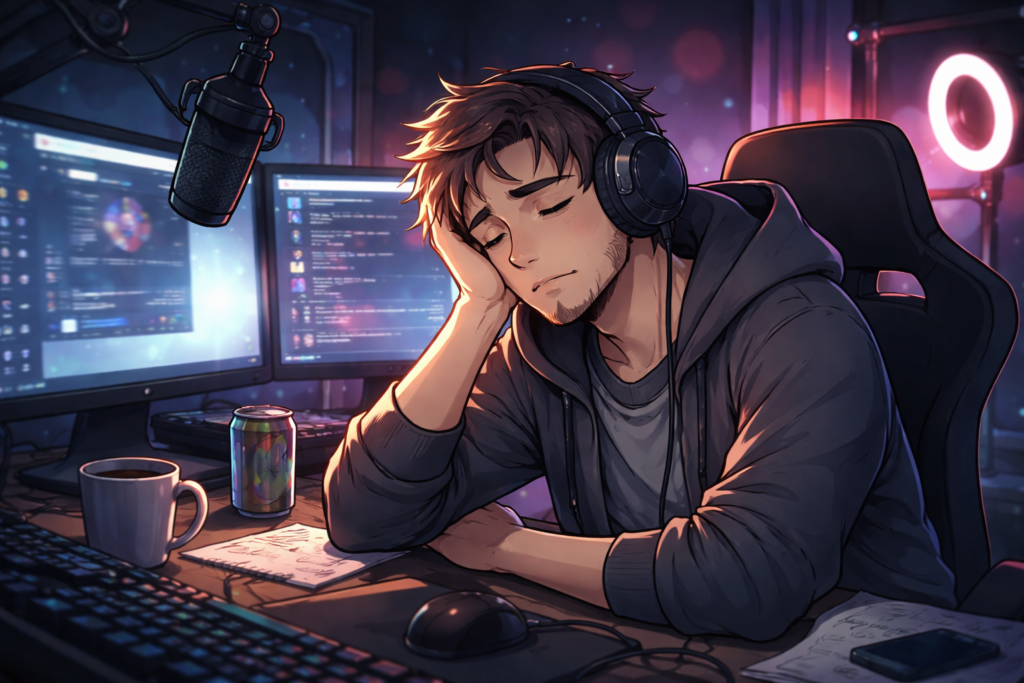
Streamer burnout rarely starts with fatigue. More often, it begins with irritation. With the feeling that streams have become longer, chat more demanding, and the joy of pressing the “go live” button has disappeared. At this point, many make the same mistake — they try to treat burnout with rest, without understanding what exactly caused it.
In streaming, burnout is almost never just about the number of hours. It is about constant internal tension that has no release for a long time.
Streamers Burn Out Not From Streaming, but From Constant Availability
The core feature of streaming is the sense of continuity. Even off-stream, a streamer remains “available”: social media, private messages, audience expectations, thoughts about the next broadcast. The boundary between work and life blurs faster here than in almost any other media format.
The brain never receives a clear signal that the work is finished. Without that signal, recovery does not happen. A person may rest physically, but psychologically still remain on stream. That is why even a week-long vacation often doesn’t help — streaming stays inside.
The Pressure of Consistency Is Stronger Than the Pressure of Growth
Paradoxically, many streamers burn out not during rapid growth, but when growth slows down. The schedule is already set, the audience is waiting, and the stream has become part of viewers’ daily lives. The streamer starts to feel trapped by their own schedule.
Missing even one stream triggers guilt: “I let people down,” “I’m losing momentum,” “the algorithms will punish me.” At this point, streaming stops being a choice and becomes an obligation. And any activity stripped of choice eventually becomes exhausting.
The Emotional Labor No One Accounts For
A streamer constantly regulates their internal state. Even when they are “just being themselves,” they are still on stage. They soften bad moods, amplify good ones, manage reactions to chat, and filter their words. This is invisible but extremely energy-consuming work.
The problem is that this labor has no clear shape. It is hard to measure and hard to explain — even to oneself. As a result, streamers often devalue their own exhaustion: “I’m just sitting and talking.” But the nervous system doesn’t see it that way.
When a Hobby Stops Being a Place of Recovery
In the early stages, streaming often serves a therapeutic function. It provides support, structure, and a sense of meaning. Over time, however, a shift occurs: the stream becomes a source of tension rather than relief.
This creates a trap. What once helped relieve stress now produces it. And the streamer may have no alternative recovery mechanisms left — all free time is consumed by the same context.
Why “Just Take a Break” Almost Never Works
A pause without restructuring is a delay, not a solution. If a streamer returns to the same mode, with the same expectations and the same internal “I must” mindset, burnout comes back faster.
Real solutions begin not with rest, but with redefining roles. A streamer needs to honestly answer: where am I working, where am I communicating, where am I present, and where am I actually living? As long as everything is blended into one continuous flow, recovery is impossible.
Real Solutions, Not Universal Advice
The first thing that truly reduces burnout risk is limiting availability. Not limiting the audience, but limiting oneself within the constant context. Clear periods of “I am not a streamer” matter more than weekends without streams.
The second is changing the type of load. It’s not always necessary to stream less. Sometimes it helps to stream differently: a new format, a different pace, fewer expectations placed on oneself. Burnout is often caused not by volume, but by emotional monotony.
The third is regaining control. Even small, conscious decisions — adjusting a schedule, dropping certain formats, reducing chat interaction — restore a sense of authorship. And it is the loss of authorship that most often burns people out.
The Viewer Is Not Always the Enemy, but They Are Not a Therapist
It’s important to say this honestly: the audience is rarely directly responsible for burnout. But it also cannot be a source of recovery. Viewers come for a state, not to take care of the streamer. Expecting otherwise only deepens the internal conflict.
Healthy streaming begins where the streamer stops looking for emotional support on stream and starts finding it outside of it.
Burnout Is Not Weakness or Failure
By 2026, streamer burnout has become almost the norm, because the format itself has grown harsher. More competition, higher pace, less room for mistakes. This is not an individual issue, but a systemic one.
Perhaps the most important shift happening now is the rejection of the idea of “enduring.” More streamers are rebuilding the format around themselves instead of reshaping themselves for the format. Some stream less often, some shorter, some differently. And that is where a second wind most often appears.
Burnout does not mean that streaming “isn’t for you.” More often, it means that your current way of streaming has stopped being sustainable. And the solution is not returning to who you were, but allowing yourself to change.