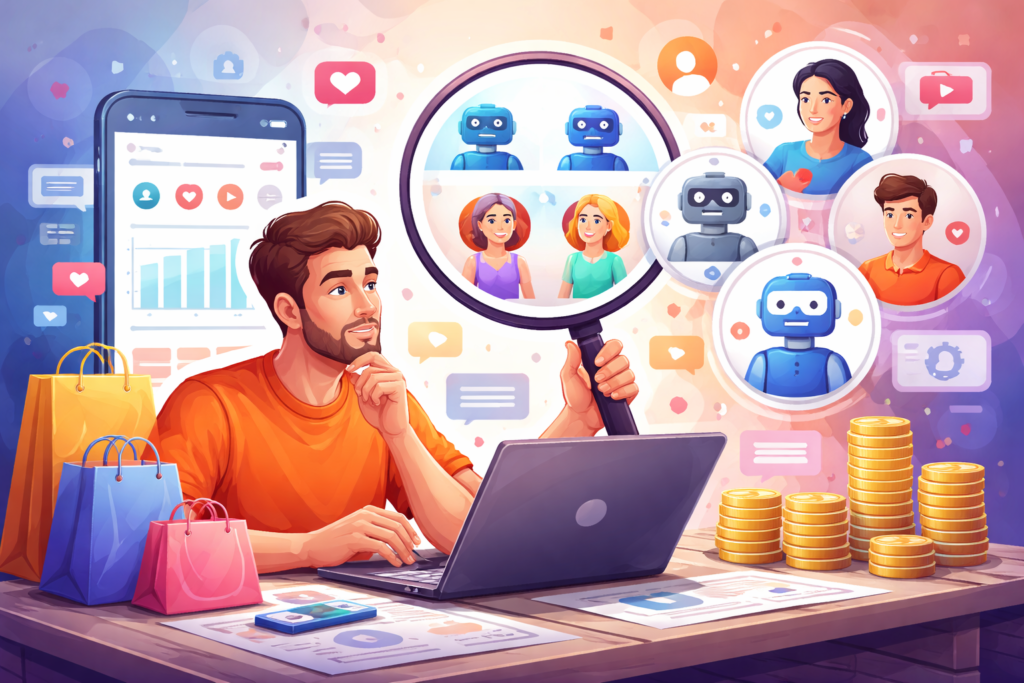
In the morning, an online store owner checks their analytics. Followers are up by five thousand. By evening—almost zero orders from social media. The comments are quiet. The Stories are watched by the same people. The feed feels like it’s shouting into a void.
The number grows. The business doesn’t.
At that point, the question “real people or bots?” stops being philosophical. It becomes financial.
People often oversimplify followers: real is good, bots are bad. But the market has been more complex for a while. Platforms have learned to read behavior deeper than likes. Algorithms evaluate not only activity, but its quality. And sometimes a thousand “real” followers can be less useful than a hundred truly engaged ones.
Let’s break it down without slogans or morality—through mechanics.
A Number That Guarantees Nothing
On any social platform—whether VK, Telegram, or Instagram—a follower is no longer just a number on a profile. It’s a behavioral object.
The algorithm evaluates:
- how quickly someone opens your post after it’s published;
- how many seconds they stay on the screen;
- whether they visit your profile;
- whether they click your link;
- whether they come back the next day.
If an account is “following” but never interacts, it becomes statistical noise. From the platform’s perspective, it’s a cold signal. And if most signals are cold, reach starts to shrink.
Bots aren’t just “empty” accounts. They are a negative distribution factor for your content.
How the Algorithm Sees Your Audience
Imagine two situations.
Scenario one. You have 50,000 followers. 35% are inflated. Of the remaining 65%, only 3–4% react actively. A post gets 200 likes and 5 comments. Site clicks: 12.
Scenario two. You have 7,000 followers. Almost all are organic. 12–15% react to a post. It collects 600 likes, dozens of comments. Clicks: 90.
In the first case, the number looks impressive. In the second, the economics work.
Every modern platform algorithm—including YouTube and TikTok—analyzes not audience size, but response rate. What matters is not scale, but reaction density.
If engagement rate drops, the system concludes the content isn’t interesting. It starts showing it less often even to real people.
The paradox is that bots “punish” you twice:
- They don’t buy.
- They reduce the chance that the people who could buy will see your content.
Why Businesses Still Buy Bots
The answer is usually not marketing—it’s psychology.
- A big number creates a sense of weight.
- A large follower counter affects how partners perceive you.
- Advertisers look at reach and scale.
There’s also an internal motive: it’s easier for a business owner to explain stagnation as “low demand” than to admit the audience is artificial.
But in 2026, follower boosting works differently than it did five years ago. Platforms can identify fake behavior via dozens of indirect signals: scroll speed, no interaction history, template activity patterns.
Algorithms consider not only likes, but watch depth, return frequency, and time clusters. Bots don’t simulate this realistically.
Real Doesn’t Always Mean Useful
There’s another extreme—“real followers” who simply stay silent.
Someone subscribed a year ago during a giveaway. Now they don’t read posts. Don’t watch Stories. Don’t remember why they followed.
Formally, they’re real. In practice, they’re passive.
The problem isn’t whether a follower is human or a bot. The problem is whether they participate in the economics of your content.
For the algorithm, what matters is:
- regular interaction,
- diverse reactions,
- saves,
- shares/forwards.
This is especially visible on Telegram, where reading depth and forwards play a key role in how posts spread.
A “dead” real audience also drags down average engagement rate.
The Economics of a Follower
Let’s translate the question into money.
Assume:
- average order value: 4,000 ₽,
- conversion from follower to purchase: 1%,
- active audience: 2,000 people.
That’s 20 purchases. 80,000 ₽ in revenue.
If activity drops by half, revenue drops with it.
If half your followers are bots, real reach can be another 30–40% lower.
The price of a “pretty number” becomes tangible.
A real follower is valuable not because they exist, but because of their LTV potential—repeat purchases, recommendations, organic distribution.
A bot creates no secondary effect. It doesn’t discuss your brand in DMs. Doesn’t send a link to a friend. Doesn’t leave a review.
What Happens to Ads With a Bot-Heavy Audience
When a business runs targeted ads on VK or Instagram, the platform analyzes existing follower behavior to build a similar audience.
If your base is distorted by bots, the algorithm builds a look-alike model from bad data.
Ads start showing to users with low conversion probability. Acquisition costs rise. CPA increases. The entrepreneur concludes: “targeting doesn’t work.”
It works. The input data was just corrupted.
How to Tell Growth Illusion From Real Growth
There are a few signs people don’t notice right away.
Followers grow, but:
- reach doesn’t increase proportionally;
- comments are repetitive or absent;
- Stories are consistently watched by the same 5–10% of the audience;
- site traffic doesn’t correlate with profile size.
If follower growth isn’t reflected in behavior, it’s not growth—it’s cosmetic.
When Bots Are Used Intentionally
There’s a scenario people rarely discuss openly.
Boosting can be used as “social proof” at the start of a project—to avoid looking like an empty profile. This is short distance. A temporary tool.
But if no engagement strategy follows, over time the bot mass starts to block organic growth.
Platforms evaluate account history. If a profile shows low reaction relative to its base for a long time, it’s harder to break into recommendations.
Real Followers Are Also a Strategy
A live audience doesn’t appear by accident.
It’s the result of:
- clear positioning,
- consistent content,
- matching expectations to reality,
- understanding each platform’s behavioral logic.
For example, on YouTube, watch time and retention in the first 30 seconds matter. On TikTok—completion rates and rewatches. On Telegram—forwards and return visits to the channel.
If content doesn’t account for these mechanics, even real followers gradually become passive.
So What’s Better?
The question is slightly misframed.
Not “real or bots.”
But “active or inert.”
Bots are guaranteed inertia.
Real followers are the potential for activity.
The market is shifting from a race for vanity metrics to a race for interaction quality. Algorithms already made that shift. Businesses are catching up.
A follower today isn’t a counter on a profile. It’s a unit of probability. Probability of viewing. Clicking. Buying. Coming back.
When the number becomes the goal, the economics start to crack.
When focus shifts to behavior, both the number and revenue grow.
You can keep growing mass.
Or you can start working on reaction density.
The difference between these strategies usually becomes visible not immediately, but after a few months—when one account fights for reach, and another gets it almost automatically.
And at that point, the question “which followers are better” stops being theoretical.