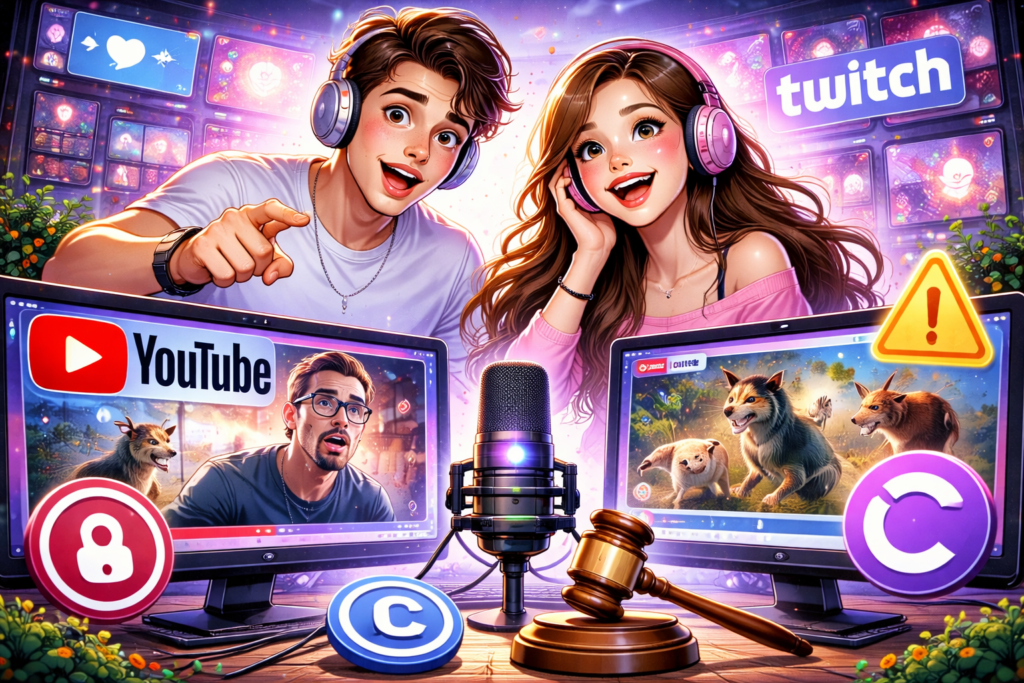
The reaction format has long stopped being niche entertainment. In 2026, reactions on YouTube and Twitch are one of the most popular types of content used by bloggers, streamers, and media personalities. Reactions to videos, clips, podcasts, shows, and even news content generate millions of views. But along with growing popularity, an important question arises more often: are reactions legal in 2026, and where does creativity end and copyright violation begin?
To understand this, it is important to look not only at platform rules, but also at the general logic of copyright law.
Why Reactions Became So Popular on YouTube and Twitch
The reason for the popularity of reactions is simple: people are interested not only in the video itself, but also in someone else’s reaction to it. Emotions, commentary, explanations, and personal opinions add new value to the content. In 2026, viewers increasingly choose reaction videos over the original content because they want interpretation, context, or live discussion.
For creators, reactions are also a convenient format. They do not require complex production — charisma, thinking, and the ability to explain matter much more. That is why reactions on Twitch and YouTube have become a mass phenomenon and a core part of streaming culture.
Are Reactions Legal in 2026 from a Legal Perspective?
The short answer is: it depends on how the reactions are made. In 2026, the basic principles of copyright law have not changed. Other people’s content is still protected by law, and using it without permission can lead to strikes, takedowns, or even legal claims.
However, there is the concept of fair use, which forms the legal basis for most reaction content. It is important to understand that fair use does not mean “anything is allowed.” It is an evaluation of each individual case.
Fair Use and Reactions: How It Works in Practice
In 2026, reactions are considered legal if they transform the original content rather than simply copying it. This means the streamer or creator must add their own value through commentary, analysis, criticism, humor, or educational context.
If a reaction looks like a genuine breakdown where the original video is used in fragments and serves as a basis for discussion, the risk of violations is minimal. But if a creator silently watches a video from start to finish with little to no interaction, such content can easily be classified as copyright infringement.
Reactions on YouTube in 2026: What Is Allowed and What Is Not
In 2026, YouTube has become stricter toward reaction content. Algorithms and moderation systems are increasingly effective at detecting videos that use copyrighted material without sufficient transformation.
Legal reactions on YouTube usually have the following characteristics:
- the video is not played in full without commentary;
- the creator regularly pauses the video to explain what is happening;
- personal opinion or analysis is added;
- the reaction does not replace the original content.
If a reaction effectively substitutes the original video, the channel risks receiving a strike, even if minimal commentary is technically present.
Reactions on Twitch: More Freedom, but Higher Risks
On Twitch, reactions in 2026 remain a more flexible format, but that does not mean there are no rules. Twitch usually reacts to copyright holder complaints rather than proactively moderating reaction content. This creates an illusion of safety, but the risk still exists.
Live reactions to movies, TV series, sports broadcasts, and paid content are especially risky. Even with active commentary, a copyright holder can file a claim, and the platform is required to respond.
Why Some Reactions Get Removed and Others Do Not
Many creators wonder why some reactions remain online for years while others are removed almost immediately. The reason lies in a combination of factors: copyright holder activity, video popularity, level of transformation, and presentation format.
In 2026, large media companies actively protect their content, while smaller creators may tolerate reactions as additional exposure. However, this does not make reactions automatically legal — it simply means the level of risk varies.
How to Make Reactions Legally in 2026
The main rule is that a reaction must be independent content. Viewers should come for your thoughts, not for someone else’s video. The more analysis, pauses, commentary, and explanations you add, the higher the chance that the content will be considered acceptable.
It is also important to avoid playing the original content in full and to stay away from material intended for paid viewing. In 2026, such violations are monitored especially closely.
The Future of Reactions on YouTube and Twitch
Reactions are not going anywhere. In 2026, they have become part of modern media culture. However, the format is evolving: simply “watching and nodding” is fading away. Audiences and platforms now demand meaningful content.
Creators who know how to analyze, explain, and add value will continue to thrive. Others will either need to change their approach or face removals and restrictions.