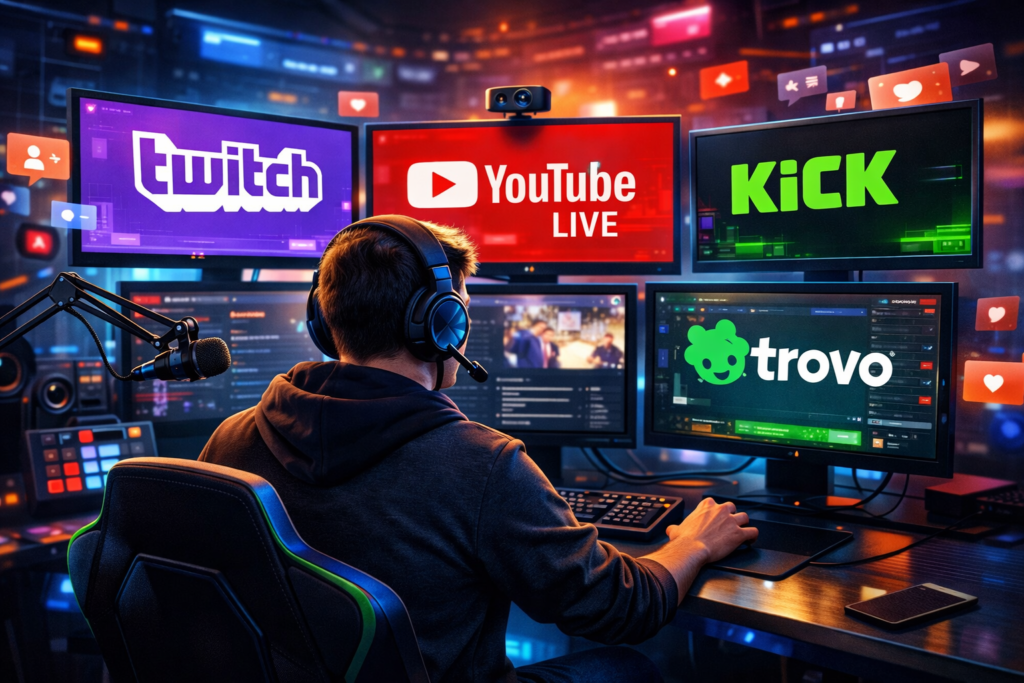
The Role of Multistreaming in Modern Streaming
Just a few years ago, multistreaming was seen as an experiment or a temporary solution for small channels. By 2026, the situation has changed. Multistreaming has become a full-fledged growth tool used by both beginner streamers and established creators. Going live simultaneously on multiple platforms is no longer unusual — it is now a conscious strategic choice.
However, multistreaming is not a universal solution or a “magic button” for fast growth. It has clear advantages, but also serious limitations. To understand whether multistreaming is right for a specific streamer, it’s important to look at its pros and cons realistically, without oversimplification.
What Multistreaming Means in Simple Terms
Multistreaming is the simultaneous broadcast of a single live stream to multiple platforms at the same time. Most often, this includes combinations of Twitch, YouTube Live, Kick, Trovo, or Facebook Gaming. The streamer runs one stream, while audiences watch it on different platforms.
At first glance, the idea seems obvious: more platforms mean more viewers. In practice, multistreaming is more complex. It affects not only reach, but also algorithms, chat interaction, monetization, and even the streamer’s mental workload.
Why Multistreaming Became Popular in 2026
The rise of multistreaming is closely tied to changes in the streaming market. Algorithms on major platforms now provide less organic exposure for new channels. Growing on a single platform has become increasingly difficult. In this context, multistreaming is seen as a way to reduce dependency on one ecosystem.
At the same time, audiences are no longer loyal to just one platform. Some viewers prefer Twitch, others YouTube, while some actively choose Kick. Multistreaming allows streamers to be present where the audience already is, instead of forcing viewers to change habits.
The Advantages of Multistreaming for Streamers
The main benefit of multistreaming is expanded reach. Streamers can test multiple platforms at once and quickly identify where their content performs best. In some cases, a format that struggles on Twitch may perform significantly better on YouTube or Kick.
Another major advantage is risk reduction. If one platform changes its algorithms, policies, or loses popularity, the streamer does not lose their entire audience. Multistreaming creates a safety net and provides a sense of stability.
It also accelerates data collection. Streamers gain faster insights into viewer retention, chat activity, and audience behavior across platforms, allowing decisions to be based on real data rather than assumptions.
The Hidden Downsides of Multistreaming
The biggest drawback of multistreaming is divided attention. A streamer cannot fully engage with multiple chats at the same time. As a result, interaction often becomes less personal, and viewers may feel less connected.
From an algorithmic perspective, multistreaming can also be problematic. Viewership is split across platforms, meaning instead of one stream with higher concurrent viewers, there are several smaller streams. This can reduce visibility within platform rankings.
Branding can also suffer. Viewers may struggle to understand which platform is the streamer’s main “home,” slowing the formation of a loyal community.
How Multistreaming Affects Channel Growth
Multistreaming rarely creates rapid growth on its own. It amplifies an existing format rather than fixing weak content. If a streamer fails to retain viewers on a single platform, multistreaming will only scale that weakness.
In 2026, many streamers use multistreaming as a temporary phase. They test multiple platforms simultaneously, analyze performance, and then focus on one or two platforms where results are strongest.
Multistreaming and Monetization
From a monetization perspective, multistreaming offers both opportunities and limitations. On the one hand, donations and subscriptions can come from multiple platforms. On the other hand, some partner programs restrict or prohibit simultaneous streaming.
Additionally, viewers tend to donate more where interaction feels personal. When attention is split, total revenue can sometimes be lower than with a focused single-platform approach.
Who Multistreaming Is Best Suited For
Multistreaming works best for streamers who already have basic experience, understand their content format, and know how to manage audience interaction. In these cases, it becomes a powerful analytical and growth tool rather than a source of chaos.
When Multistreaming Is a Bad Idea
Multistreaming is often ineffective for complete beginners, streamers who rely heavily on close chat interaction, or those unwilling to analyze performance data. In such cases, it can slow growth and increase burnout.
Is Multistreaming Worth It in 2026
In 2026, multistreaming is not a mandatory step — it is a tool. It reduces platform dependency and helps streamers find their audience faster, but it requires strategy, discipline, and clear goals.
Ultimately, multistreaming strengthens not algorithms or reach, but the streamer’s overall strategy. And it is the strategy that determines whether multistreaming becomes a growth driver or a source of problems.