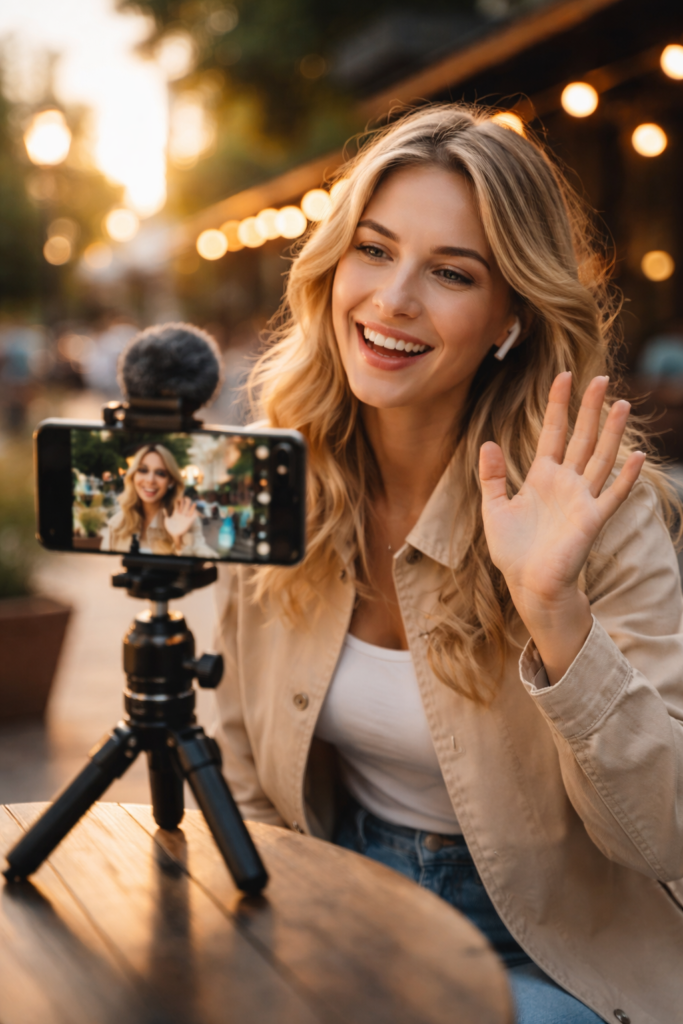
Most mobile streams look the same. A phone held in the hand, shaky video, delayed reactions to chat messages, and the feeling that viewers just dropped in to “peek” rather than intentionally watch a stream. The problem isn’t the device. The problem is that phones are treated as a temporary substitute for a “real” stream instead of a standalone format with its own logic.
A professional mobile stream doesn’t start with apps or settings. It starts with understanding one thing: viewers already know you’re streaming from a phone, and they’re ready to adapt to that. The real question is whether you adapt with them.
Your Phone Is Not a Camera — It’s a Point of Presence
When a streamer turns on a computer, it feels like sitting down to work. When they turn on a phone, it feels like stepping into an environment. That’s why mobile streams are perceived as more personal, more alive, and less about “content.” And that’s not a drawback — it’s the main advantage.
Problems begin when streamers behave as if they’re still sitting at a desk: long pauses, static framing, monotone speech. In this mode, a phone stream becomes irritating. Viewers sense a mismatch — a mobile format with studio behavior.
A professional approach means embracing movement. Even if you’re sitting still, a phone stream should feel potentially dynamic. Slight changes in angle, posture, or framing aren’t noise — they’re signals of presence.
Image Quality Matters Less Than Stability
A common mistake is chasing maximum video quality. People buy extra lenses, enable 4K, push their phones to the limit — and end up with freezes, overheating, or app crashes.
For viewers, professionalism in mobile streaming isn’t about ultra-sharp details. It’s about the absence of problems. If the video is stable, the audio doesn’t drop, and the stream doesn’t crash, it already feels high-quality. Everything else is secondary.
In practice, moderate resolution, stable internet, and enough battery life create a sense of a “held together” stream. And viewers value that cohesion far more than visual perfection.
Audio Is the One Thing You Can’t Fix Later
Viewers can forgive average lighting. They can adapt to vertical video. They might even tolerate shaky footage. But they won’t tolerate bad audio — and this is what mobile streams ignore most often.
A phone’s built-in microphone works well only in ideal conditions: silence, close distance, no echo. Any deviation turns speech into background noise. A professional mobile stream almost always uses an external microphone, even a basic one.
Interestingly, viewers rarely realize why they feel comfortable. They simply stay longer. And when the sound is bad, they leave — without being able to explain why.
A Camera Below Eye Level Instantly Feels Amateur
There’s a small detail that immediately signals an unprofessional stream: a camera pointing upward from below. This angle breaks trust. Faces distort, eye contact weakens, and the streamer appears insecure — even when speaking confidently.
Professional mobile streams usually solve this very simply: the phone is positioned at eye level or slightly above. You don’t need a tripod — just a stable surface. What matters isn’t the gear, but the feeling that the frame was chosen, not accidental.
Viewers are extremely sensitive to these details, even if they can’t articulate them consciously.
Reading Chat Is a Skill, Not a Background Action
On mobile streams, chat is often either ignored or becomes a source of chaos. The streamer gets distracted, loses their train of thought, and the stream falls apart.
A professional approach is to integrate chat into the rhythm instead of reacting to every message. For viewers, it’s more important to feel that their messages can become part of the conversation than to receive instant replies.
Many strong mobile streams follow the same pattern: the streamer speaks in blocks, then pauses and deliberately dives into the chat. This creates structure without feeling scripted.
Phones Require Short Meaningful Segments
Even if a stream lasts an hour, it should be built from short logical segments. Mobile viewers are easily distracted by notifications, surroundings, and movement. If a thought stretches too long, it gets lost.
Professionalism here means being able to rephrase and refocus. Not repeating the same idea, but reconstructing it for new viewers joining mid-stream. It’s difficult — and it’s exactly what separates experienced streamers from people who are “just live.”
External Simplicity Doesn’t Mean Internal Randomness
A good mobile stream always looks simpler than a studio setup. But behind that simplicity is preparation: understanding the topic, having a loose conversational route, and knowing where improvisation is safe — and where it isn’t.
The viewer shouldn’t see the plan. They should feel that the stream holds together. And that feeling comes not from equipment, but from the streamer’s clarity about why they pressed “go live” in the first place.
In the end, professional mobile streaming isn’t a compromise or a temporary solution. It’s a standalone format where the winner isn’t the one with the most expensive gear, but the one who understands viewer behavior and environmental limits. The phone doesn’t get in the way — it sets the rules. And accepting those rules is what makes a stream truly professional.