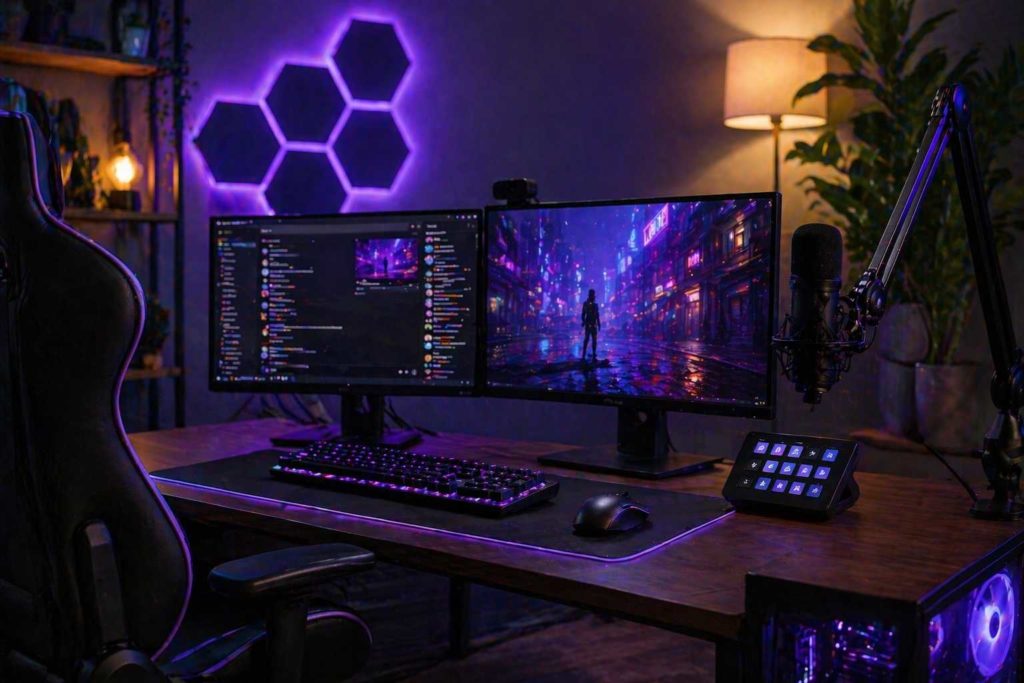
Professionalism on Twitch is often confused with visual polish. It seems like you need expensive equipment, complex design, perfect lighting, and high-end graphics to make your channel look “like the big streamers.” As a result, streamers either delay progress because they’re “not ready yet,” or invest in details that barely affect how the channel is perceived.
But viewers don’t evaluate your channel as a production. They don’t compare budgets, analyze equipment, or try to guess how much your overlay cost. Their perception is much simpler: is it clear what’s happening, does everything work consistently, and can they stay without feeling chaos?
A professional channel is not one that looks expensive. It’s one that behaves predictably.
Why Professionalism Is a Feeling, Not a Set of Elements
When a viewer joins a stream, they form an impression within seconds. Not through details, but through feeling. Is there a voice, is there movement, is it clear what’s going on, is there structure?
If the stream feels cohesive, even without perfect visuals, it is perceived as “solid.” But if there are delays, pauses, abrupt transitions, or strange decisions, even expensive visuals won’t save it.
Professionalism is the absence of friction. Nothing interferes with the viewing experience.
Stability Matters More Than Quality
One of the most common mistakes is chasing maximum settings: 1080p, high bitrate, complex scenes. In reality, this often leads to instability: frame drops, lag, delays.
Viewers forgive average quality, but they don’t forgive instability — because it disrupts the experience.
A professional channel is one that performs consistently every stream. No surprises.
It’s better to be slightly simpler but stable than perfect on paper and unstable in reality.
Clear Stream Structure as a Foundation
A stream shouldn’t feel like a random flow. Even if it’s live and flexible, it needs internal logic.
A viewer can join at any moment and should quickly understand what’s happening — not through explanation, but through observation.
If a stream starts with waiting, silence, or “warming up,” it feels unprepared. And people leave before the “main part” begins.
Professionalism means every moment of your stream feels complete.
Why Audio Matters More Than Video
One of the most underrated aspects is audio. Many focus on visuals, forgetting that sound creates the main sense of presence.
A плохой microphone can be compensated. Poor audio delivery cannot.
If your voice is quiet, unclear, noisy, or inconsistent, viewers get tired faster than they would from average visuals.
A professional stream is one where the voice is clear, stable, and effortless to listen to.
Design as Part of Professional Perception
Design doesn’t make a channel professional by itself, but it strengthens that perception. When thumbnails, banners, and panels are consistent, the channel feels cohesive.
If the design is chaotic, disconnected, or overloaded, it creates the impression that the stream is the same.
It’s not about “looking beautiful,” but about clarity. Minimal clutter, maximum readability.
Streamer Behavior as the Key Factor
No design can compensate for behavior. If a streamer gets lost, stays silent too long, doesn’t react, or creates unnecessary pauses, it breaks the sense of professionalism immediately.
A professional stream is not about perfect speech. It’s about avoiding “dead moments.”
Even with few viewers, the stream should feel alive. No waiting, no “there’s no one here, I can be silent.”
The viewer never sees a “beginning.” For them, it’s always the middle.
Why Overloading Looks Unprofessional
There’s a temptation to add everything at once: animations, alerts, effects, transitions. It seems like it makes the stream “richer.”
But overload creates the opposite effect. Too many elements distract, interfere with perception, and create chaos.
A professional stream is clean. Nothing gets in the way of watching.
Consistency as the Core Factor
Professionalism isn’t built in a single stream. It’s formed through repetition.
Consistent behavior, consistent quality, consistent rhythm. When viewers know what to expect.
If every stream differs in quality and delivery, it destroys trust.
Stability creates a sense of control — and that is the foundation of professionalism.
Why “Expensive” Doesn’t Mean “Professional”
You can invest in equipment, design, and graphics — and still look unprofessional. Because the issue is not resources, but system.
If there is no structure, no stability, no clarity — no investment will fix it.
And наоборот: even a simple channel can feel professional if it is structured, predictable, and clear.
Professionalism as a Result, Not a Goal
You can’t “make a channel professional” with a single action. It’s not a checklist you can complete.
It’s the result of many small decisions: simplify, stabilize, remove unnecessary elements, increase clarity.
When a stream becomes easy to watch, without friction, it starts to feel professional.
And that — not visual appearance — determines whether a viewer stays or leaves.