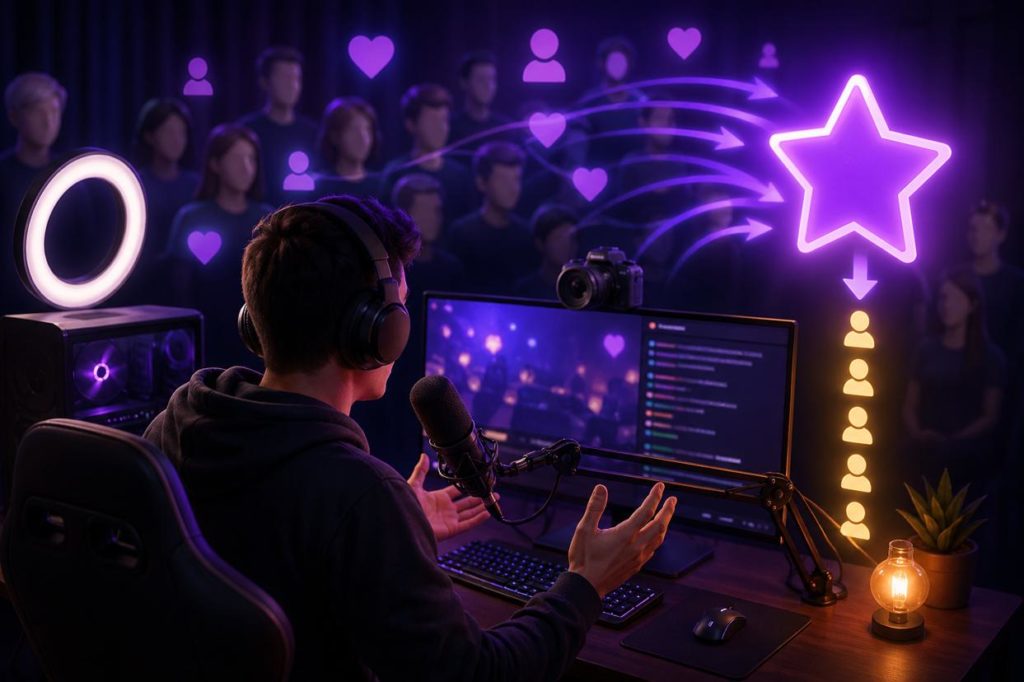
Twitch subscriptions are often seen as the main source of income, yet they are also the one that most often “doesn’t work,” even on channels with steady viewership. This creates a paradox: there are viewers, the chat is sometimes active, the stream is consistent — but subscriptions remain low. It may seem like the audience is “wrong,” “not willing to pay,” or simply “not interested in supporting.” In reality, the issue is rarely the viewers themselves, but how the stream is structured and what conditions it creates for decision-making.
A subscription is not a reaction to a stream itself. It is a reaction to a repeatable experience. If a stream does not create that experience, the “Subscribe” button becomes just another interface element that viewers ignore. Revenue on Twitch is not tied to how many people are watching — it depends on whether those people turn into consistent behavior.
Why Subscriptions Don’t Happen Automatically
Viewers come to Twitch in observation mode. They owe nothing to the streamer, they are not looking for ways to spend money, and they have no obligation to support the channel. Their goal is simple: quickly decide whether to stay. If a stream feels like a one-time experience, even if it’s good, it doesn’t create the desire to pay. The viewer’s logic is straightforward: if I can just watch, why should I subscribe?
Subscriptions only appear when there is a sense of continuation. When the stream stops feeling like a single event and starts becoming a place worth returning to. This has little to do with visual quality or even content in the traditional sense. It’s about predictability and the feeling of “I know what I’ll get here.”
Without that feeling, the viewer remains a consumer. They may watch for a long time but never move to the next stage.
The Difference Between a Viewer and a Participant
The key distinction that directly impacts subscriptions is the viewer’s role within the stream. There are passive viewers who simply watch, and active participants who feel involved in what’s happening. Subscriptions almost never come from passive viewers, even if they spend a lot of time on the stream.
A passive viewer feels no connection. They see no difference between “being here” and “not being here.” As a result, they have no internal trigger to act. It’s not that they dislike the streamer — they simply feel indifferent.
A participant is someone who engages. They chat, receive responses, and feel noticed. This creates a sense of presence. And this is where the foundation for subscriptions appears — not as “support,” but as a way to reinforce their role.
A subscription is the transition from observation to participation, expressed through action.
Why High Viewership Doesn’t Equal High Revenue
You can see channels with similar viewer counts but drastically different subscription numbers. This is not about the audience itself, but about how interaction is structured within the stream. If viewers are not engaged, they do not convert — no matter how many there are.
The mistake is treating viewer count as a universal metric. From a monetization perspective, what matters is not how many people watch, but how many feel connected. One engaged viewer can generate more revenue than ten passive ones.
That’s why subscription growth does not directly follow viewer growth — it follows engagement growth.
Format as the Foundation of a Subscription Model
Subscriptions cannot exist without structure. Not in terms of “stream type,” but in terms of repeatable patterns. If every stream feels random, with no rhythm or consistency, viewers don’t form expectations. And without expectations, there is no reason to return.
A clear format creates predictability. Viewers understand what they will get when they come back. This reduces uncertainty and increases retention. Without retention, subscriptions don’t work.
The format doesn’t have to be rigid or boring — it needs to be recognizable. Even with variation, the overall experience should feel consistent.
A subscription is essentially a bet that this experience will repeat.
Why Subscriber Perks Don’t Solve the Problem
A common approach is to add value through perks: emotes, badges, exclusive access. While logical, these only amplify existing interest. If a viewer doesn’t want to return, perks won’t create that desire.
Perks are a rational justification for a decision that is already close to being made. They help finalize it, but they don’t create motivation from scratch.
If the stream lacks a strong foundation, no additional features will change the outcome. They simply remain unused options.
Integrating Subscriptions into Stream Behavior
Subscriptions start working when they become part of the stream itself, rather than an external feature. When viewers see that subscribing is not just clicking a button, but an action that changes something.
This could be streamer reactions, shifts in dynamics, added attention, or recognition. It doesn’t require artificial mechanics — it requires visible impact.
When viewers understand that their action matters, they start to perceive it as meaningful.
This is what turns a subscription from a “payment” into participation.
Why Pressure Reduces Conversion
Direct attempts to push subscriptions often backfire. Frequent reminders, requests, or emphasis on support create pressure, especially for new viewers.
When someone has just joined and hasn’t formed a connection yet, pressure feels premature. They are not ready to decide.
A subscription should feel like a natural continuation, not an obligation. The less it is pushed, the more likely it is to happen.
Consistency as the Main Revenue Driver
Subscriptions don’t happen instantly. They are the result of accumulated interactions. A single stream rarely converts viewers, but repeated visits build familiarity.
Viewers return, recognize the format, and feel comfortable in the environment. Eventually, they decide to commit.
The goal is not to “get a subscription,” but to create conditions where viewers come back multiple times.
Revenue on Twitch is driven by repeatable behavior, not one-time actions.
How to Know It’s Working
The first sign is consistency. Subscriptions appear regularly, not randomly. The second is the absence of reminders — people subscribe on their own. The third is a shift in audience behavior: active participants begin forming a core community.
If this isn’t happening, the stream is still operating at a consumption level.
Subscriptions as a Result of a Well-Structured Stream
Trying to “earn from subscriptions” directly usually leads to weak results because it ignores the core factor — viewer behavior.
Subscriptions are not a tool, but a signal. They show that the stream has moved beyond casual viewing and become a place people return to.
When a stream is built around that principle, revenue grows naturally — not through pressure or tricks, but as a result of genuine interaction.