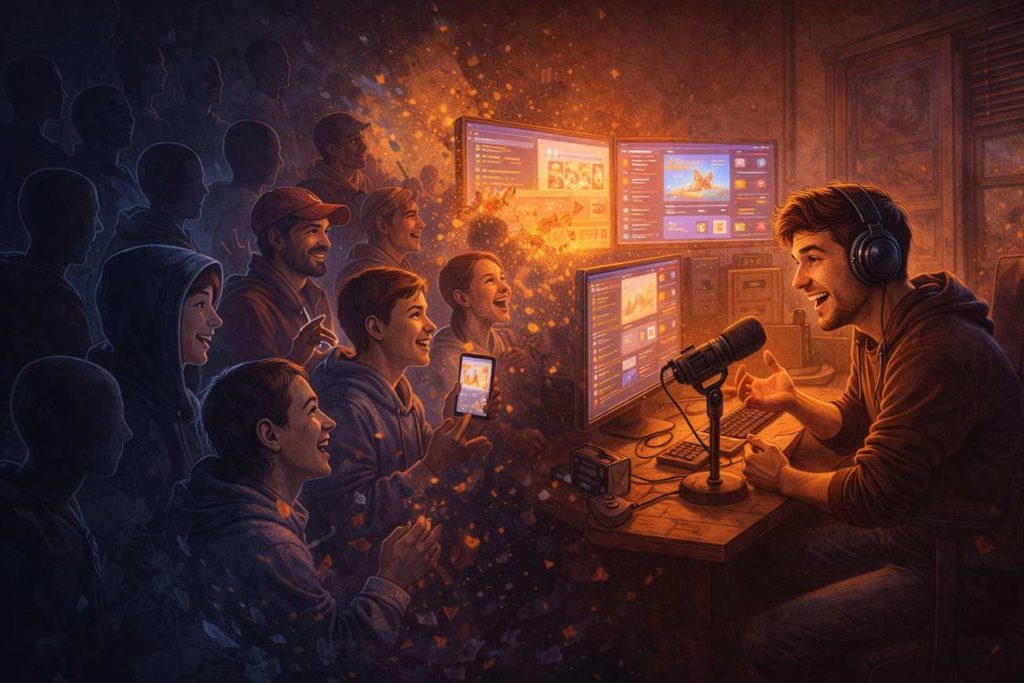
When people talk about “your audience,” it often feels like it already exists somewhere and you just need to find it. As if you only need to start streaming and the right people will come if your content is good. But in reality, an audience is not a ready-made group sitting inside the platform.
It forms around your stream.
And this is a crucial point. You don’t find an audience — you create the conditions where a specific type of viewer starts staying and coming back.
Why “Everyone” Is a Mistake at the Start
One of the most common traps is trying to make a stream “for everyone.” It seems logical: the wider the appeal, the more people can join. But on Twitch, it works the opposite way.
If a stream doesn’t have a clear identity, it doesn’t connect with anyone in particular. A viewer can’t tell if it’s for them, so they leave faster.
An audience appears where there is clarity and consistency — where someone can say, “this is for me” or “this isn’t for me.”
Without that, there is no retention.
Why Audience Is Built Through Behavior, Not Topic
Your game or category affects incoming traffic, but it doesn’t determine who stays.
Who stays depends on the streamer’s behavior: pace of speech, energy level, communication style, reactions to chat, and overall atmosphere. The same content can attract completely different audiences depending on how it is delivered.
Your audience is not “people who like the game.” It’s people who connect with your style.
And your style is what filters viewers.
Why Your First Viewers Shape the Future of Your Channel
At the beginning, your audience is unstable. People arrive randomly, from different categories, with different expectations. But this is where selection happens.
Some leave. Some stay. Some return.
Those who stay begin to form the core.
If your stream is chaotic at this stage, your audience will be random. If there is consistency, a specific type of viewer begins to stick.
And that type will attract more of the same.
Why Growth Starts with Filtering, Not Attracting
This may sound counterintuitive: growth begins not with attracting everyone, but with filtering.
If your stream tries to keep everyone, it becomes vague. But if it clearly communicates its format, some viewers will leave — and that’s normal.
The ones who stay are the ones who fit.
And they become your base.
The clearer the filter, the faster your audience forms.
Why Consistency Matters More Than “Interesting Content”
Many streamers try to constantly “impress” — new ideas, changing formats, adding features. But this often slows audience formation.
Viewers don’t have time to adapt.
An audience forms through repetition. When the stream feels consistent from one broadcast to another. When viewers know what to expect and return for that specific experience.
Interest may attract. But consistency builds return.
Why Audience Starts to “Multiply Itself”
Once even a small core audience appears, an important process begins. Viewers start influencing each other.
Someone writes in chat — movement appears. Others join in. An atmosphere forms.
New viewers enter and see a live, active space instead of an empty stream. This increases the chance they stay.
Your audience begins to amplify itself.
But this only happens after a base is formed.
Why Expectations Must Match Reality
Viewers arrive with expectations — from the category, title, or thumbnail. If the stream delivers something different, a gap appears.
This reduces retention.
That’s why everything must align: game, description, delivery, behavior. When it matches, viewers don’t need to re-evaluate — they immediately engage.
This accelerates audience formation.
Why You Shouldn’t Drastically Change Your Style
Once your audience starts forming, sudden changes can break it. People come for a specific experience. If it disappears, they stop returning.
This doesn’t mean you shouldn’t evolve. But changes must be gradual.
Otherwise, your channel resets every time.
Why Audience Is a Process, Not a Result
You can’t “find your audience” once and be done. It constantly evolves, expands, and refines.
But the core principle stays the same: an audience forms around consistent behavior and a clear format.
If that exists — it grows.
If not — it falls apart.
What It Really Means to “Find Your Audience”
It’s not about discovering ready-made viewers inside Twitch.
It’s about building a stream that:
- creates a clear and repeatable experience,
- filters viewers through style and delivery,
- retains those who connect with it,
- and gradually turns them into a returning audience.
When this happens, your audience stops being a problem to solve.
It becomes a natural extension of your stream.