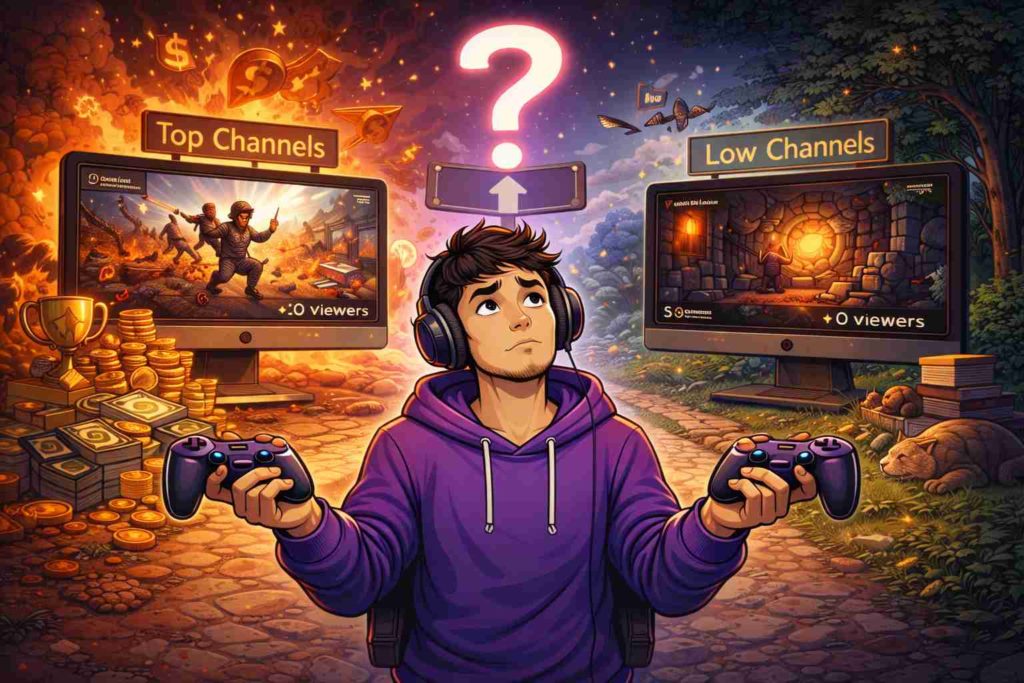
When streamers think about growth, their focus almost always shifts to content: how to speak, how to retain viewers, how to make streams more engaging. The game itself is often treated as a background element — something secondary that can be changed without consequences. It feels like if the stream is good enough, it will “carry” any category.
But in reality, the game you choose determines whether your stream has any chance of getting discovered in the first place.
Because on Twitch, viewers don’t choose a streamer first — they choose a category. Only then do they pick a channel within it.
Why the Game Is Not Content but an Entry Point
A game is not just what you play. It’s the environment where you are discovered. It defines the list of streams you appear in and the context in which viewers evaluate you. This is where the decision happens: click or scroll past.
If the game is chosen poorly, your stream can be high-quality but invisible.
In this sense, the game is not about “what to stream,” but about “where you can be seen.”
Why Popular Games Rarely Bring Viewers at the Start
The logic of “going where the audience is” seems obvious. But in highly popular categories, attention is distributed extremely unevenly. Top streamers take most of the traffic, while the bottom of the list receives almost no clicks.
If you don’t have initial viewers, you end up at the bottom — outside the visibility zone.
Even a great stream doesn’t work in this case because no one opens it.
This is one of the most common reasons new streamers struggle to grow.
Why Small Categories Don’t Automatically Solve the Problem
The opposite strategy is choosing less competitive or niche games. There are fewer streamers, it’s easier to rank higher, and your stream becomes more visible.
But this creates another problem: lack of audience traffic.
If there are no viewers in the category, even being in the top position won’t bring growth. You become visible — but to no one.
That’s why low competition alone doesn’t guarantee results.
Why Balance Between Traffic and Competition Matters
The optimal choice is not extremes, but balance. A game should have enough viewers to generate traffic, but not be overloaded with strong channels.
The key benchmark is your ability to reach at least the middle of the category list.
If you are in a position where you can be seen, clicks begin. If clicks appear, retention becomes possible. And only then does growth start.
Why Viewer-to-Streamer Ratio Matters More Than Total Viewers
One of the most important metrics is not total viewers in a category, but competition density — how many viewers are available per stream.
A category with 5,000 viewers and 50 streams can offer more growth potential than one with 50,000 viewers and 5,000 streams.
Because in the second case, you simply disappear.
This factor is often ignored, but it directly impacts discoverability.
Why Your Stream Format Must Match the Game
Choosing a game is not only about numbers. It’s also about audience expectations.
Some games demand high skill and fast-paced gameplay. Others reward relaxed streams and strong interaction.
If your stream style doesn’t match expectations, retention drops — even if viewers click on your stream.
And this is critical.
Because Twitch evaluates not just clicks, but whether viewers stay. Without retention, your stream won’t move up.
Why the Same Game Can Deliver Different Results
Sometimes streamers switch games and see different results, even if their content stays the same. This may seem random, but it isn’t.
The environment changes.
One category may have traffic and room for discovery. Another may be overcrowded or empty.
Your content doesn’t change — but your visibility does.
And that directly affects growth.
Why You Shouldn’t Get Stuck in One Game
Even if a game works now, it won’t necessarily work forever. Categories evolve: new streamers enter, audience interest shifts, and competition increases.
If you don’t track these changes, you hit a ceiling.
Sometimes switching games creates more growth than improving content — simply because the entry point changes.
Why the Game Is a Tool, Not Your Identity
One of the biggest traps is tying your identity to a single game. This limits growth.
At the beginning, the goal is not your “favorite game,” but a “working category” — one that brings traffic.
Once you build an audience, you can expand and move them across different games.
But at the growth stage, the game is a tool.
What It Really Means to Choose the Right Game
It’s not about picking what you like.
Not about choosing the most popular option.
Not about picking the least competitive niche.
It’s about finding a category where:
- there is consistent viewer traffic,
- competition doesn’t block visibility,
- your stream format matches audience expectations.
When the game is chosen correctly, your stream starts getting clicks. When clicks appear, retention becomes possible. When retention exists, growth begins.
And at that point, it becomes clear: choosing the right game is not a detail.
It’s the starting point of channel growth.