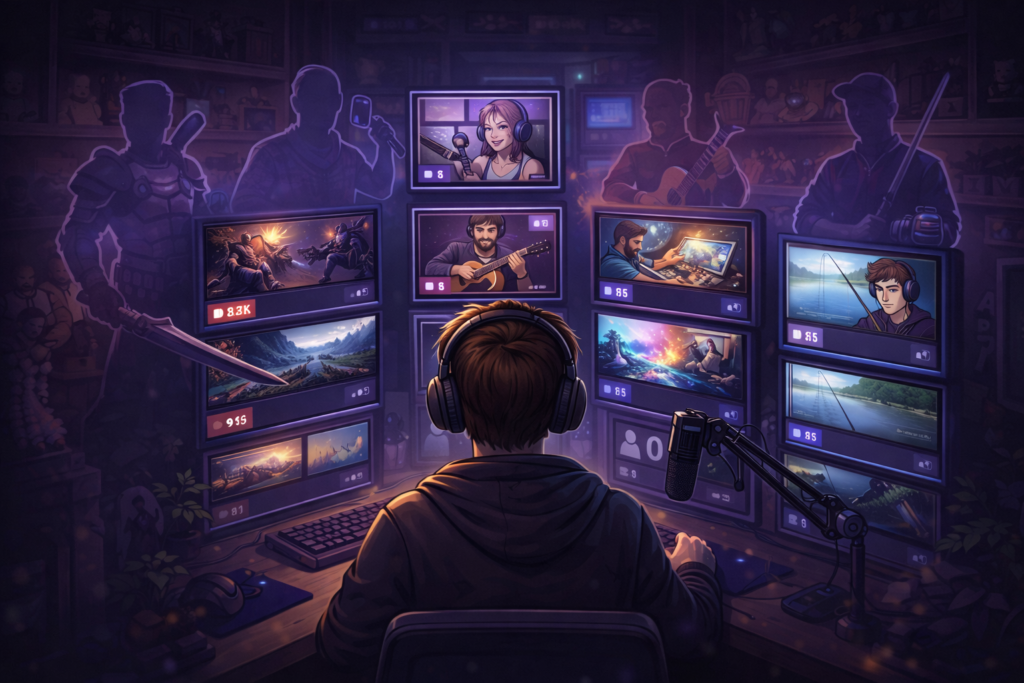
There is an illusion that a niche is simply a category choice: a game, “Just Chatting,” music, or creative streams. It feels like once you pick a direction, everything else will fall into place.
But in reality, a niche on Twitch is not the section you stream in — it’s the way viewers start recognizing you and coming back.
That’s why the question “how to choose a Twitch streaming niche” is often asked too late or too superficially. People choose a format, but don’t understand what will actually hold attention.
Why a Niche Is Not About the Game, but About Viewer Expectation
At the beginning, it seems like your niche is defined by what you play. But viewers rarely remember a streamer as “the one who plays that specific game.”
They remember the feeling they get from the stream.
The same game can be presented as a relaxed background stream, an aggressive competitive format, a conversational experience, or an analytical breakdown.
Formally, it’s one niche — but in practice, it’s four completely different channels.
And this is where it becomes clear: a niche is not about content choice, but about the role you play for the viewer.
Why “Streaming Everything” Slows Down Growth
Many beginners start with “I play whatever I like.” It’s natural — no one wants to limit themselves.
But for the viewer, this kind of channel feels unfocused. They don’t understand why they should come back.
Today one game, tomorrow another, the next day a different format. There is no sense of a central idea.
And that’s the core problem. Without a center, there is no accumulation.
Each stream feels like a separate event, not part of something you can get used to.
Why an Overly Narrow Niche Can Also Fail
The opposite extreme is choosing a very narrow niche and locking yourself into it: one game, one format, one style.
At the start, this may create clarity, but it often leads to burnout and limited growth.
The channel becomes dependent on a single source of interest.
As soon as interest drops — or the streamer gets tired — the entire structure begins to collapse.
That’s why a niche shouldn’t be narrow, but structured.
Not “one topic forever,” but a clear logic you can build around and expand from.
How Viewers Actually “Read” Your Niche
An interesting detail is that viewers rarely define a niche in words.
They don’t think: “this is a co-op gaming channel with social interaction.”
They feel it through repeating patterns.
They visit multiple times and notice a consistent experience: similar pacing, similar interaction style, a recognizable tone.
This creates predictability.
And predictability is what drives return viewers.
If every stream feels different — even if each one is good — the viewer doesn’t build a connection.
Why a Niche Is Built Over Time, Not Chosen Once
Another mistake is treating a niche as a one-time decision.
In reality, it almost always forms through experience.
A streamer starts, experiments with different formats, observes where engagement appears, where they feel most alive, where the stream has energy.
Gradually, a direction forms from this process.
And this is what creates a sustainable niche — not an artificially chosen category.
Why You Must Consider Viewer Behavior, Not Just Interest
Advice often sounds simple: choose what you enjoy. That matters — but it’s not enough.
Because streaming is not only about what you like, but also about how viewers behave.
Where they stay longer, where they feel comfortable, where they return.
If a format is enjoyable for you but doesn’t create retention, it won’t grow.
That’s why choosing a niche is always a balance between your interest and audience response.
How to Know Your Niche Is Starting to Work
It doesn’t show up as sudden growth.
It shows up as a shift in behavior.
Returning viewers begin to appear.
People start recognizing you.
The chat feels less random.
The stream starts to feel like an ongoing process rather than isolated sessions.
This is the main signal that your niche is forming.
Why a Niche Is a Foundation, Not a Limitation
Many fear that choosing a niche will lock their channel in place — that they’ll have to do the same thing forever.
But a good niche works the opposite way.
It gives you a center to expand from.
You can introduce new games, formats, and topics while maintaining recognizability.
Because viewers are no longer coming for a specific game — they come for how you deliver it.
That’s the difference between limitation and structure.
What Choosing a Twitch Niche Actually Means
It’s not about picking a category or deciding what to stream.
It’s about creating a repeatable experience that viewers want to return to.
When your channel stops being a random set of streams and becomes a space with a clear internal logic.
That’s the moment Twitch stops feeling chaotic.
And starts working in your favor.