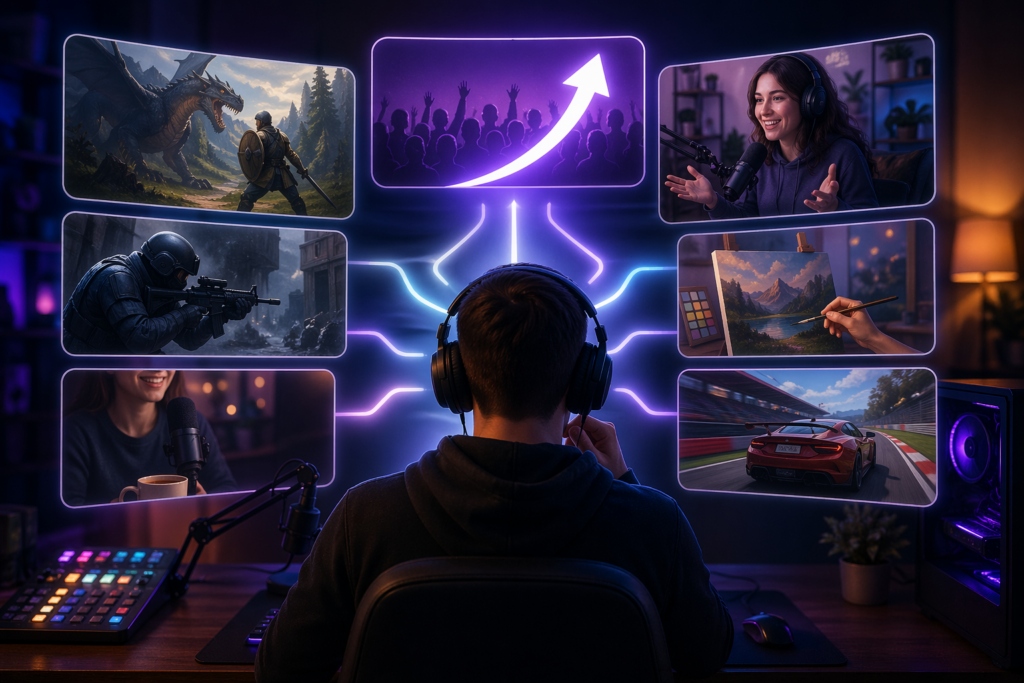
Choosing a Twitch stream format is often seen as a secondary task. It seems logical to first figure out the game, configure OBS, buy a decent microphone, learn how to talk—and then worry about the format later. In practice, the opposite happens: without a format, any improvements won’t deliver consistent results. Your channel might look and sound better, but it still won’t grow.
Format is not just about the stream topic or the game you play. It’s the way viewers understand what’s happening, why they should stay, and what they’ll get in the next 5–10 minutes. It’s a perception structure, not a checklist of actions. Without this structure, every stream feels random. And a random stream doesn’t build the habit of coming back.
When someone opens a stream, they don’t analyze it deeply. They aren’t giving you a “chance to shine.” They already have several tabs open and dozens of alternatives, so decisions are made quickly. If it’s not clear what’s going on within the first seconds, their brain simply switches away. At that moment, it doesn’t matter how interesting you are—you didn’t have time to show it.
That’s why format is not about style—it’s about readability.
Why Even Good Content Fails Without a Format
One of the most common situations: the streamer tries hard, talks, reacts, plays decently, but viewers don’t stick around. Internally, it feels like the problem is quality—”I need to be more interesting,” “talk more,” “improve my charisma.” But looking from the viewer’s perspective, the picture is different.
The stream looks like a flow of actions without structure. One moment there’s a reaction, another moment silence, then a sudden switch, then a pause. To the streamer this feels natural; to the viewer it’s chaos. They can’t predict what will happen next, so they see no reason to stay.
Twitch doesn’t promote “good content” on its own. It amplifies streams where viewers already stay. And viewers stay where they quickly understand what’s happening. Therefore, format is not a decoration—it’s the condition that makes content work at all.
Format Is an Entry Point, Not a Mood
Many streamers treat format as a mood: today an active stream, tomorrow a chill one, the day after just “for fun.” This makes sense from the creator’s perspective, but it doesn’t work from the viewer’s perspective.
The viewer doesn’t know what you did yesterday. They join at a specific moment and perceive that moment as the entire stream. If that moment looks like waiting, a pause, or an attempt to “warm up,” they won’t wait for more. They close the tab.
Format answers a simple question: “Why should I open this stream again?” And that answer must be consistent every time. Not in the details, but in the feeling. If today one type of experience, tomorrow another—a habit doesn’t form.
And without habit, there is no growth.
How a Format Actually Takes Shape
You can’t just invent or copy a format. It’s built from three layers: your behavior, audience expectations, and the platform’s mechanics.
Layer one — you
Not in the abstract sense of “be yourself,” but concretely: how you react, where you speed up, where you go silent, how you structure your speech. The format should amplify these traits, not break them. If you try to play a role, it becomes noticeable quickly and fails to hold attention.
Layer two — category
Every game or category on Twitch has its own pace and expectations. In fast-paced games, viewers expect constant reactions, quick decisions, commentary. In calmer categories, they expect conversation, atmosphere, involvement in the process. If the format doesn’t match that rhythm, there’s a disconnect.
Layer three — algorithm
Twitch doesn’t evaluate format directly. It looks at viewer behavior: how long they watch, whether they return, whether they engage in chat. This means the format must not just “please you”—it must create conditions for retention.
When these three layers align, the stream feels cohesive. When they don’t, it falls apart.
Why Copying Someone Else’s Format Doesn’t Work
It’s very tempting to take a popular streamer’s format and simply repeat it. The logic is clear: if it works for them, it must be a universal solution. But there’s an important detail—a large streamer’s format is already tied to their audience.
They have a chat that actively responds. They have viewer expectations. They have channel context. When you copy the actions without that foundation, they lose meaning. The same words, the same reactions—but no response.
The result is a feeling of “emptiness.” The format seems to exist, but it’s not alive. Because it didn’t grow from your behavior and your audience.
You can’t take a format ready-made. You can only adapt it and grow it.
Which Formats Work Best at the Start
At the beginning, formats that are easy to read work best. Not necessarily complex or unique—on the contrary, simple but clear.
- An active stream with constant commentary and no long pauses.
- A format focused on communication, where the game is just background.
- A stream with a goal or challenge, giving a sense of progress and results.
The key criterion: the viewer should understand what’s happening within 10–15 seconds. If they can articulate it—the format works. If not—they leave, even if the stream is objectively good.
What matters is not what the format is called, but how transparent it is.
How to Know You’ve Chosen the Right Format
The most common mistake is to look only at viewer count. But the number alone doesn’t tell you much. What matters far more is how people behave inside the stream.
- Do they stay longer?
- Do they come back for the next stream?
- Do they start typing in chat?
- Does the stream feel “alive,” even with few viewers?
If people come and leave quickly—the problem is almost always the format. Not the equipment, not the video quality, not a “lack of charisma.” It’s that the stream doesn’t provide a clear experience.
A good format creates a sense of continuity. Even with low viewership, there are no pauses, no feeling of emptiness. There is momentum.
Why You Shouldn’t Change Format Every Stream
Many streamers constantly search for the “perfect approach” and therefore change their format almost every stream. One format today, another tomorrow. As a result, none of them have time to take hold.
Format works through repetition. Viewers need to encounter the same feeling several times for a habit to form. If every stream is different—no habit forms.
This doesn’t mean you can’t experiment. But experiments should be targeted, not destructive to the foundation. Otherwise, every stream becomes a restart from zero.
Format as a Foundation, Not a Detail
Growth on Twitch rarely starts with a sudden leap in quality. It starts when the stream becomes understandable. When a viewer joins and immediately understands what’s happening and why they should stay.
Format is that understandability. It’s not about creativity for creativity’s sake—it’s about clarity and repeatability. And that’s what separates streams that just “run” from streams that start to grow.
As long as the format is undefined, any effort gets diluted. Once it appears—even a small viewership begins to turn into a stable audience.