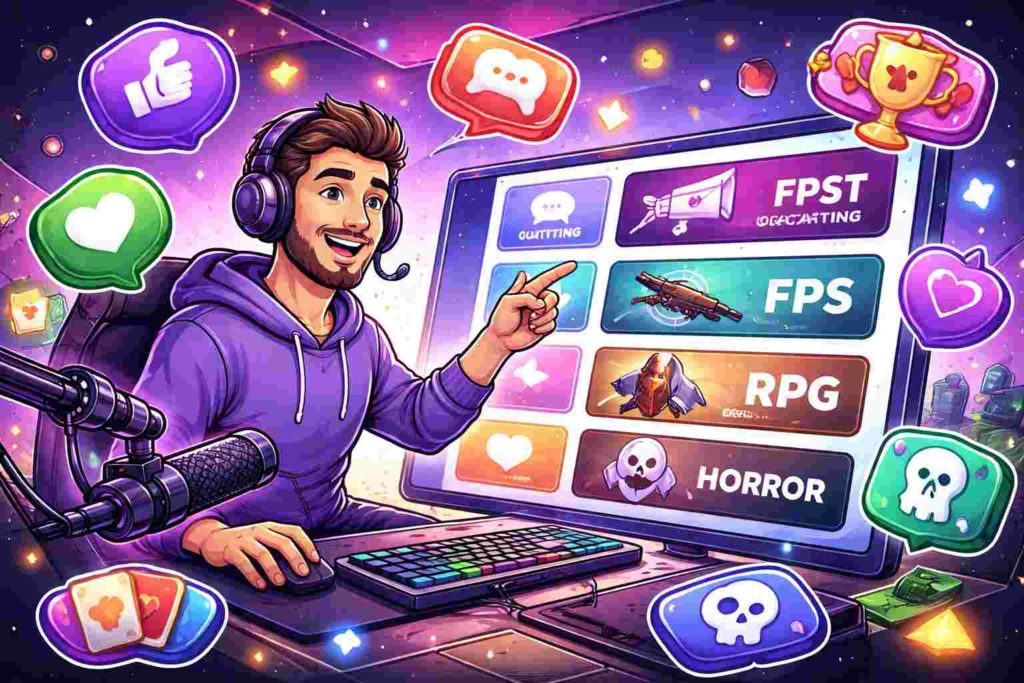
Choosing a category on Twitch is often treated as a formality. A streamer goes live, selects a game or section, and assumes that’s the end of it. It feels like the content is what matters, while the category is just a label under the stream. But in reality, the category determines whether anyone will see you at all.
Because Twitch doesn’t search for “good streams.” It distributes attention within categories.
And if you are in the wrong category, you are competing in the wrong system.
Why a Category Is Not About Topic, but About Competition
It’s important to understand: a category is not just a description of what you’re doing. It’s a list of streams you will be placed next to. That’s where viewers decide whether to click on you or not.
If you start a stream in a category with thousands of active channels, you automatically end up at the bottom of the list. Even if your content is strong, it simply won’t be seen. Not because it’s bad, but because it exists outside the attention zone.
In this sense, a category is not about matching the topic — it’s about positioning.
You are not choosing “where to stream,” you are choosing “who you compete with for attention.”
Why Large Categories Rarely Help New Streamers Grow
Popular categories create an illusion of opportunity. It seems like more viewers means more chances. In reality, the opposite happens.
The bigger the category, the higher the competition for top positions. And on Twitch, top positions take almost all the traffic. Everything below gets leftovers.
If you don’t have an initial viewer base, you don’t move up. If you don’t move up, you don’t get clicks. It becomes a closed loop.
That’s why streaming in an oversaturated category often feels like “streaming into the void,” even if there are thousands of viewers.
Why Small Categories Are Not Always Better
The logical conclusion is to go into small categories. Less competition, easier to reach the top, higher chance to be noticed.
But there’s another problem — lack of traffic.
If a category has almost no viewers, even first place doesn’t bring meaningful exposure. You become visible, but there’s no one to see you.
That’s why small categories only work when there is at least some activity. It’s not enough to be “at the top” — you need to be where viewers actually are.
Why Balance Between Competition and Traffic Matters
The optimal category is neither the biggest nor the smallest. It’s a category with active viewer flow but without overwhelming competition from strong channels.
This is where growth becomes possible.
If you can reach even the upper third of the list, your chances of being opened increase dramatically. And that’s what creates the first entries into your stream.
A category should give you the chance to be seen, not just exist.
Why Category Choice Affects Twitch Algorithms
Twitch evaluates viewer behavior within each category. It tracks which streams are opened, where viewers stay, and where they return.
If your stream starts getting clicks and retention, it can move higher. But that only happens if those clicks exist in the first place.
The category is the source of those first clicks.
Without them, the algorithm has nothing to work with. Even a strong stream doesn’t grow because it never receives the initial signal.
Why Changing Categories Can Change Results
Sometimes the same stream performs differently in different categories. It may seem strange, but the explanation is simple.
The environment changes.
In one category, you get lost among hundreds of channels. In another, you become visible. The content stays the same, but the probability of being clicked changes.
This is one of the most underrated growth levers.
Why You Must Consider Viewer Behavior Inside Each Category
Different categories mean different expectations. In some, viewers want calm streams; in others, fast-paced action; in others, interaction and conversation.
If your stream style doesn’t match those expectations, viewers will leave faster, even if your numbers look good.
This affects not only retention, but also how your stream is ranked within the category.
Your category should match not only your topic, but also your format.
Why “Just Chatting” Doesn’t Work for Everyone
Many streamers choose “Just Chatting” because it’s the most flexible category. But it’s also one of the most competitive.
Without an existing viewer base, it’s almost impossible to reach a visible position there.
In addition, viewers in this category often choose streams based on personality rather than topic. That makes it even harder to break through without a defined identity.
That’s why “Just Chatting” is not a starting point, but rather a later stage.
Why Your Category Should Evolve with Your Channel
What works at the beginning may stop working later. As your viewer base grows, you can enter more competitive categories. As your channel evolves, your strategy should change.
A category is not a fixed decision. It’s a tool that needs to adapt.
If you stay in the same category without adjusting for growth, you may hit a ceiling.
What It Really Means to Choose the Right Category
It’s not just about selecting a game or section.
It means:
- finding an environment where you can be seen,
- evaluating competition,
- understanding viewer behavior,
- and choosing a position where you have a chance to get incoming traffic.
When the category is chosen correctly, your stream starts getting its first clicks. When clicks appear, retention follows. When retention grows, the channel starts to grow.
And that’s when it becomes clear that category is not a minor setting.
It’s the point where channel growth actually begins.