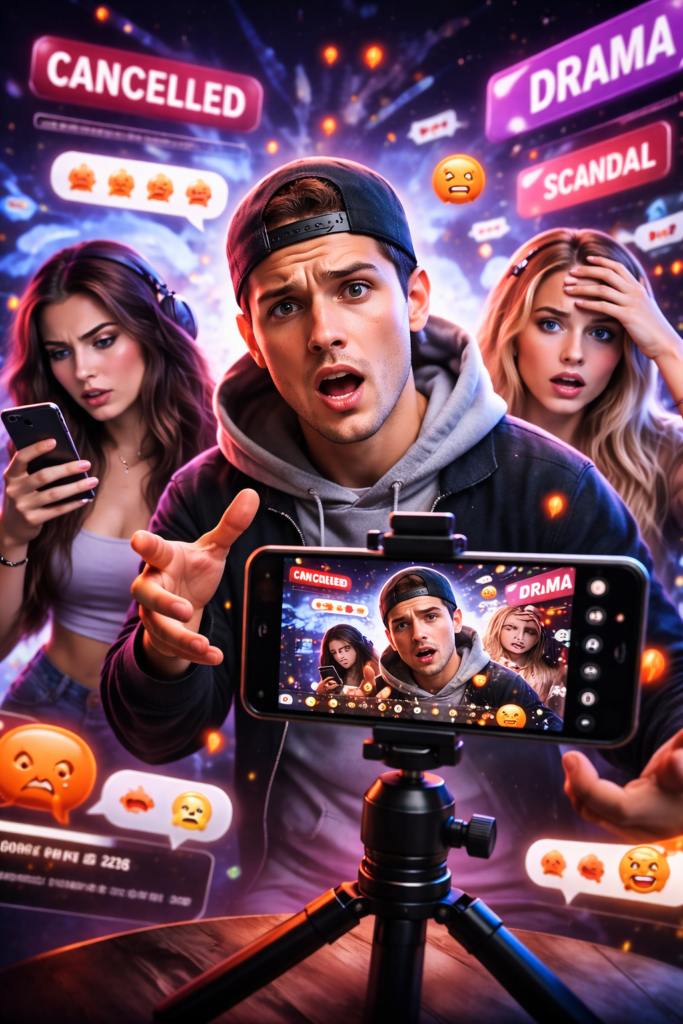
Looking at the streaming landscape of 2026 from the outside, it may seem that scandals have become a mandatory part of growth. Almost every major name has faced conflict, bans, canceled sponsorships, clipped moments, or a careless phrase said live. From the outside, it looks like a strategy — as if making noise is the only way to grow now.
But when you examine these stories not through headlines but through their underlying mechanics, something else becomes clear: most of the most scandalous streamers of the year did not seek conflict intentionally.
More and more often, a scandal emerges not as a calculated move, but as a side effect of a mismatch between format, scale, and audience expectations.
A Scandal No Longer Looks Like “One Bad Moment”
In 2026, instant career-ending disasters are rare. A single clip rarely destroys a career. What matters instead is accumulation. Old streams, half-forgotten phrases, and emotional moments from different periods gradually form a coherent narrative — and at some point, the streamer is no longer seen as a living person, but as an image with fixed traits.
Repetition has become more dangerous than sharpness. Not “what they said,” but “they always talk like this.”
Type One: The Streamer Who Didn’t Notice They Had Grown
One of the most common scandal scenarios of 2026 is rapid growth without a change in behavior. A streamer continues speaking the same way they did for a small community, but now they are being watched by hundreds of thousands. The context changes, but the communication style does not.
Jokes meant “for insiders” start to sound like firm positions. Unfiltered conversations land in recommendations. And the streamer sincerely does not understand why they are being criticized — after all, they have always been this way.
This is where the first major controversies appear — not because the person became worse, but because they became more visible.
Type Two: A Platform Conflict Disguised as Personal Drama
In 2026, streamers increasingly clash with platforms, but they almost always frame it as a personal story: “I was misunderstood,” “they’re suppressing me,” “they want to silence me.”
From the viewer’s perspective, it reads differently: the streamer refuses to accept updated rules, and the platform is no longer willing to look the other way.
Algorithms have become stricter, policies more formalized, and space for informal agreements has nearly disappeared. The loudest scandals of this type look like fights for justice, but they tend to end the same way — declining reach and a platform switch.
What the Most Scandalous Streams of 2026 Actually Look Like
If you remove the names and focus on the mechanics, it becomes clear that scandals are surprisingly similar. They rarely look like deliberate provocation. More often, they look like a stream that went off track — and couldn’t be stopped in time.
One of the most common cases is a relaxed “no-topic” stream. The streamer casually chats with the audience, talks about money, sponsorships, and behind-the-scenes details. In the moment, it feels honest and open. But a single phrase, clipped out of context, begins to sound like an admission of wrongdoing. The stream is not deleted, the streamer does not apologize — they see no issue. A few days later, brands quietly disappear from the schedule.
Another frequent scenario is an emotional breakdown live on stream. Fatigue, pressure, and a toxic chat. The streamer goes live without a plan, talks too much, reacts to provocations. In reality, it’s just a bad day. In clips, it becomes “unstable behavior.” Algorithms amplify the sharpest moments, and the image solidifies faster than any explanation can undo.
There is also a separate category of jokes that leave the platform. Inside the community, they are read as irony. Outside the context, they turn into accusations. These clips quickly spread into short-form platforms where no one knows the streamer or their style. At that point, negotiating with the audience is impossible — because it is no longer their audience.
Some of the most visually striking scandals involve real-time conflicts with moderation. A sanction notification appears, followed by an emotional reaction, commentary live on stream, and attempts to mobilize viewers. As spectacle, it’s compelling content. In terms of consequences, it is almost always a losing position.
Finally, there are streams framed as “social experiments.” Offline interactions, provocative questions, engagement with people who don’t fully understand the format. While the stream is live, it’s entertaining. Once the recording remains, it becomes clear that boundaries were blurred. These streams most often end in reports, complaints, and bans.
Type Three: The Streamer Who Became a Media Figure but Acts Like a Private Person
In 2026, many streamers have crossed an invisible line: they became part of the broader media landscape but continue to speak as if they are still in a closed chat. Any statement begins to live its own life — detached from intention, tone, and context.
This is where the central conflict of the year emerges: streaming is no longer about “I said it and was understood.” It is about interpretation — about how you are seen by people who have never watched your previous hundred streams.
That’s why the most scandalous streamers of 2026 are not necessarily the most aggressive or provocative. More often, they are those who failed to adapt to a new scale of public visibility. They did not plan to be scandalous. They simply continued streaming the way they always had.
And perhaps the main takeaway here is not that streamers need to be “more careful.” It’s that in 2026, a stream is no longer a private conversation by default — even if that’s how it begins.