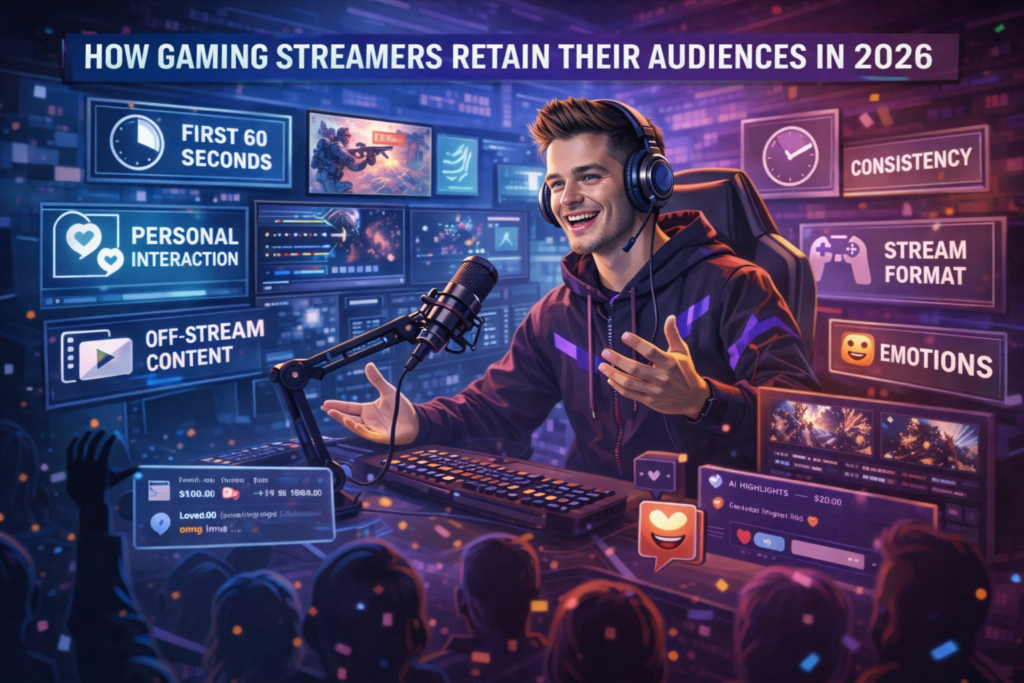
A few years ago, audience retention in streaming followed a simple rule: play well and people will watch. In 2026, that formula no longer works. Gaming streaming has become an oversaturated market where high skill is only a baseline requirement, not a guarantee of stable viewership. Today, viewers choose not just the game and not just the streamer, but the overall experience they get from the broadcast.
That is why the question of how gaming streamers retain their audience has become critical for anyone who wants to grow and earn through streaming. Retention directly affects average concurrent viewers, revenue, platform recommendations, and a channel’s long-term sustainability.
Why Audience Retention Matters More Than Acquisition
Many beginner streamers make a common mistake: they focus on attracting new viewers while neglecting those who have already joined. However, Twitch, YouTube Live, and other platforms in 2026 primarily evaluate channels based on retention — how long viewers stay on the stream and whether they come back.
Gaming streamers with strong retention receive more algorithmic recommendations even with fewer subscribers. This turns audience retention into a strategic asset rather than a secondary metric.
The First 60 Seconds as the Decision Point
One of the most underestimated elements of streaming is the opening. In 2026, viewers decide whether to stay or leave within the first 30–60 seconds. Gaming streamers who successfully retain their audience always understand why someone clicked on their stream in the first place.
This is not about loud greetings or artificial hype. What matters is immediate context: what is happening in the game, what the stream format is, and what viewers can expect next. Successful streamers often start broadcasts already in action rather than with long introductions. The viewer must feel involved instantly.
Intentional Stream Pacing
One of the main reasons viewers leave streams is pacing issues. Even an interesting game can feel boring if the stream rhythm is poorly managed. Gaming streamers who retain audiences constantly work with tempo: they alternate intense moments with calmer ones, comment on downtime, and explain their decisions.
Silence on stream is often perceived as a lack of presence. Even analytical or competitive content requires continuous verbal engagement. The streamer does not need to talk nonstop, but viewers must feel that the streamer is present and engaged.
The Power of Dialogue and Personal Attention
In 2026, chat is no longer a secondary element. For gaming streamers, audience retention is directly tied to the quality of interaction. When viewers know their messages might be noticed, read, and discussed, they stay longer.
Experienced streamers frequently ask chat questions, respond to answers, and return to earlier messages. This creates a dialogue rather than a one-way broadcast. Even small viewer counts become an advantage, as each viewer feels personally valued.
Format Matters More Than the Game
One of the biggest beginner misconceptions is believing in the “right game.” In reality, audience retention depends far more on stream format than on the game itself. The same gameplay can retain viewers for hours or lose them in minutes depending on presentation.
Formats may focus on education, challenges, restricted playthroughs, experiments, or even relaxed background gameplay. Gaming streamers who retain audiences clearly understand what differentiates them from dozens of similar channels in the same category.
Predictability as a Trust Factor
Audience retention is impossible without predictability. This does not mean monotony or boredom. It refers to a consistent schedule, clear stream duration, and an expected format.
When viewers know when a streamer goes live and what to expect, habits form. In 2026, habit is one of the strongest retention drivers. People return to places that feel comfortable and familiar.
Managing Viewer Emotions
Gaming streamers retain audiences not through constant action, but through emotional atmosphere. This can be calmness, humor, tension, or a sense of participation. The key requirement is authenticity.
Viewers are highly sensitive to fake emotions. Attempts to artificially force reactions often have the opposite effect. Honest emotional engagement with what is happening on screen is far more effective.
Off-Stream Content as a Retention Tool
In 2026, audience retention goes beyond live broadcasts. Clips, highlights, and short-form videos serve not only to attract new viewers but also to bring existing ones back. A successful clip reminds viewers about the streamer and motivates them to return for the next stream.
Gaming streamers who retain their audience build a unified content ecosystem. Live streams, clips, and social media reinforce each other rather than existing separately.
Why Retention Is a Skill, Not a Talent
The biggest misconception is that audience retention is an innate trait. In reality, it is a skill developed through analysis, mistakes, and feedback. Successful gaming streamers regularly review their broadcasts, identify where viewers drop off, and adjust their format accordingly.
In 2026, the winners are not the loudest or the most mechanically skilled, but those who understand their audience best and build long-term relationships.
Conclusion: What Really Keeps Viewers Watching
Gaming streamers retain audiences not through tricks or algorithms, but through attention to detail. Understanding pacing, format, emotions, and dialogue creates a living space viewers want to return to.
In a highly competitive environment, retention becomes the main indicator of streamer maturity. It is what separates temporary viewership spikes from sustainable channels that grow over years.