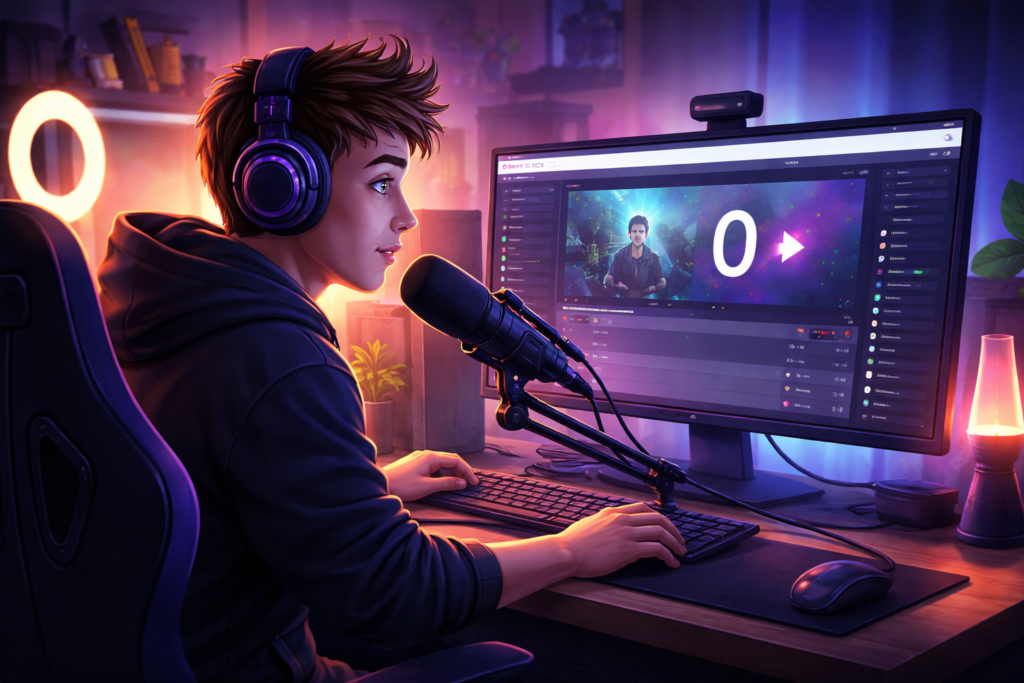
There’s one thing almost nobody talks about out loud. When someone is just thinking about streaming, everything looks like a checklist of technical steps: download OBS, buy a microphone, set up scenes, choose a nickname. It feels like the start is purely about equipment and software. But in reality, your first Twitch stream doesn’t begin with the “Go Live” button. It begins with the feeling that you’ll be talking into the void. And this is exactly where most beginners break, because the real experience sharply clashes with expectations.
Why Starting on Twitch Is Almost Always Quieter Than Expected
When someone launches their first stream, they subconsciously expect at least some activity. It feels like at least one viewer will show up, someone random will join, write in chat, ask a question. But more often, the opposite happens: viewer count is zero, sometimes one person joins for a few seconds and leaves immediately, and the chat stays empty. It creates a strange feeling — you are streaming, but it’s as if no one even knows you exist.
This is not a mistake and not a problem with your channel. It’s the natural logic of Twitch. The platform doesn’t promote new streams on its own. Until there are signals — clicks, watch time, engagement — your stream stays buried deep in the listings. That’s why the start almost always feels like silence, and it’s important to be prepared for that.
What Really Happens in the First Minutes of a Stream
There’s an important nuance here that is often overlooked. A viewer on Twitch doesn’t come to “support a beginner.” They come to check. They scroll through categories, see a small preview, and in a split second decide whether to click. If something catches their attention — they join. If not — they move on.
But even if they join, you only have a few seconds to hold their attention. The viewer won’t wait for you to “warm up,” won’t give you time to “get comfortable,” and won’t consider that this is your first stream. They evaluate only one thing: is there a reason to stay right now? If there isn’t, they leave just as quickly as they came.
That’s why your first stream is not about perfect technical setup. It’s about your ability to immediately create a sense of a live, ongoing process that people can join.
Why Preparation Often Leads You in the Wrong Direction
Many beginners go so deep into preparation that the actual moment of going live keeps getting delayed. They spend weeks setting up scenes, searching for perfect overlays, comparing microphones, watching dozens of tutorials. From the outside, it looks like a serious approach, but inside it’s often just avoidance of the real start.
The problem is that no amount of preparation makes your first stream “smooth.” There will still be pauses, uncertainty, and the strange feeling of talking into the void. This is an unavoidable stage. And the difference between those who start and those who stay stuck in preparation is simply who is willing to go through that discomfort.
What the First Real Streaming Experience Looks Like
A typical first stream tends to follow the same pattern. A person goes live and starts speaking energetically, as if they already have viewers. Then they notice the viewer count is zero and gradually slow down. Pauses appear, speech becomes less confident, and at some point the stream turns into silent gameplay. After that, the stream ends with the thought: “maybe this isn’t for me.”
But this is not about talent or whether streaming “fits you.” It’s about the mismatch between expectations and the real logic of the platform. Twitch doesn’t give immediate feedback — it has to be built gradually.
What Actually Changes Things at the Start
The key turning point happens when a streamer stops seeing the broadcast as a performance for viewers and starts seeing it as a process that viewers can join. It’s a subtle but critically important difference.
When you wait for viewers, you depend on their arrival. When you create momentum, viewers enter something that is already alive. In that state, you don’t go silent at zero viewers, you don’t lose rhythm, and you don’t try to impress an abstract audience. You simply run the stream as a continuous process that already has energy.
Why Your First Viewers Are Almost Always Random
At the beginning, your channel doesn’t attract an “audience” in the usual sense. Random people come in: someone clicks from a list, someone searches for a specific game, someone is just browsing categories. They have no reason to stay unless your stream creates one.
And that reason is not built with generic phrases like “hey, how are you,” but with the overall feeling of what’s happening. Is there movement? Is there energy? Does it feel like something is happening right now? Viewers read this instantly and decide whether to stay or leave without any internal debate.
What It Really Means to Start Streaming
Starting to stream is not about technology, not about channel design, and not even about your first audience. It’s about being willing to go through a phase where there is no confirmation that you are doing things right. And that confirmation doesn’t appear immediately — sometimes it takes weeks.
At that point, the only thing left is the internal decision to continue. Not because there are results yet, but because you understand that the process is just beginning and the first signals take time to appear.
Where Growth Actually Begins
Growth doesn’t start with your first stream and isn’t tied to your first viewer. It begins when streaming stops being an experiment and becomes a regular process. When rhythm appears, when you start noticing what works and what doesn’t, when your focus shifts from numbers to viewer behavior.
Gradually, you begin to see who joins, when people leave, and where attention holds longer. This is when Twitch stops feeling like a mystery and starts to make sense as a system with its own logic.
And this path always looks the same. It starts with a stream with zero viewers and continues only if the streamer stays live despite the silence.