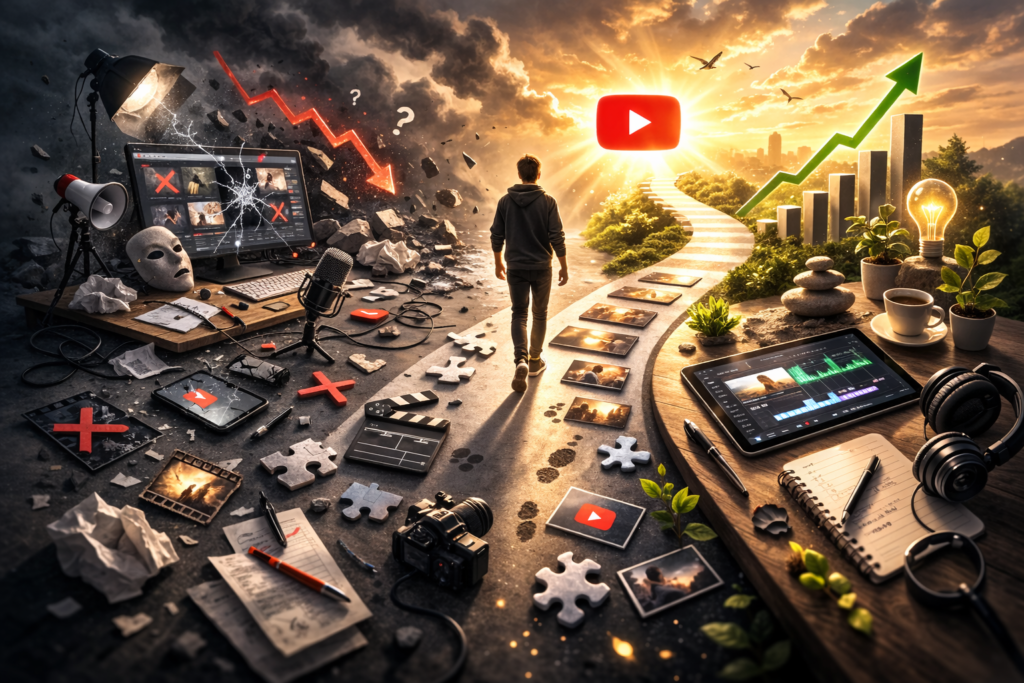
Almost every beginner YouTube creator is confident they know where they might go wrong. Bad audio, a weak camera, an unappealing thumbnail, the wrong topic. These issues are obvious, easy to notice, and relatively easy to fix. Much more dangerous are the other mistakes — the ones that look like a “normal start” and therefore remain unnoticed for a long time.
In 2026, YouTube no longer forgives these kinds of mistakes. Not because the platform has become harsher, but because viewing behavior has changed. Videos are no longer evaluated. They are either integrated into a habit, or they are not. And most new channels get stuck at this exact stage — not because of poor content, but because of incorrect expectations about the process itself.
Mistake One: Starting With an Image Instead of Behavior
One of the most common beginner mistakes is trying to build an image right away. The creator focuses on how they look, how they speak, how they should be perceived. They construct a “persona,” think through style, delivery, even speech patterns. Formally, everything looks right — but growth does not begin.
The problem is that YouTube does not work with images. The YouTube platform works with behavior. It does not care who you are as a character. It cares about what the viewer does after clicking. Do they stay? Do they return? Do they continue watching something else?
When a channel starts with an image instead of understanding the viewer’s state at the moment they press play, a disconnect appears. The creator tries to be interesting, while the viewer is simply looking for comfort. This conflict almost always ends in silence.
Mistake Two: Treating Each Video as an Event
Beginners often treat every upload as an event. They prepare for a long time, worry, reshoot, and try to pack in as much meaning as possible. The result is a polished, complete, “important” video. And that is exactly why it performs poorly.
In 2026, YouTube is not a space of events — it is a space of flow. A video does not exist on its own, but as part of continuous viewing. When a video feels like a separate act that demands attention and involvement, it breaks the flow. A viewer may watch it once, but rarely returns and almost never queues it next.
The mistake is not that the video is bad. The mistake is that it is too self-contained.
Mistake Three: Trying to Please the Algorithm
Many beginner creators sincerely believe the algorithm can be “won over.” They read advice, track metrics, try to guess the right length, structure, and pacing. The video begins to look like an attempt to meet the system’s expectations rather than the viewer’s.
The paradox is that the algorithm does not respond to effort. It responds to outcomes. If a video is watched calmly, without spikes or drop-offs, it gets expanded distribution. If a video creates tension — even if it is useful and smart — the system becomes cautious.
When a creator focuses on the algorithm, they almost always interfere with viewing. The viewer feels this before they understand it. And they leave.
Mistake Four: Explaining Who You Are Too Early
One of the most underestimated mistakes is the introduction. Beginners love to talk about themselves. Who they are, why the channel exists, what will be here, why it is worth watching. They believe the viewer will not understand the context without this.
In practice, the opposite happens. The viewer has not yet decided whether they want to watch the video at all, and they are already being asked to decide on trust, interest, and subscription. It is too early.
A video that explains itself feels insecure. As if it is justifying its own existence. The algorithm reads this as instability, and the viewer experiences it as unnecessary effort.
Mistake Five: Confusing Usefulness With Relevance
Beginner creators often bet on usefulness. More information, more advice, more “value.” They genuinely want to help. But YouTube is not a place where people seek help in a direct sense.
People look for a state. Background. Pauses. A feeling that they can watch without strain. When a video demands active thinking, memorization, and concentration, it is automatically postponed — even if the topic is interesting.
The mistake is not that the video is useful. The mistake is that it is irrelevant to the viewing moment.
Mistake Six: Too Many Experiments at the Start
The advice to “test formats” sounds logical, but in practice it often slows growth. A beginner tries different styles, tones, and approaches. Today one format, tomorrow another, the day after something new. They search for what works.
The problem is that the system does not have time to understand anything. Viewer behavior differs, signals contradict each other, and context does not form. The algorithm acts cautiously because the risk is high.
Channels grow faster when they appear repetitive at the beginning. Fewer experiments, more consistency. This reduces uncertainty and speeds up understanding.
Mistake Seven: Relying on Feedback
Comments, likes, and reactions look like indicators of interest. And emotionally, they matter a lot to the creator. But for growth, these signals are secondary.
Beginners often draw conclusions based on comments. They change delivery, speed up, simplify, or complicate content based on the active audience. The problem is that the active audience is a minority.
The main audience watches silently. They do not comment, argue, or thank. But their behavior determines growth. When a creator listens only to noise, they begin to lose the quiet — but most important — viewers.
Mistake Eight: Expecting Clear Progress
Many beginners expect linear growth. A few views today, a bit more tomorrow, even more next month. When this does not happen, it feels like something is broken.
In reality, YouTube growth is almost never linear. It looks like a long pause, then a jump, then another plateau. This is not a bug or a punishment. It is the result of accumulated context.
The mistake is treating a pause as failure and suddenly changing everything. Often, this is exactly when the channel was closest to a shift.
Mistake Nine: Trying Too Hard to Be “Interesting”
One of the subtlest mistakes is the constant desire to hold attention. To be dynamic, bright, intense. The creator fears the viewer will get bored.
In reality, YouTube is increasingly used as a space for rest. A video that constantly demands reaction becomes exhausting — even if it is objectively interesting.
Channels often grow faster when the creator has “nothing to prove.” When the pace is calm, pauses are allowed, and attention is not squeezed out. It feels paradoxical, but the absence of pressure creates comfort.
Mistake Ten: Thinking Mistakes Are Bad
The biggest mistake beginner creators make is being afraid of mistakes. Afraid to upload an imperfect video. Afraid the “algorithm will remember.” Afraid of ruining the start.
In 2026, YouTube remembers almost nothing in a negative sense. It does not punish weak videos. It simply does not amplify them. The real problem is not mistakes, but the absence of observation.
While a creator tries to be correct, they often stop being attentive. And growth begins precisely with attention — to how people watch, when they watch, and what they do next.
What Almost All Beginner Mistakes Have in Common
If everything is reduced to one idea, most beginner YouTube mistakes are not about content quality, but about a misunderstanding of how YouTube is actually watched.
Videos are perceived not as products, but as parts of habits. Not as performances, but as background. Not as events, but as continuations.
As long as a creator makes videos “the right way,” growth may not begin. And when they stop trying and simply fit into viewing behavior, movement appears.
And this transition almost always happens later than expected — but earlier than it seems.