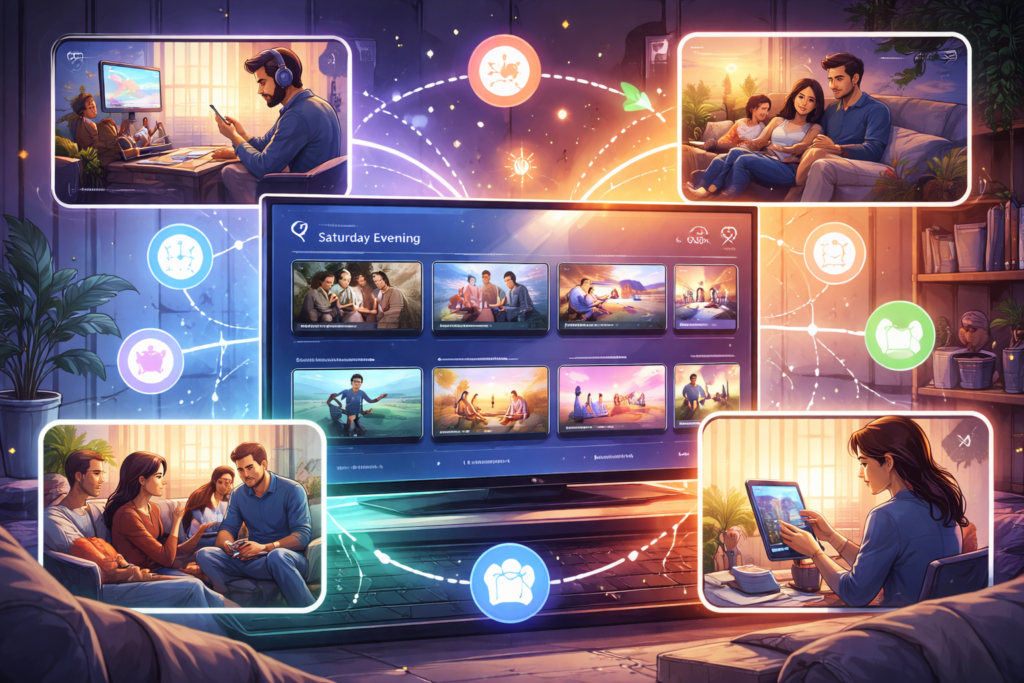
In 2025, viewers rely on several familiar viewing patterns: short videos during breaks, a series in the evening, background content while commuting. Platforms have already learned to predict preferences, but they still operate on a simplified model: “what you watch → what to show next.”
By 2030, this logic will shift. Streaming will stop reacting only to interests and will begin accounting for contextual states—not just taste, but the reason a person turns on a screen at a specific moment.
Choices will depend not on genre, but on a combination of factors: time of day, fatigue, who is nearby, the device being used, and even the previous day. The same user in the morning, afternoon, and evening will receive not different recommendations, but different types of media experiences.
How Much Time Are You Ready to Spend?
Previously, platforms asked a single question: “What will you like?”
By 2030, that question will change to: “How much time are you ready to give right now?”
This marks a shift from preference-based recommendations to attention management. Algorithms will account not only for viewing history, but for real consumption patterns within specific time windows.
If a user regularly stops watching after 8–12 minutes, the platform will not push a 45-minute episode. Instead, it will offer a format that naturally fits the available time, without the feeling of “not finishing.”
As a result, content length will stop being a fixed attribute and become an adaptive parameter.
Algorithms Will Assemble Scenarios, Not Videos
The next stage of streaming evolution is a move from recommendation to composition. Platforms will no longer serve individual videos or episodes, but assemble meaningful content blocks tailored to a specific time slot.
Instead of a traditional catalog, users will encounter streams designed for a purpose:
- an evening after work,
- watching with friends,
- a short pause before leaving,
- background viewing.
This means users will stop manually choosing content. They will choose a mode, and the platform will determine the content.
Formats Will Lose Their Rigid Boundaries
The distinction between “short-form” and “long-form” content will gradually disappear. The same material will exist in multiple versions: condensed, extended, episodic.
Stories will become modular. Scenes can be watched individually or combined into longer sequences. This is especially important for viewers who no longer plan viewing sessions in advance and increasingly consume content in fragments.
Content will no longer be a finished unit. It will become a flexible structure that adapts to behavior instead of dictating it.
Streaming as an Attention Partner
By 2030, streaming platforms will stop being simple video libraries. They will become intermediaries between people and their time.
Algorithms will take into account:
- the device used for viewing,
- time of day,
- the presence of other people,
- previous interaction scenarios.
A particularly noticeable shift will be toward group consumption. Recommendations will increasingly be built not for a single user, but for shared contexts: families, friends, couples.
As a result, streaming will evolve from a source of entertainment into a tool for social interaction.
Why This Is Not a Prediction but a Continuation
Signs of this shift are already visible today. Platforms analyze not only what people watch, but how long, in what sequence, and at which moments of the day.
People no longer choose content consciously. They respond to prompts, signals, and convenience. Streaming adapts to this behavior because failing to do so means losing attention.
2030 will not bring a sudden break. It will simply formalize an existing trend: the transition from content selection to managing the viewer’s state.
An Open Ending
The future of streaming is not about abandoning films or series. It is about abandoning the idea that viewers must adapt to formats.
Content will adapt to life—its rhythm, pauses, fatigue, and shared moments. And the question “what should I watch?” will gradually be replaced by another: “how do I want to spend this time?”
The answer to that question will become the new interface of streaming.