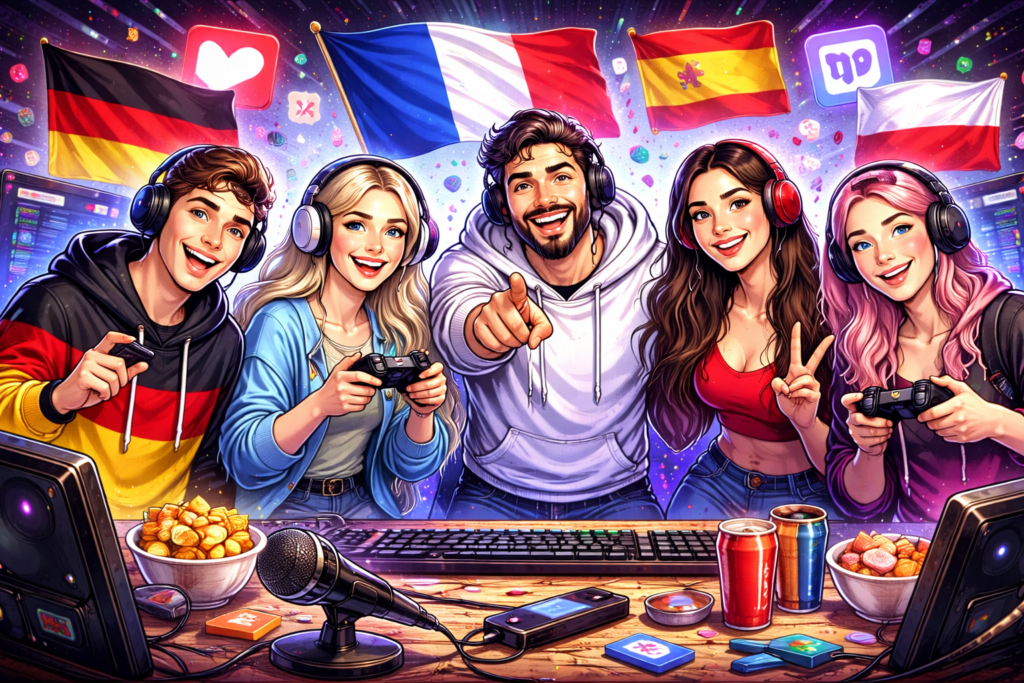
European streaming in 2026 is not a single market and not simply “English-language Twitch with accents.” It is a mosaic of scenes, each operating by its own rules. Language, cultural code, communication style, and even audience attitudes toward pauses, conflict, and improvisation all play a role. That is why a list of European streamers worth watching cannot be reduced to a simple ranking based on live viewer numbers.
What makes the European scene compelling is its diversity. The same format may work perfectly in Germany and fail completely in France. In some regions, audiences expect spectacle and emotion; in others, calm dialogue or clear structure and professionalism. In 2026, European streamers succeed not through scale, but through precise alignment with their audience.
Why European Streaming Does Not Follow a Single Model
Unlike the United States, where Twitch and streaming culture developed around a more universal entertainment model, Europe has always remained fragmented. Language here is not just a tool of communication, but a filter for audience formation. Streamers almost always operate within a specific country or regional context, even when broadcasting in English.
This also affects viewer behavior. European audiences are generally less tolerant of artificial hype and loud “performances for numbers.” Authenticity, consistency, and a sense of dialogue are valued more than constant emotional pressure.
Twitch as the Main Stage for European Streamers
Despite the growth of alternative platforms, Twitch remains the central hub of European streaming. However, Europe looks different within Twitch compared to the broader English-speaking segment: there are fewer universal stars and more strong local leaders.
Streamers here rarely “capture the entire continent.” Instead, they retain their audiences more deeply and remain relevant longer within their home countries.
Streamers from Germany and Northern Europe
The German and Scandinavian Twitch scenes traditionally prioritize structure and consistency. Stable schedules, clear formats, and minimal chaos during broadcasts are highly valued.
Among streamers truly worth watching, Trymacs and Papaplatte are often mentioned. Their streams are not built around constant conflict, but around personality, chat interaction, and carefully structured entertainment.
Northern Europe is also strong in creators who combine gaming with conversational formats. They rarely rely on emotional pressure, holding attention through calm, confident delivery. For viewers, this is long-term streaming rather than content built for short-lived peaks.
France and Southern Europe
The French streaming scene in 2026 is one of the most distinctive in Europe. Twitch has long expanded beyond gaming here and become part of pop culture. Streamers actively work with IRL formats, events, and large-scale collaborations.
Among the most prominent figures is Gotaga, who maintains leader status through a mix of media presence and direct audience engagement. French streamers more often treat a stream as an event rather than just a broadcast.
In Spain and Italy, formats tend to be more emotional, yet still less aggressive than in the American segment. Audiences expect charisma, but not constant pressure.
The United Kingdom and English-Speaking Europe
English-speaking European streamers face a difficult position, competing directly with American Twitch creators. To stand out, they must develop a distinct identity rather than replicate universal formats.
A strong example is TommyInnit, who built a loyal audience through specific humor and a clearly defined persona. European streamers broadcasting in English tend to succeed when they emphasize their non-American identity rather than trying to hide it.
Eastern and Central Europe
Streamers from Poland, the Czech Republic, and the Baltic states increasingly reach beyond local communities in 2026. At the same time, they maintain strong ties to national audiences, making their streams more intimate but highly sustainable.
There are fewer continent-wide household names here, but more creators genuinely worth watching for atmosphere and honest viewer interaction.
Why European Streamers Are Worth Watching Right Now
In 2026, European streaming has reached a stage of maturity. Stable scenes have formed, yet they are not as overheated as the American market. This gives viewers real choice: streams can be selected by mood, language, and pace without adapting to a universal format.
European streamers often win not through maximum numbers, but through trust. Their audiences are smaller, but more loyal. This is why many viewers tired of oversaturated content are increasingly turning toward the European scene.
How to Choose European Streamers to Watch
If quality matters more than numbers, it is worth paying attention to several factors:
- the language and cultural context of the stream
- pace and style of interaction with chat
- consistency rather than peak viewer counts
- a sense that the streamer is comfortable within their format
European streaming rarely revolves around constant pressure. Stability and authenticity are valued — and that is why European streamers in 2026 are truly worth watching.