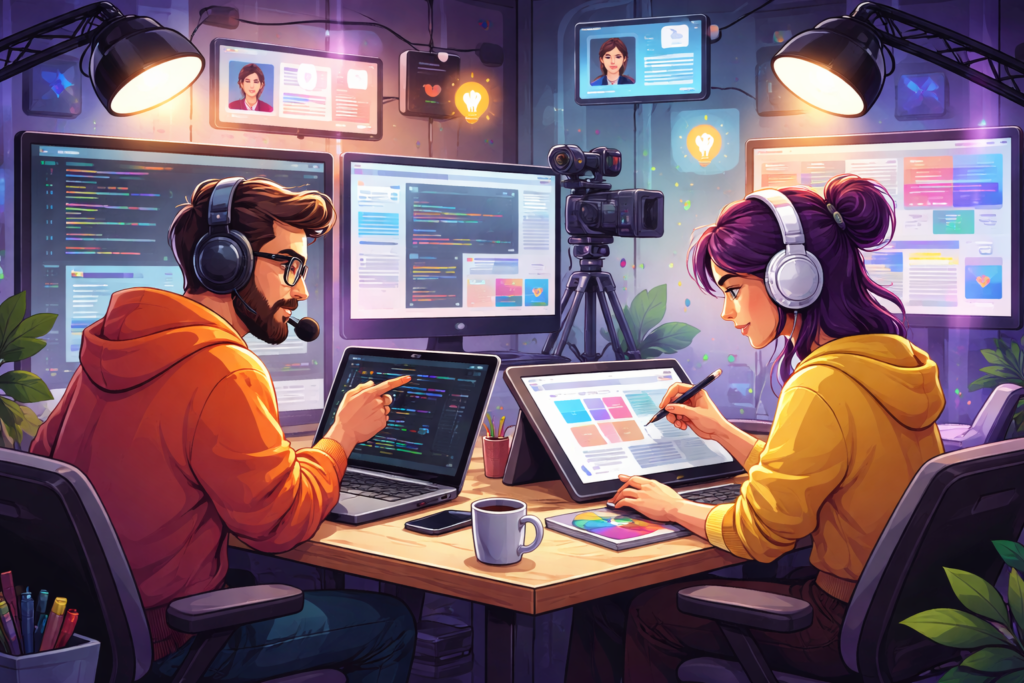
By 2026, educational streaming in IT and design has fully stopped being a free alternative to online courses. It no longer competes directly with online schools or tries to offer a “complete learning path.” Instead, it has settled into a distinct and sustainable niche: showing live thinking processes that cannot be packaged into lessons or checklists.
These streams are not watched by beginners or people looking for a quick entry into a profession. Their audience consists of people already in motion: those who are studying, working, facing limitations, and trying to understand how to think further. This is why educational streams increasingly act as a bridge between courses, real practice, and self-directed learning.
Why Educational Streaming Became Sustainable
The key difference between a stream and a course is uncertainty. In IT and design, this is not a weakness but a value. Viewers care less about a perfect result and more about the path to it: doubts, exploring alternatives, backtracking, mistakes, and dead ends.
By 2026, it became clear that recorded learning content becomes outdated quickly, courses lose value without context, and real questions almost always arise outside any “curriculum.” Streaming operates exactly in this space, showing how a professional thinks here and now, with current tools, real constraints, and live problems.
Who People Watch in IT and Design Streaming
Audiences respond poorly to universal instructors. Streams perform much better when creators do not promise a complete roadmap, openly acknowledge gaps in their knowledge, and work on real tasks instead of artificial educational examples.
These streamers can be developers, designers, product specialists, art directors, or freelancers. Their value lies not in status or formal expertise but in transparency of process. Many of them do not even call themselves educators; they simply work and allow others to observe.
Format Matters More Than Knowledge Level
In educational streaming in 2026, the entry level matters less than the format. Viewers return where there is consistency, a clear framework, and a repeatable structure.
The most effective streams clearly define what will happen: task breakdowns, code or design reviews, working on real projects, and discussing decisions in real time. Long lecture-style streams have almost disappeared, replaced by working sessions where the streamer does not “teach” but thinks out loud while solving a problem.
Why IT and Design Are Especially Well-Suited for Streaming
In both IT and design, much of the real value exists between actions. Why one approach was chosen, why another was rejected, and why a solution looks correct but does not work in a specific context.
Streaming makes it possible to capture these intermediate decisions. That is why educational streams are often watched as recordings, not for the final result but for the reasoning behind it. In design, the visual process and live commentary matter. In IT, debugging, error analysis, and real-world trade-offs are key.
Monetization Without Mass Audiences
Educational streaming rarely attracts huge live audiences, yet it monetizes effectively. Viewers are not paying for knowledge itself but for access to thinking and real processes.
Subscriptions, paid reviews, private working streams, and ongoing support models tend to be more stable than attempts to sell promised outcomes. This approach proves more honest and sustainable than mass-market educational products.
Mistakes That Break Educational Streams
The most common mistake is simplifying content to chase growth. When streamers constantly explain basics, smooth out complexity, and target an abstract beginner, they lose their core audience. People come for depth, not universality.
The second mistake is trying to turn a stream into a course. Once a stream becomes linear, predictable, and “correct,” it loses its main advantage over recorded content.
Why Interest in Educational Streaming Keeps Growing
By 2026, many professionals have grown tired of finished educational products. Increasingly, what matters is not a promised outcome but the opportunity to observe real work in progress.
Educational streaming wins precisely because it makes no promises, does not package knowledge, and does not pretend to be complete. It shows the profession as it truly is, with uncertainty, doubt, and ongoing decision-making.
What Comes Next
Educational streamers in IT and design will not become mass influencers, and that is their strength. They integrate into professional environments rather than platform algorithms and remain relevant longer than any “learn from scratch” format.
As long as professions remain complex and constantly evolving, streaming as a form of shared thinking will remain valuable—not as education, but as a way to stay inside the process.