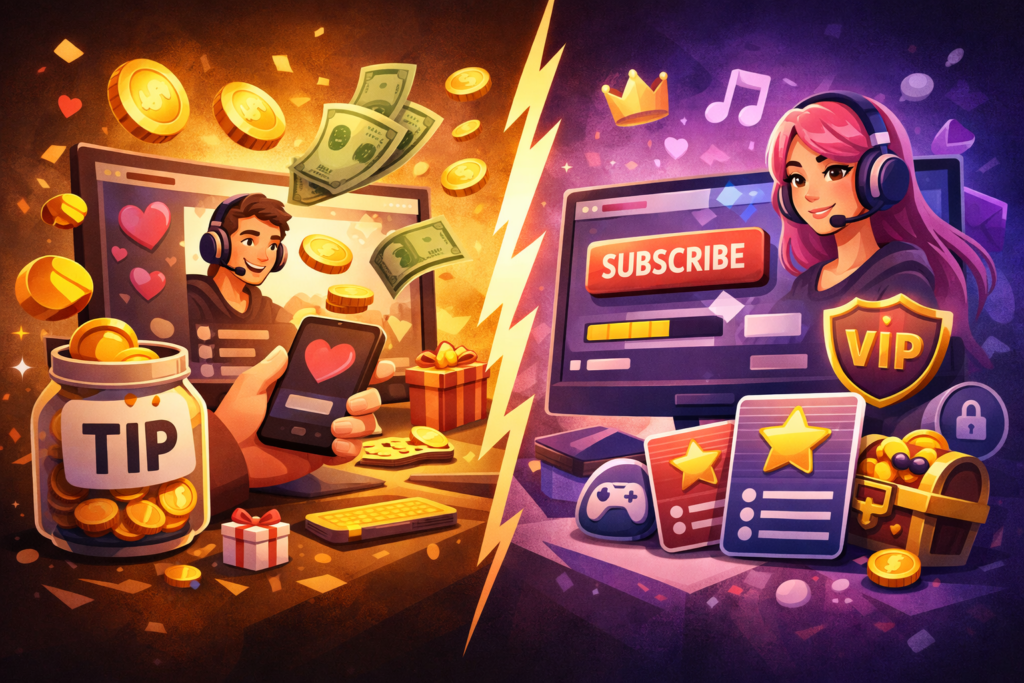
Just a few years ago, stream monetization seemed straightforward: donations meant income, and without donations, streaming remained a hobby. Today, the situation has changed. More and more streamers are asking themselves what is actually more profitable — donations or subscriptions — and whether it is possible to build stable income that does not depend on viewers’ moods.
At first glance, donations look like fast money, while subscriptions seem like a long-term path. But when you look deeper, the picture becomes far more complex. Let’s break down how both models work, what mistakes streamers make, and which option brings higher and more predictable income in practice.
How Donations Work in Streaming
Donations are the most emotional form of support. Viewers send money in the moment, often driven by emotions: a joke, the streamer’s reaction, a viral clip, or the overall chat atmosphere. That is exactly why donations feel so attractive at the beginning.
For beginner streamers, donations are often the first real source of income. Even with a small average viewership, it is possible to receive meaningful support if the audience is engaged. However, donations have one critical downside — they are almost impossible to plan.
One stream can “pop off” emotionally and bring in a solid amount of money, while the next stream with the same viewership earns very little. Donations depend on many factors: seasonality, audience mood, economic conditions, and even how actively the streamer reminds viewers about support.
Over time, many creators experience burnout. Constant hints about donations, waiting for reactions, and comparing daily earnings start to affect both the stream atmosphere and the streamer’s mental well-being.
Subscriptions as a Tool for Stable Income
Subscriptions work differently. They are not an impulsive decision but a conscious choice. Viewers subscribe not for a single moment, but for consistent content, a sense of belonging, and long-term support for the creator.
The main advantage of subscriptions is predictability. Streamers know in advance how many people support them each month. This makes it easier to plan channel development, improve content quality, and feel financially secure.
Subscriptions also tend to cause less irritation. Viewers pay for clear value: custom emotes, badges, private chats, additional content, or simply the status of being a core community member.
That said, subscriptions take time. Audiences do not subscribe instantly. Trust, consistency, and the feeling that the streamer genuinely values loyal viewers are essential.
Donations vs Subscriptions: The Key Difference
Simplified, donations are spikes, while subscriptions are the foundation. Donations can generate higher income on certain days, but subscriptions almost always win in the long run.
Streamers who rely only on donations often face instability. Those who focus on subscriptions earn smaller but much more consistent amounts.
In practice, the most profitable approach is a combination. Donations remain a bonus and emotional element, while subscriptions become the core of financial stability.
Why Subscriptions Are Often More Profitable Long-Term
A subscriber is not just a source of money, but part of the community’s core. Such viewers are more likely to:
- return to streams regularly;
- participate actively in discussions;
- defend the streamer in chat;
- support additional projects.
This directly impacts channel growth. A strong core audience makes streams more engaging, increases retention, and attracts new viewers.
Donations rarely create this long-term connection. A viewer may donate once and never return.
Common Mistakes When Choosing Between Donations and Subscriptions
One of the most common mistakes is relying only on donations while ignoring subscriptions, often due to fear that no one will subscribe.
The opposite extreme is disabling donations completely and relying solely on subscriptions. In this case, streams often lose emotional moments and spontaneous support.
Another frequent issue is copying other streamers’ models without considering personal communication style and audience expectations.
How to Understand What Works Best for You
If your stream is built around live interaction, humor, and reactions, donations may perform better. If viewers come for consistent content, knowledge, or atmosphere, subscriptions usually bring higher income over time.
The best indicator is audience behavior: return rate, chat activity, and willingness to stay long-term clearly show subscription potential.
Final Thoughts: Donations or Subscriptions?
Donations win in speed and emotions, while subscriptions win in stability and growth. In reality, the most profitable strategy is a hybrid model where subscriptions form the income base and donations enhance engagement.
This balanced approach is increasingly becoming the foundation of long-term and sustainable streaming monetization.