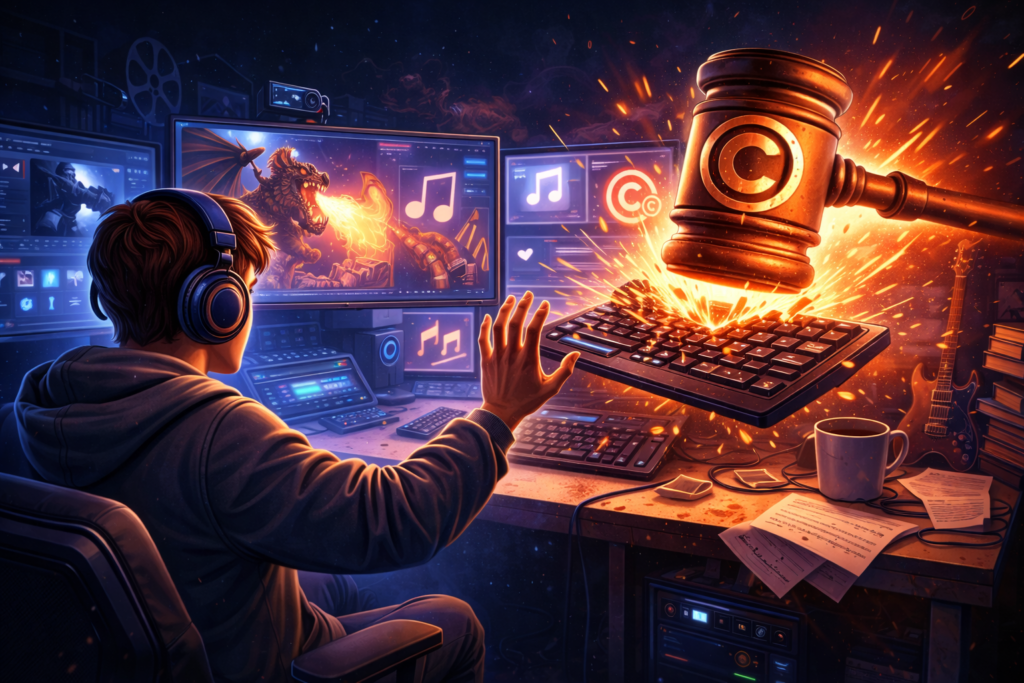
For a long time, copyright existed alongside streaming, but not inside it. Laws were written for films, music, television, and later for video platforms with uploaded content. Streaming appeared to be something in between: public, yet fleeting; a form of broadcasting, but without editorial control or scheduling.
By 2026, this uncertainty has largely disappeared. Streams are no longer treated as “broadcasts that will end and vanish.” They are now considered a form of content distribution with the same legal consequences as any other publication.
When “I Just Turned It On” Is No Longer an Argument
One of the most persistent illusions of streaming is the feeling of spontaneity. The camera is on, the game is running, music plays in the background, something happens on screen “casually.” For a long time, this created the impression that copyright concerns were secondary.
In 2026, this argument no longer holds. It does not matter whether the content was planned, intentionally included, or appeared accidentally. If it is publicly streamed, it is considered use.
Music from a game, a background track, a video playing on a second screen, or a movie clip used in a reaction — all of this is treated as part of the stream, not as incidental background noise.
The Platform as the First Rights Enforcer
Formally, copyright exists to protect creators and rights holders. In practice, within streaming, the platform becomes the first and most powerful regulator. It decides what is acceptable long before a rights holder becomes directly involved.
On YouTube, this is enforced through Content ID and automated matches. On Twitch, through DMCA notices, audio muting, and archive restrictions. For streamers, the result is the same: disputes with rights holders almost always happen after a penalty, not before it.
Platforms act preemptively because they carry their own legal risks. In this sense, they will always be more cautious than individual creators.
Music as the Main Source of Conflict
The most vulnerable area of streaming remains music. Even in 2026, it generates the greatest number of misunderstandings.
Streamers often assume that:
- a paid subscription allows public streaming,
- music included in a game is automatically licensed for streaming,
- short clips “do not count.”
In practice, the opposite is true. Most licenses cover personal listening, not public broadcasting. Even when music is embedded in gameplay, streaming rights may be restricted by publishers or separate rights holders.
This is why platforms increasingly choose not to analyze nuances and instead mute audio or block segments entirely.
Reactions, Reviews, and the Gray Zone of Fair Use
Reaction content was long perceived as relatively safe. Commentary overlays, pauses, and transformations were considered sufficient for fair use.
In reality, fair use is not a permission — it is a legal argument. It offers no automatic protection and rarely applies at the algorithmic level.
A streamer may be legally justified and still face platform actions:
- removal of the recording,
- reduced visibility,
- suspension of monetization.
As a result, many creators abandon complex formats not because they are prohibited, but because the consequences are unpredictable.
Archives Are Riskier Than Live Streams
One of the paradoxes of streaming is that live broadcasts are often less vulnerable than their recordings. While a stream is live, rights holders may simply not notice the use. Archives, however, remain accessible, indexed, and repeatedly reviewed.
This is why many copyright restrictions in 2026 are applied retroactively. The stream ends without issue, but a notice arrives days or weeks later.
This changes behavior. Streamers increasingly think not about the live moment, but about how the content will look in the archive — even when the recording itself is not essential.
Games and Licenses No One Talks About
Game streaming was long considered safe by default. Publishers encouraged streams because they functioned as promotion. As the stakes increased, however, conditions became more specific: restrictions on music, cutscenes, story segments, and in-game videos.
By 2026, streamers more often face partial limitations rather than full bans. Some elements are allowed, others are not. These rules are rarely obvious and are often buried deep in user agreements.
Violations in such cases look less like piracy and more like oversight. The consequences, however, remain the same.
Algorithms Do Not Understand Context
One of the core problems of copyright in streaming is automation. Algorithms do not distinguish between background and intent, irony and quotation, criticism and use.
If a match is detected, enforcement follows automatically. A streamer may be correct in principle, but this is not considered at the initial stage. Context appears only during appeals — if they are even reviewed.
This makes streaming especially vulnerable: it exists in real time, but is judged after the fact using static rules.
Self-Limitation as a Practical Skill
By 2026, understanding copyright is no longer a purely legal issue — it becomes a practical skill. Streamers learn in advance to:
- choose safe content sources,
- disable music,
- avoid high-risk segments,
- adapt formats to platform restrictions.
This does not always look like censorship. More often, it is adaptation. Content becomes quieter, more cautious, and less saturated with external elements.
Copyright as Part of the Atmosphere
Sometimes a stream feels empty: no music, no inserts, no reactions to external videos. This is not an artistic choice, but the result of invisible boundaries.
Copyright in streaming rarely appears directly. It is felt as silence, muted audio, or the absence of familiar background elements — as something that could have been included, but was intentionally left out.
In this sense, copyright stops being a legal topic and becomes part of the environment in which streamers learn to operate — without violations, disputes, or unnecessary attention.