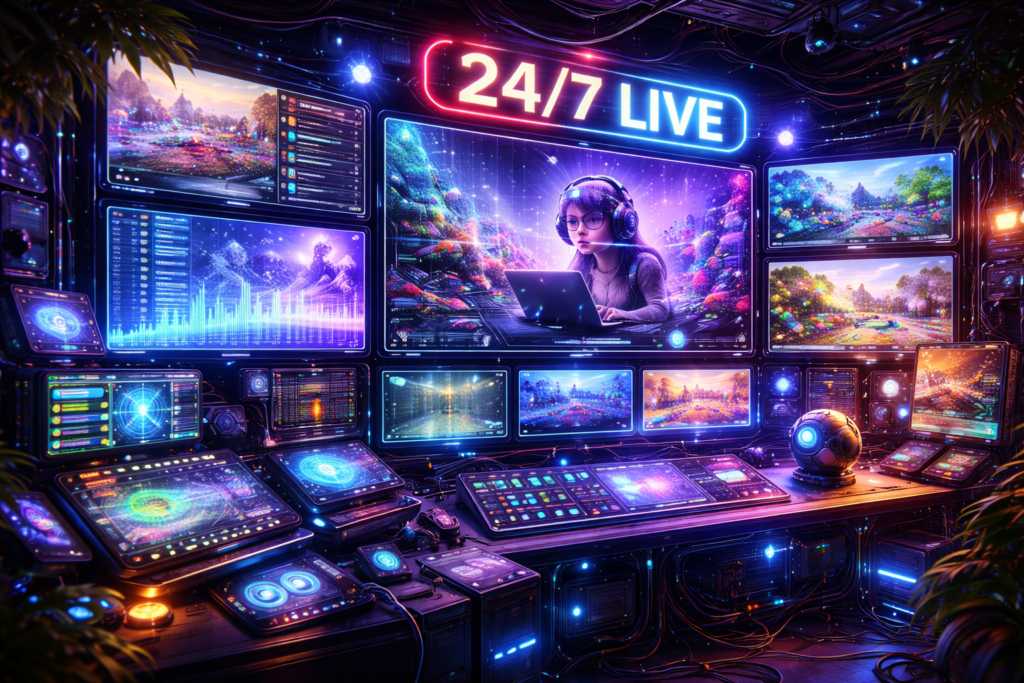
Not long ago, streaming was closely associated with presence: a person on screen, a chat, reactions, and a strong sense of “here and now.” Gradually, however, platforms began to feature channels with no host, no schedule, and no clear beginning. They simply run. Day and night, weekdays and holidays—the stream is always live.
Automated streaming channels look like streams, but function more like systems. And that is precisely what makes them important—not as a format, but as a shift in how streaming itself is understood.
When a Stream Is Assembled Without a Human
An automated stream is not a recorded loop. It is a live flow assembled in real time from predefined rules: data sources, scenarios, reactions, and visual templates.
Music, gameplay replays, news, charts, generative animations, archived fragments—all of this can be combined into a continuous live broadcast without direct human involvement. The channel does not “go live”; it operates.
On platforms like YouTube and Twitch, such channels already exist as 24/7 streams. By the end of the decade, however, their logic becomes more complex: fewer repeats and more adaptation to time of day, audience behavior, and context.
Why People Watch This at All
From the outside, an automated stream may look strange: no one tells jokes, reads donations, or reacts to individual viewers. But most of the audience is not there for dialogue—they come for a mode.
These streams are often turned on:
- as background for work,
- as a source of steady rhythm,
- as a flow of information or music,
- as the feeling that “something is happening.”
Viewers do not expect climaxes. They are not afraid of missing a moment. Automated channels are valued precisely because nothing depends on catching a specific event.
The Algorithm Instead of the Host
In these channels, the role of the streamer is performed by logic. Not a personality, but a set of rules: what to show in the morning, what to run at night, how to react to audience growth, when to change tempo or visuals.
The algorithm becomes the editor. It decides what fits the moment and what does not. Often, viewers do not even think about the stream being automated—they simply accept it as part of the environment.
That is why such streams rarely provoke strong emotions, but also rarely irritate.
An Economy Without Charisma
At first glance, automated streams may seem impossible to monetize. No personality means no emotional attachment. But here, money works differently.
People pay not for a person, but for:
- access to a continuous flow,
- convenience,
- predictability,
- practical value.
This can include subscriptions, embedded advertising, branded segments, and partner integrations that do not interrupt the stream, but dissolve into it. Such streams do not demand attention—they occupy it gently.
Where Automation Feels Most Natural
Automated streaming channels work best where humans interfere more than they help. Data streams, news feeds, repetitive gameplay scenarios, music selections, and generative visuals.
These are spaces where stability matters more than improvisation. Where viewers are not looking for conversation, but for presence. In these niches, automation is not perceived as replacing humans—it feels like the most natural solution.
Why This Is Still Called Streaming
Formally, an automated channel could be called an “online player” or a “live feed.” Yet the word “stream” remains, because the core quality is still there—the sense of real time.
The broadcast is happening now. Not “recorded,” not “available later,” but unfolding in the present. Even if that present is assembled by machines, it still feels real.
Human Presence as an Option
Interestingly, humans do not disappear entirely from automated channels. They simply stop being mandatory. Sometimes a voice appears, sometimes a comment, sometimes manual intervention. But this is no longer the foundation—it is an overlay.
The human becomes a rare event within a stable system. And because of that rarity, human presence starts to feel special again.
A Flow That Does Not Demand Attention
An automated streaming channel does not try to удержать the viewer. It does not rush them, ask for likes, or remind them of itself. It simply runs.
Sometimes it is closed after five minutes. Sometimes it plays in the background for hours. Sometimes people return after days. There is no conflict in this—because such streams do not compete for attention. They exist alongside it.
And perhaps it is in this format that streaming finally stops being a show and becomes an environment.