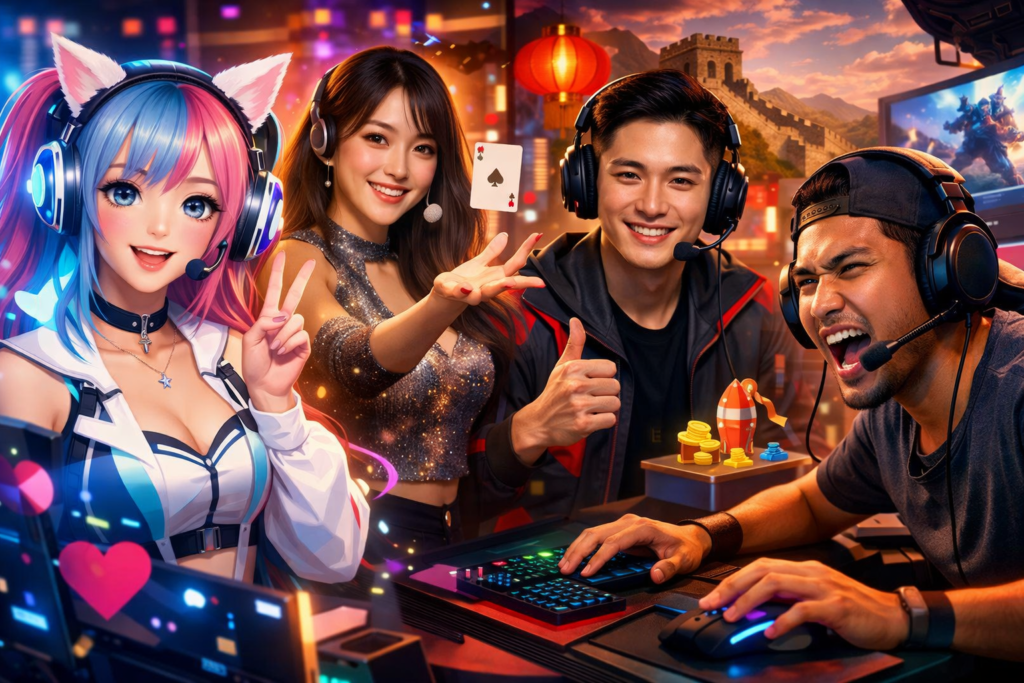
Asian streaming in 2026 is no longer just “a different culture” or an exotic niche for Western audiences. It represents a distinct content logic, where format often matters more than personality, and stream structure is more important than spontaneity. This is why Asian streamers are increasingly becoming reference points for platforms and media, rather than remaining a purely local phenomenon.
Unlike European and American streaming, where individual charisma is almost always central, streaming in Asia is more often treated as a product rather than improvisation. This fundamentally changes how broadcasts are built, how attention is retained, and how audience loyalty is formed.
Why Asian Streaming Works Differently
The key difference of Asian streamers is their approach to live broadcasts as carefully designed formats. Even when a stream appears “live” and spontaneous, it is usually supported by a script, precise timing, and a clear understanding of roles.
Audiences in Asia are less tolerant of chaos but more loyal to consistency. Viewers come not for surprises, but for a predictable experience. If a format works, it is not replaced — it is refined.
This is driven by both content consumption culture and intense competition. In Japan, South Korea, and China, streamer density is so high that survival depends not on being the loudest, but on delivering consistently high-quality content.
Japan: VTubers as a Separate Genre
It is impossible to discuss Japanese streaming in 2026 without mentioning the VTuber scene. Hololive and Nijisanji have long transformed virtual streamers into a full-scale industry.
The VTuber format solves several challenges at once:
- reduces personal risks for streamers
- prioritizes character over the individual
- allows creators to work as roles rather than personal identities
For audiences, this is perceived more like a series than a live stream. Viewers return not to a person, but to a character, voice, and behavioral style.
VTuber streams are often more strictly structured than traditional broadcasts. They feature less chaos, but more rituals, recurring elements, and recognizable patterns.
South Korea: Discipline and Pace
South Korean streaming balances emotional expression with rigid structure. On platforms such as AfreecaTV, streamers operate under intense competition and strict audience expectations.
Key values include:
- consistent scheduling
- high content density
- tight chat moderation
Korean streamers rarely allow long “empty” pauses. Even talk-based streams follow an internal rhythm with segments, reactions, and interactive elements, making broadcasts less relaxed but more dynamic.
Emotions in Korean streaming are often exaggerated, yet controlled. Strong reactions are part of the format, not a loss of control.
China: Streaming as an Industry
Chinese streaming in 2026 is both the most closed and the largest ecosystem. Platforms such as Douyu and Huya operate more like media corporations than social platforms.
Chinese streamers typically:
- work under formal contracts
- follow strict platform regulations
- are integrated into centralized promotion systems
Formats are carefully selected and scaled. If something proves effective, it is replicated across hundreds of channels. Individuality gives way to efficiency.
For viewers, this results in a flow of polished but standardized content. Chinese streaming rarely revolves around personal vulnerability — control and performance outcomes are prioritized instead.
Southeast Asia: Hybrid Growth
In Southeast Asian countries such as Thailand, Indonesia, and Vietnam, streaming is growing faster than anywhere else in 2026. While rigid standards are still forming, audiences are already highly active.
Formats are often hybrid:
- gaming combined with IRL streaming
- live streams paired with short-form video
- local humor mixed with global trends
This scene is closer to the European model but incorporates Asian attention to visuals and pacing. Many new formats originate here before being adopted by major platforms.
How Asian Streamers Differ from Western Creators
In summary, Asian streaming in 2026 is built on several core principles:
- format takes priority over improvisation
- consistency is valued more than spontaneity
- visual identity and role-playing are critical
- a stream is a product, not a casual conversation
This does not make it better or worse — it simply reflects a different logic where both viewers and streamers understand the rules in advance.
Why Asian Streaming Formats Are Being Copied
Platforms favor predictability. Asian streaming provides stable metrics, clear behavioral patterns, manageable chat environments, and strong audience retention.
In 2026, elements of Asian streaming are increasingly visible worldwide — from VTuber avatars to stricter broadcast structures. This trend is a direct response to content oversaturation and uncontrolled chaos.
The Future of Asian Streaming
Asian streamers in 2026 are setting trends rather than following them. Their formats evolve more slowly, but integrate more deeply into platform ecosystems, making the scene stable but less flexible.
In the coming years, hybrid models are likely to dominate, combining Asian structural discipline with Western creative freedom. It is at this intersection that the next major streaming formats will emerge.